
Running a trade business in Ireland means juggling customer calls, scheduling jobs, managing teams, and keeping operations smooth. Many plumbing, HVAC, and electrical business owners find themselves overwhelmed by administrative tasks that drain time and resources. AI automation offers a practical solution to streamline workflows, capture more leads, and boost revenue without hiring additional staff. This guide walks you through the exact steps to set up AI automation tailored for your trade business, from initial preparation through successful deployment and ongoing optimisation.
Table of Contents
- Understanding AI automation for trades businesses
- Preparing for your AI automation setup
- Step by step AI automation setup process
- Overcoming common pitfalls and verifying success
- Discover tailored AI automation solutions for trades businesses
- Frequently asked questions
Key takeaways
| Point | Details |
|---|---|
| AI adoption accelerating | Over 72% of Irish small businesses now use at least one AI tool in daily operations |
| Multiple applications available | AI handles predictive maintenance, automated customer service, and intelligent phone systems for trades |
| Proper setup crucial | Success requires clear prerequisites, systematic execution, and continuous refinement of AI systems |
| Common failures preventable | Integration gaps and budget underestimation cause most projects to stall before delivering value |
| Measurable benefits proven | Effective automation increases lead capture rates, operational efficiency, and customer satisfaction scores |
Understanding AI automation for trades businesses
AI automation refers to intelligent software systems that handle repetitive tasks, make decisions based on data patterns, and interact with customers without human intervention. For plumbing, HVAC, and electrical businesses in Ireland, this technology transforms how you manage daily operations. Instead of manually answering every phone call or scheduling each appointment, AI systems work around the clock to capture leads, qualify prospects, and book jobs directly into your calendar.
The applications extend far beyond simple chatbots. Modern AI voice agents and automation solutions can predict when equipment might fail based on service history, automatically dispatch technicians to urgent jobs, and send follow up messages to customers after appointments. These systems learn from every interaction, continuously improving their responses and recommendations.
Benefits for trade businesses include dramatic reductions in missed calls, faster response times that convert more leads into paying customers, and freed up administrative time that lets you focus on actual trade work. Over 72% of Irish small businesses have begun using at least one AI tool in their workflow as of late 2024, confirming this technology has moved from experimental to essential.
For plumbing businesses, AI can automatically triage emergency calls versus routine maintenance requests. HVAC companies use predictive algorithms to schedule seasonal tune ups before systems fail. Electrical contractors deploy AI assistants that answer technical questions from customers whilst you're on site at another job.
The operational efficiency gains translate directly to revenue growth. Businesses report capturing 30 to 40% more leads simply by ensuring every call gets answered professionally, even at midnight or during busy periods. Customer satisfaction improves because response times drop from hours to seconds.
Pro tip: Start by identifying your biggest operational bottleneck, whether that's missed calls, scheduling chaos, or slow follow ups. Target your first AI implementation at solving that specific pain point rather than trying to automate everything at once.
Preparing for your AI automation setup
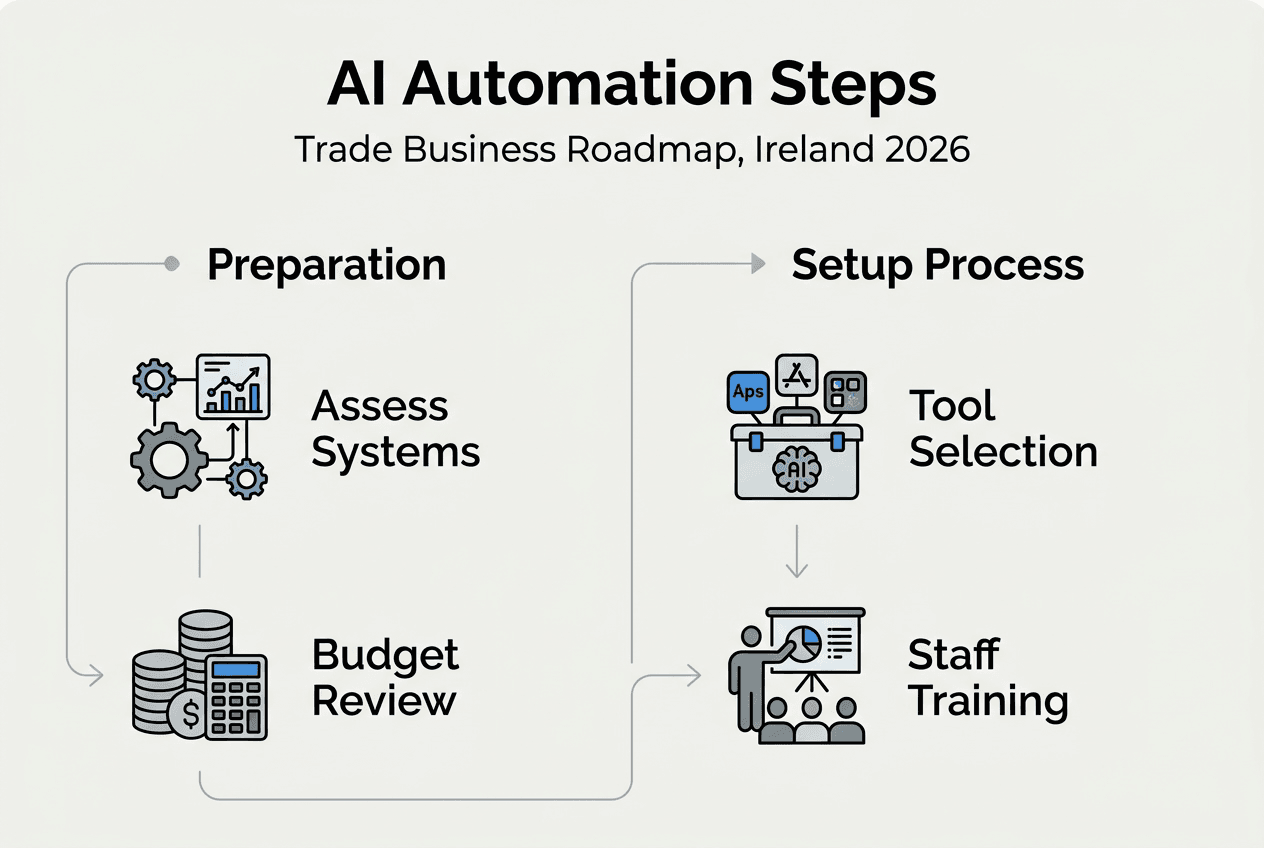
Successful AI implementation begins long before you install any software. Assess your current systems thoroughly to understand what tools you already use and how information flows through your business. Document your existing workflows for handling customer enquiries, scheduling jobs, dispatching technicians, and following up after service calls. This baseline helps you identify exactly where AI can add the most value.

Compatibility between AI solutions and your existing customer relationship management or job management software determines whether implementation runs smoothly or becomes a nightmare. A common pitfall is the lack of integration between AI systems and existing CRM or ERP platforms. Before committing to any AI vendor, verify they offer direct integrations with the specific software you currently use, whether that's Jobber, ServiceTitan, or another platform popular among Irish trades businesses.
Budget planning requires honest assessment of both upfront costs and ongoing expenses. Most AI automation platforms charge monthly subscription fees based on call volume or features used. Factor in potential costs for initial setup, staff training, and technical support during the first few months. Tight budgets and underestimated timelines can mean technical initiatives stall after initial enthusiasm wanes.
Identify whether you have technical skills in house to manage AI systems or need external support. Many trade business owners lack IT backgrounds, making professional AI and automation audit services valuable for ensuring proper setup and avoiding expensive mistakes.
| Prerequisite | Requirement | Why it matters |
|---|---|---|
| Internet connectivity | Reliable broadband with backup | AI systems need constant connection to function properly |
| Existing software audit | List of current CRM, scheduling, and communication tools | Determines integration complexity and compatibility |
| Process documentation | Written workflows for customer interactions and job management | Provides blueprint for what AI should automate |
| Budget allocation | Funds for software, setup, and 3 to 6 months of operation | Prevents project abandonment due to cash flow issues |
| Technical support plan | In house skills or vendor relationship | Ensures problems get resolved quickly without downtime |
Pro tip: Schedule vendor demonstrations that use your actual business scenarios rather than generic examples. Ask them to show exactly how their AI would handle a typical emergency call or scheduling conflict specific to your trade. This reveals whether their solution truly fits your needs or just sounds impressive in marketing materials.
Step by step AI automation setup process
Choosing the right AI tools starts with matching capabilities to your specific trade business needs. Voice agents excel at handling inbound calls, qualifying leads, and booking appointments. Chatbots work well for website visitors who prefer typing questions. Workflow automation platforms connect different systems so data flows automatically between your phone system, calendar, and job management software. Research vendors that specialise in trades businesses rather than generic AI providers, as they understand industry specific requirements like emergency dispatch protocols and seasonal demand patterns.
Setting up AI voice agents for automated inbound call handling requires configuring how the system answers, what questions it asks callers, and when it transfers to a human.
and automate workflows for trades businesses. Start by scripting common call scenarios: emergency requests, appointment bookings, service enquiries, and billing questions. Train the AI on your pricing, service areas, and typical job timelines so it provides accurate information to callers.Automating scheduling and customer service via chatbots involves embedding conversational interfaces on your website and social media channels. Configure the chatbot to check your calendar availability in real time, propose appointment slots to customers, and send confirmation messages automatically. Connect it to your customer database so it recognises returning clients and references their service history during conversations.
Integrating AI systems with business management software ensures information captured by AI flows directly into your existing workflows. Set up two way synchronisation so appointments booked by the AI voice agent appear immediately in your technician scheduling system. Configure automatic job creation when the AI qualifies a lead, eliminating manual data entry that wastes time and introduces errors.
Testing workflows and training staff on new systems prevents confusion when you go live. Run mock calls through your AI voice agent, deliberately testing edge cases like customers with thick accents or complex requests. Have team members interact with chatbots to identify confusing responses or missing information. Conduct training sessions where staff learn how to monitor AI interactions, when to intervene, and how to refine the system based on real world performance.
| AI tool type | Primary benefit | Ideal use case |
|---|---|---|
| Voice agents | Never miss calls, 24/7 availability | Handling inbound enquiries and emergency requests |
| Chatbots | Instant website responses | Qualifying leads and answering common questions |
| Workflow automation | Eliminate manual data entry | Connecting phone systems to job management software |
| Predictive maintenance | Prevent equipment failures | Scheduling proactive service before breakdowns occur |
| Automated follow up | Improve customer retention | Sending review requests and maintenance reminders |
Pro tip: Launch your AI automation with a pilot programme covering just one service area or customer segment. Monitor performance closely for two to four weeks, gathering feedback from both customers and staff. Use these insights to refine the system before rolling it out across your entire business, reducing risk and building confidence in the technology.
Overcoming common pitfalls and verifying success
AI automation projects fail when businesses underestimate the ongoing maintenance and refinement required. Up to 95% of AI projects in small businesses break down before producing clear value. The technology isn't set and forget. Voice agents need regular updates as your services, pricing, or policies change. Chatbots require new training data when customers ask questions the system hasn't encountered before. Integration connections can break when software vendors update their platforms.
Poor integration between AI systems and existing tools creates data silos that defeat the purpose of automation. When your AI voice agent captures lead information but that data doesn't flow automatically into your CRM, staff must manually transfer details, reintroducing the inefficiency you tried to eliminate. Verify integrations work correctly by testing complete workflows from initial customer contact through job completion and payment.
Unrealistic expectations doom projects before they start. AI won't magically solve deep operational problems or compensate for poor service quality. It amplifies what you already do, making efficient processes more efficient and exposing broken workflows more quickly. AI project overruns now reach 200% of original estimates when businesses fail to account for customisation needs and integration complexity.
Monitoring key performance indicators reveals whether your AI automation delivers measurable value. Track metrics like call answer rates, lead conversion percentages, average response times, and customer satisfaction scores. Compare performance before and after AI implementation to quantify improvements. Set up dashboards that display these metrics in real time so you spot problems quickly.
Steps to troubleshoot issues and make iterative improvements include reviewing call recordings to identify where the AI struggled, analysing chat transcripts for confusing interactions, and gathering feedback from customers about their experience. Use these insights to refine scripts, add training data, and adjust system behaviour.
- Do schedule monthly reviews of AI performance metrics and customer feedback
- Do maintain detailed documentation of system configurations and customisations
- Do invest in staff training so your team understands how to work alongside AI
- Don't ignore warning signs like increased customer complaints or dropped calls
- Don't assume the AI will handle every situation, always provide escalation paths to humans
- Don't neglect regular software updates and security patches for AI platforms
"Up to 95% of AI projects in small businesses break down before producing clear value, often due to inadequate planning, poor integration, or lack of ongoing maintenance."
Pro tip: Schedule quarterly AI audit consultation services to have experts review your system performance, identify optimisation opportunities, and ensure you're extracting maximum value from your automation investment. Regular professional audits catch issues before they become expensive problems.
Discover tailored AI automation solutions for trades businesses
Apex Emerald specialises in AI voice agents and automation solutions designed specifically for Irish plumbing, HVAC, and electrical businesses. Our platform handles everything from initial lead capture through appointment booking and customer follow up, integrating seamlessly with popular job management systems used across Ireland.
Our AI and automation audit services assess your current operations and identify exactly where AI can deliver the biggest impact for your specific business. We don't sell generic solutions. Instead, we build custom automation workflows that match how your trade business actually operates, ensuring smooth adoption and measurable results within 90 days.
AI implementation case studies from Irish trades businesses demonstrate real world success: plumbing companies capturing 40% more leads, HVAC contractors reducing administrative time by 15 hours weekly, and electrical services achieving 24/7 customer availability without hiring night staff. These aren't theoretical benefits but proven outcomes from businesses similar to yours.
Frequently asked questions
What are the essential phases for setting up AI automation?
The setup process includes four essential phases: preparation and assessment of current systems, selection and configuration of appropriate AI tools, integration with existing business software, and testing with ongoing optimisation. Most trades businesses complete initial setup within four to eight weeks, though complex integrations may require additional time.
How long does AI automation take to implement in a trades business?
Basic AI voice agent setup typically takes two to four weeks from initial configuration to going live with real customers. More comprehensive automation involving multiple systems and custom integrations usually requires six to eight weeks. The timeline depends heavily on how well documented your current processes are and whether your existing software offers straightforward integration options.
What systems must AI automation integrate with for trades businesses?
AI automation should connect with your phone system for call handling, calendar software for appointment scheduling, customer relationship management platform for lead tracking, and job management system for work orders. Payment processing integration allows the AI to handle billing enquiries, whilst email and SMS platforms enable automated follow up communications.
How much does AI automation cost for a small trades business?
Entry level AI voice agent platforms start around €200 to €400 monthly for basic call handling and appointment booking. Comprehensive automation including chatbots, workflow integration, and advanced features typically costs €600 to €1,200 monthly. Initial setup fees range from €1,000 to €3,000 depending on customisation requirements and integration complexity.
How do I measure if AI automation is working effectively?
Track concrete metrics including call answer rate percentage, lead to appointment conversion rate, average response time to customer enquiries, and customer satisfaction scores. Compare these numbers against your baseline performance before AI implementation. Successful automation typically increases lead capture by 30 to 40% and reduces administrative time by 10 to 20 hours weekly.
What should I do if my AI system makes mistakes with customers?
Review recordings or transcripts of problematic interactions to identify exactly where the AI struggled. Update training data and refine scripts to handle similar situations better in future. Always provide clear escalation paths so customers can reach a human when needed. Most AI platforms improve accuracy over time as they learn from corrections you make.
Recommended
- AI Voice Agents for Trades Ireland | Apex Emerald AI
- AI & Automation Audit Services | Strategic Technology Consulting | Apex Emerald AI
- AI & Automation Audit Services | Fractional CTO Ireland | Apex Emerald
- AI Voice Agents & Automation Solutions | Trades Business AI | Apex Emerald
- Asset Protection Strategies 2026: Safeguard Your Business Assets – Safes and Security Direct
- Workflow For Forex Automation: Step-by-Step Trading Setup