
Many trades businesses hesitate to adopt AI, fearing it will replace their human customer service agents and create impersonal interactions. The reality is quite different. AI actually supports and enhances customer service, delivering measurable improvements in response times, booking rates, and customer satisfaction. Irish trades businesses using AI have achieved zero hold times and double-digit revenue growth. This guide explains AI's practical role in plumbing, HVAC, and electrical sectors, with real examples showing how to implement these solutions effectively whilst maintaining the personal touch your customers value.
Table of Contents
- How AI transforms customer service in trade businesses
- Key AI capabilities enhancing trades customer service
- Challenges and best practices for AI implementation in trades
- How to successfully apply AI in your trade business: a practical guide
- Explore AI solutions tailored for trades businesses
- Frequently asked questions
Key takeaways
| Point | Details |
|---|---|
| AI enhances human service | AI handles routine enquiries whilst human agents focus on complex issues requiring expertise and empathy |
| Proven Irish results | Trades businesses achieved 13% revenue growth, zero hold times, and 70% customer satisfaction scores |
| Implementation requires planning | Success depends on governance, GDPR compliance, staff training, and seamless system integration |
| Predictive capabilities | AI analyses patterns to anticipate customer needs with up to 90% accuracy |
How AI transforms customer service in trade businesses
AI fundamentally changes how trades businesses interact with customers by automating repetitive tasks and improving response quality. AI chatbots automate responses to common enquiries about pricing, availability, and service areas, freeing human agents to handle emergency calls and technical consultations. This division of labour creates better outcomes for both customers and staff.
Consider real results from Irish businesses. Ami AI achieved 70% CSAT supporting Irish Water customers during high-stress situations like water outages and billing queries. The AI handled thousands of routine questions whilst escalating complex cases to human agents. Meanwhile, My Plumber Plus grew revenue 13% after implementing Avoca AI, which eliminated hold times entirely and captured leads that previously went to voicemail.
The transformation extends beyond business hours. AI voice agents answer calls at 2am when a burst pipe floods a kitchen, booking emergency appointments and gathering critical details before your on-call plumber even picks up the phone. This 24/7 availability turns missed opportunities into booked jobs.
Key benefits for trades businesses include:
- Immediate response to customer enquiries regardless of call volume
- Consistent service quality across all customer touchpoints
- Reduced administrative burden on office staff
- Increased booking conversion rates from enquiry to confirmed appointment
Pro Tip: Start with AI handling appointment scheduling and common questions about your services, then gradually expand to more complex interactions as your system learns.
"AI doesn't replace the expertise of a qualified electrician or plumber. It ensures every customer gets timely attention whilst your skilled team focuses on the work only they can do."
The AI voice agents and automation solutions available today integrate with existing job management systems, creating seamless workflows from first contact to completed job. This integration prevents the disconnected experience customers hate, where they repeat information multiple times to different people.
Key AI capabilities enhancing trades customer service
Understanding specific AI capabilities helps you evaluate which solutions suit your business needs. Four core functions drive meaningful improvements in trades customer service: automation, personalisation, predictive analytics, and system integration.
Automation handles the volume. Chatbots resolve up to 80% of routine customer requests without human intervention. For trades businesses, this means instant answers about service coverage, pricing brackets, and appointment availability. The AI never puts customers on hold during busy periods or routes them through frustrating phone menus.
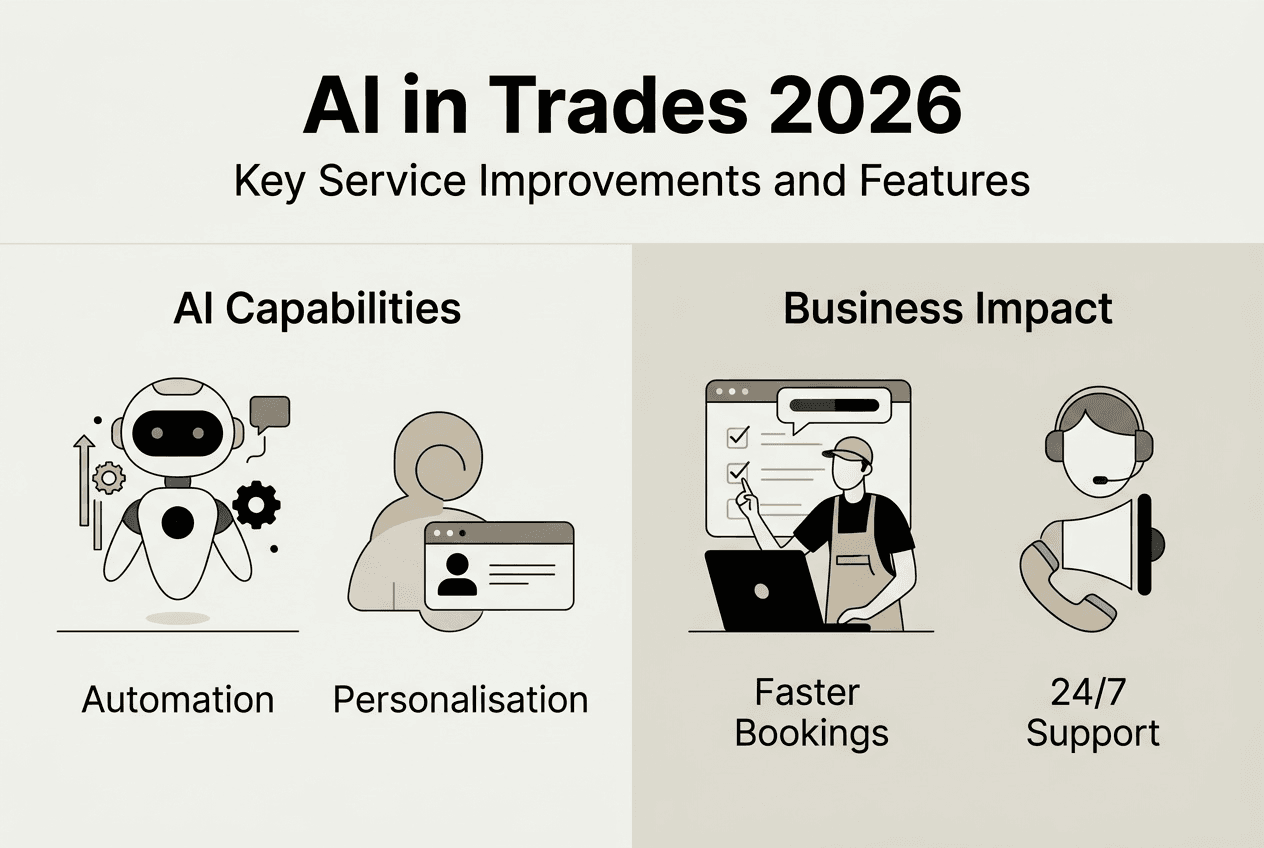
Personalisation creates better experiences. AI systems recognise returning customers, reference their service history, and tailor responses based on previous interactions. A customer who had a boiler service three months ago receives proactive reminders about annual maintenance. This personalised approach can increase satisfaction by up to 20% compared to generic interactions.

Predictive analytics anticipate needs. AI analyses customer interactions to identify patterns and predict future requirements with up to 90% accuracy. Your HVAC business can identify customers likely to need system upgrades based on equipment age and service patterns, reaching out proactively rather than waiting for breakdowns.
System integration ensures smooth operations. AI connects with your CRM, job management software, and communication platforms, creating unified customer records. When a customer calls about a previous job, the AI instantly accesses complete history and provides context-aware responses.
| Capability | Primary benefit | Trades application |
|---|---|---|
| Automation | Handles routine enquiries | Appointment booking, service area confirmation, pricing information |
| Personalisation | Tailored interactions | Service history reference, maintenance reminders, equipment-specific advice |
| Predictive analytics | Proactive service | Equipment replacement forecasting, seasonal demand planning |
| System integration | Unified data flow | Seamless handoffs between AI and human agents, complete customer context |
Implementing these capabilities requires careful planning:
- Build comprehensive knowledge bases covering your services, pricing structures, and common customer questions
- Train AI models on actual customer conversations to understand trades-specific terminology
- Establish clear escalation rules for situations requiring human expertise
- Monitor performance metrics to identify improvement opportunities
- Update AI responses regularly as your services and policies evolve
Pro Tip: Review AI conversation logs monthly to identify recurring questions your knowledge base doesn't address adequately, then expand your AI's capabilities accordingly.
The AI voice agents for trades Ireland market has matured significantly, offering solutions specifically designed for plumbing, HVAC, and electrical businesses rather than generic customer service tools. These specialised systems understand industry terminology and common customer scenarios, requiring less customisation to deliver effective results.
Challenges and best practices for AI implementation in trades
Successful AI implementation requires addressing organisational and technical challenges before they derail your project. Many businesses focus on selecting the right technology whilst overlooking the governance and process changes necessary for sustainable success.
Organisational risks outweigh technical risks when AI automation fails. The technology works reliably, but businesses struggle with unclear ownership, inadequate governance, and misalignment between AI capabilities and strategic goals. A plumbing business implementing AI without defining who manages the system, updates responses, and handles escalations creates confusion that undermines customer service rather than improving it.
Common implementation challenges include:
- Lack of clear governance structure for AI system management
- Insufficient staff training on working alongside AI tools
- Inadequate knowledge base content leading to inaccurate responses
- Poor integration with existing systems creating data silos
- Overlooking customer preferences for human interaction in certain situations
Privacy compliance cannot be an afterthought. GDPR requires careful handling of customer data, and AI systems processing names, addresses, service histories, and payment information must implement appropriate safeguards. Irish trades businesses must ensure their AI providers offer data processing agreements, secure storage within the EU, and clear data retention policies.
Balancing automation with human escalation proves critical. Customers appreciate AI efficiency for simple tasks but expect seamless transfer to human agents for complex issues. An electrical business using AI must ensure customers can easily reach a qualified electrician when discussing safety concerns or unusual electrical problems. The AI should recognise these situations and escalate immediately rather than attempting to handle them inadequately.
Pro Tip: Assign a specific team member as AI system owner responsible for monitoring performance, updating content, and coordinating with your AI provider for improvements.
Best practices for successful implementation:
- Establish governance roles before launching AI systems
- Create detailed escalation protocols defining when human intervention is required
- Conduct thorough staff training on AI capabilities and limitations
- Implement regular quality reviews of AI interactions
- Maintain transparent communication with customers about AI use
- Ensure compliance with GDPR and industry-specific regulations
Avoid common pitfalls by starting small and expanding gradually. Begin with AI handling appointment scheduling and basic enquiries, then add capabilities as your team gains confidence and your knowledge base improves. This phased approach reduces risk and allows course corrections before problems affect many customers.
The AI and automation audit services help identify potential issues before implementation, assessing your current processes, system compatibility, and organisational readiness. This upfront investment prevents costly mistakes and ensures your AI deployment aligns with business objectives.
How to successfully apply AI in your trade business: a practical guide
Implementing AI effectively requires systematic planning and execution. Follow these steps to deploy AI solutions that genuinely improve customer service and operational efficiency in your trades business.
Step 1: Assess your business needs and customer pain points. Analyse where customers experience delays, frustration, or poor service. Review missed calls, voicemail volumes, and peak demand periods. Identify which routine tasks consume excessive staff time. This assessment reveals where AI delivers maximum impact.
Step 2: Choose AI providers with trades sector experience. Generic customer service AI lacks understanding of industry terminology and common scenarios. Select providers demonstrating success with plumbing, HVAC, or electrical businesses. Request case studies and speak with existing clients about their experiences.
Step 3: Build customised knowledge bases for accurate responses. Document your services, pricing structures, service areas, and answers to frequent customer questions. Include details about emergency procedures, typical job durations, and equipment recommendations. Comprehensive knowledge bases enable AI to provide helpful, accurate information.
Step 4: Integrate AI with existing CRM and support tools. Ensure your AI solution connects with job management software, scheduling systems, and customer databases. This integration creates seamless information flow and prevents customers repeating details across multiple interactions.
Step 5: Train staff and maintain human escalation options. Educate your team about AI capabilities, escalation procedures, and how to access AI conversation history. Establish clear protocols for situations requiring human expertise. Staff should view AI as support rather than replacement.
Step 6: Regularly review AI performance and update models. Monitor key metrics including customer satisfaction, resolution rates, and escalation frequency. Analyse conversations where AI struggled and improve knowledge base content. Technology evolves rapidly, so schedule quarterly reviews with your AI provider.
| Provider | Primary strength | Best for |
|---|---|---|
| Ami AI | High-stress customer support with excellent CSAT scores | Businesses handling emergency calls and complex enquiries |
| Avoca AI | Revenue growth through improved booking conversion | Businesses focused on capturing and converting more leads |
Real examples demonstrate these steps in action. My Plumber Plus reduced hold times to zero minutes and handled over 1,000 calls monthly after implementing Avoca AI. They started with appointment booking, then expanded to service enquiries and follow-up communications. The phased approach allowed staff to adapt whilst maintaining service quality.
Ami AI's approach focuses on escalating only when necessary, keeping knowledge current, and guiding customers with concise, actionable language. Irish Water's implementation prioritised accurate information delivery during stressful situations like service disruptions, achieving 70% customer satisfaction despite challenging circumstances.
Your implementation timeline should span three to six months from initial assessment to full deployment. Rush implementations skip critical steps like staff training and knowledge base development, leading to poor customer experiences. Allocate sufficient time for testing, refinement, and gradual expansion of AI capabilities.
The AI and automation audit consultation provides expert guidance throughout implementation, identifying potential obstacles and recommending solutions tailored to your specific business context. This support proves especially valuable for businesses implementing AI for the first time.
Explore AI solutions tailored for trades businesses
Ready to transform your customer service with AI? Apex Emerald AI specialises in solutions designed specifically for Irish trades businesses in plumbing, HVAC, and electrical sectors. Our AI voice agents handle appointment booking, enquiry management, and customer communications 24/7, integrating seamlessly with your existing job management systems.
Discover how AI voice agents and automation solutions can eliminate hold times, increase booking conversion rates, and free your team to focus on delivering excellent service. We provide comprehensive implementation support, from initial assessment through ongoing optimisation, ensuring your AI deployment achieves measurable ROI within 90 days.
Our AI and automation audit services evaluate your current processes, identify improvement opportunities, and create detailed implementation roadmaps tailored to your business. We help you navigate technical decisions, governance requirements, and GDPR compliance whilst maximising the value AI delivers to your customers and operations.
Frequently asked questions
What is the role of AI in customer service for trades businesses?
AI handles routine customer enquiries, appointment scheduling, and information requests whilst human agents focus on complex technical issues and emergency situations. This division improves response times and service quality for all customers.
How does AI improve customer satisfaction in plumbing, HVAC, and electrical services?
AI eliminates hold times, provides instant responses regardless of call volume, and ensures consistent service quality across all interactions. Irish trades businesses using AI report customer satisfaction scores of 70% and higher.
Will AI replace human customer service agents in my trades business?
No, AI supports human agents rather than replacing them. AI handles repetitive tasks like appointment booking and common questions, freeing your team to focus on situations requiring expertise, empathy, and complex problem solving.
How do I ensure AI implementation complies with GDPR requirements?
Choose AI providers offering data processing agreements, EU-based data storage, and clear data retention policies. Implement appropriate security measures and maintain transparency with customers about how their information is used.
What results can I expect from implementing AI in my trades business?
Irish trades businesses report measurable improvements including zero hold times, 13% revenue growth, improved booking conversion rates, and enhanced customer satisfaction. Results vary based on implementation quality and business context.
How long does it take to implement AI customer service solutions?
Typical implementations span three to six months from initial assessment to full deployment. This timeline includes knowledge base development, system integration, staff training, and gradual expansion of AI capabilities.
Recommended
- AI Voice Agents for Trades Ireland | Apex Emerald AI
- AI Voice Agents & Automation Solutions | Trades Business AI | Apex Emerald
- AI & Automation Audit Services | Strategic Technology Consulting | Apex Emerald AI
- AI & Automation Audit Services | Fractional CTO Ireland | Apex Emerald
- Role Of AI In Trading: Revolutionizing Forex Automation