
Many trade business owners in Ireland dismiss AI as a tool for tech giants, assuming it has little relevance to plumbing, HVAC, or electrical work. This misconception costs them dearly. While competitors capture emergency calls at midnight and automate tedious admin tasks, sceptical businesses watch revenue slip away. AI isn't futuristic speculation anymore. It's a practical necessity for trade businesses that want to grow in 2026. This article reveals why AI has become essential for operational efficiency and revenue growth in Ireland's trade sectors, and how you can implement it without disrupting your existing operations.
Table of Contents
- Why AI matters for trade businesses in Ireland
- How AI improves operational efficiency and customer engagement
- AI applications specific to trade infrastructure and leak detection
- Getting started with AI in your trade business
- How Apex Emerald supports trade businesses with AI
- Frequently asked questions
Key takeaways
| Point | Details |
|---|---|
| After-hours revenue | AI captures emergency calls 24/7, converting missed opportunities into billable jobs |
| Administrative efficiency | Automated scheduling and follow-ups eliminate non-billable tasks that consume technician time |
| Infrastructure savings | Leak detection AI reduces water loss and operational costs whilst conserving resources |
| Hybrid models work best | Combining AI automation with human expertise maximises customer service quality |
| Data readiness matters | Structured processes and clean data are prerequisites for successful AI implementation |
Why AI matters for trade businesses in Ireland
Every missed call represents lost revenue. For plumbing, HVAC, and electrical businesses, this isn't abstract theory. It's the emergency job that goes to a competitor because your technician was elbow-deep in a boiler repair when the phone rang. Companies lose significant revenue to competitors by missing after-hours calls.
The maths is brutal. A single emergency plumbing call averages €300-500. Miss five calls per week, and you've surrendered €78,000-130,000 annually to competitors who answer their phones. That's not counting the lifetime value of customers who never return after reaching your voicemail.
Trade businesses face three critical bottlenecks:
- Technicians on-site cannot answer phones without disrupting billable work
- After-hours and weekend calls go straight to voicemail when emergencies command premium rates
- Administrative tasks like appointment confirmations, estimate follow-ups, and review requests consume hours that could be spent on revenue-generating work
These aren't minor inconveniences. They're structural problems that cap your growth regardless of how skilled your technicians are or how competitive your pricing is. You can hire the best plumber in Dublin, but if customers can't reach you when a pipe bursts at 2am, your expertise is irrelevant.
"The difference between a thriving trade business and a struggling one often comes down to availability, not ability. AI solves the availability problem without requiring you to hire night staff or compromise service quality."
The competitive landscape has shifted. Trade businesses that deploy AI voice agents and automation solutions capture every lead whilst competitors lose opportunities to voicemail. This isn't about replacing human expertise. It's about ensuring that expertise gets the chance to demonstrate its value by connecting with customers when they need help most.
How AI improves operational efficiency and customer engagement
AI transforms how trade businesses handle customer interactions from first contact through job completion. The impact starts the moment a potential customer calls.

AI answers every call in under 10 seconds, 24/7. No hold music. No voicemail. A burst pipe at midnight gets the same instant response as a routine service call at noon. This immediacy matters because customers rarely call a second business after the first one answers.
Beyond answering, AI qualifies leads in real time. It asks the right questions to determine urgency, location, and job scope. Emergency calls get flagged for immediate dispatch. Routine maintenance requests get scheduled for optimal time slots. Price shoppers get filtered before wasting your estimator's time. This qualification happens in seconds, not the hours it takes to return voicemails.
Here's how AI handles common trade business scenarios:
- Emergency triage: AI identifies urgent situations requiring immediate dispatch versus jobs that can wait until morning
- Appointment scheduling: Available time slots sync with your calendar, eliminating phone tag and double bookings
- Lead qualification: Budget, timeline, and project scope questions filter serious customers from casual enquiries
- Follow-up automation: Estimate reminders, review requests, and maintenance notifications send automatically based on job completion dates
- Information delivery: Common questions about pricing, service areas, and availability get answered instantly without human involvement
The efficiency gains compound. When your dispatcher isn't spending three hours daily returning voicemails and confirming appointments, they can focus on complex scheduling challenges and customer relationship building. When technicians aren't interrupted mid-job by phone calls, they complete work faster and with fewer errors.
Pro Tip: AI receptionists work best in a hybrid model: AI for after-hours and peak overflow, human dispatcher for complex scheduling and customer relationships. This combination maximises efficiency without sacrificing the personal touch that builds long-term customer loyalty.
Customer engagement improves because responsiveness improves. A customer who gets an instant answer and confirmed appointment time is dramatically more likely to book than one who leaves a voicemail and waits. Speed creates trust. Trust creates bookings.
The automation extends beyond calls. AI handles text message enquiries, website chat, and email with the same instant responsiveness. Customers reach you through their preferred channel and get immediate, helpful responses regardless of when they make contact or which platform they choose.
AI applications specific to trade infrastructure and leak detection
Whilst AI voice agents handle customer interactions, specialised AI applications transform technical service delivery itself. Water infrastructure presents a compelling example of AI's direct impact on trade business operations and profitability.
Ireland's water infrastructure loses millions of litres daily through undetected leaks. Traditional leak detection relies on visible signs, customer reports, or scheduled inspections. By the time a leak becomes obvious, significant water loss and potential property damage have already occurred. This creates both environmental waste and expensive emergency repairs.
AI-driven leak detection reduces water loss by identifying and locating leaks quickly, often before they cause visible damage. Acoustic sensors and pressure monitors feed data to AI systems that recognise patterns indicating leaks. The technology pinpoints leak locations with remarkable accuracy, even in challenging infrastructure like trunk mains where traditional detection methods struggle.
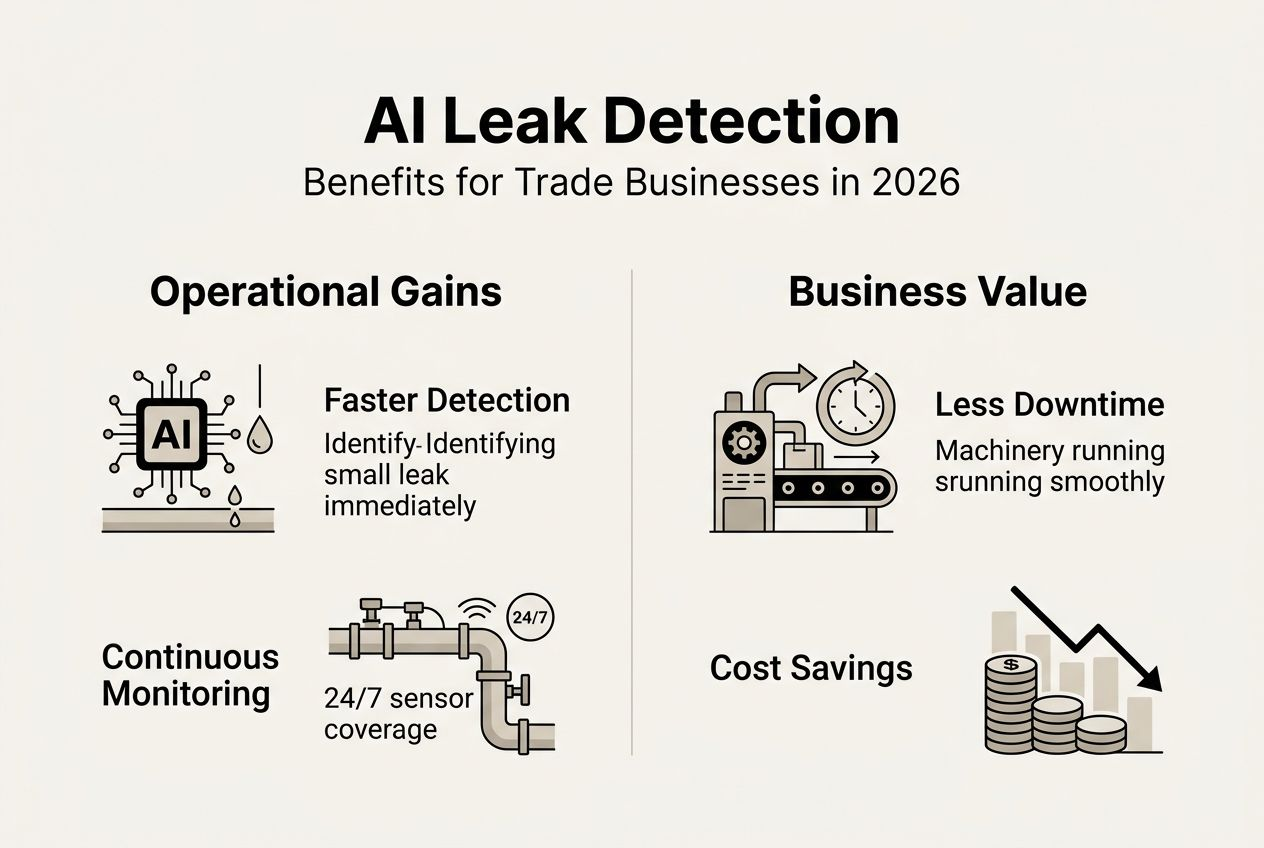
For plumbing businesses, this technology creates new service opportunities and competitive advantages:
| AI Leak Detection Benefit | Business Impact | Customer Value |
|---|---|---|
| Early detection | Prevents emergency callouts, enables scheduled maintenance | Lower repair costs, reduced property damage risk |
| Precise location | Reduces diagnostic time and invasive investigation | Faster repairs, less disruption |
| Continuous monitoring | Identifies developing issues before failure | Predictive maintenance prevents emergencies |
| Resource conservation | Reduces water waste | Environmental responsibility, lower utility bills |
Commercial properties particularly benefit from continuous monitoring. A hotel with a slow leak in its distribution system might lose thousands of euros monthly in water costs before the problem becomes apparent. AI detection identifies the issue within days, enabling repairs before significant financial impact.
Pro Tip: Position leak detection services as preventive maintenance rather than emergency response. Businesses and property managers will pay premium rates for systems that prevent expensive emergencies, creating recurring revenue streams beyond traditional reactive plumbing work.
Residential applications are emerging rapidly. 24/7 automatic leak detection for apartments and homes provides property owners with peace of mind and insurance benefits. Plumbers who offer installation and monitoring services differentiate themselves from competitors still operating purely on a reactive emergency model.
The financial case is straightforward. A commercial building that prevents one major leak incident annually through AI monitoring saves far more than the monitoring system costs. For plumbing businesses, the recurring revenue from monitoring subscriptions provides predictable income that smooths the peaks and valleys of emergency call volume.
Real-world implementations demonstrate substantial returns. Dublin's water infrastructure projects using AI leak detection have identified previously undetectable losses, saving millions of litres and reducing operational costs. Trade businesses that understand and offer these technologies position themselves as innovative partners rather than commodity service providers.
Getting started with AI in your trade business
Implementing AI successfully requires more than purchasing software. The foundation matters as much as the technology itself.
AI only pays off when you have usable, structured data and consistent processes. A chaotic operation with inconsistent record keeping and ad hoc procedures won't benefit from automation. AI amplifies your existing systems. If those systems are disorganised, AI amplifies the chaos.
Start with an honest assessment of your current operations:
- Do you have standardised processes for intake, scheduling, and follow-up?
- Is customer data organised in a system rather than scattered across notepads and memory?
- Can you clearly define what information you need from customers to quote and schedule jobs?
- Do technicians follow consistent protocols for job completion and documentation?
If you answered no to multiple questions, process improvement must precede AI implementation. Document your ideal workflow. Standardise how information flows from initial contact through job completion. Clean up your customer database. These steps create the foundation AI needs to function effectively.
Once your processes are solid, assess which AI solutions address your specific bottlenecks. Common options for trade businesses include:
| AI Solution | Primary Benefit | Best For | Implementation Consideration |
|---|---|---|---|
| Voice agents | 24/7 call answering and qualification | Businesses missing after-hours calls | Requires clear call scripts and qualification criteria |
| Scheduling automation | Eliminates appointment phone tag | High-volume service businesses | Needs integration with existing calendar systems |
| Lead qualification systems | Filters serious prospects | Businesses with high enquiry volume | Requires defined qualification criteria |
| Leak detection technology | Preventive maintenance revenue | Plumbing businesses seeking differentiation | Needs technical training and monitoring infrastructure |
Hybrid models typically deliver the best results for trade businesses. AI handles high-volume, repetitive tasks like after-hours calls and appointment confirmations. Human staff manage complex situations requiring judgement, relationship building, or technical expertise. This combination maximises efficiency without sacrificing service quality.
Implementation should be phased rather than attempting everything simultaneously. Start with your biggest pain point. For most trade businesses, that's missed calls. Deploy an AI voice agent for after-hours and overflow. Measure results for 90 days. Refine the system based on real performance data. Then expand to additional applications.
Partnering with specialists accelerates success. AI voice agents and automation solutions designed specifically for trade businesses integrate faster and perform better than generic tools. Industry-specific solutions understand trade business workflows, terminology, and customer expectations without requiring extensive customisation.
Consider professional assessment before implementation. AI and automation audit consultation identifies exactly where AI will deliver the highest return for your specific business. This prevents expensive mistakes like implementing sophisticated systems for problems that don't actually constrain your growth.
The investment ranges from modest to substantial depending on scope. Basic AI voice agents start at a few hundred euros monthly. Comprehensive automation systems with multiple integrations cost more but deliver proportionally greater returns. Calculate ROI based on captured revenue from previously missed opportunities rather than viewing AI as a pure cost centre.
Training matters as much as technology. Your team needs to understand how AI fits into workflows, when to override automated decisions, and how to leverage AI-generated data for business insights. Plan for onboarding time and ongoing refinement as you learn what works best for your specific operation.
How Apex Emerald supports trade businesses with AI
Transitioning from understanding AI's potential to implementing it successfully requires specialised expertise. Apex Emerald AI delivers AI voice agents and automation solutions built specifically for Ireland's trade businesses, addressing the unique challenges plumbing, HVAC, and electrical companies face.
The platform integrates AI call handling, lead qualification, and appointment scheduling with your existing job management systems. This seamless integration means AI enhances rather than disrupts your current operations. Technicians continue using familiar tools whilst AI handles the repetitive tasks that previously consumed administrative time.
Beyond software, strategic AI and automation audit services assess your business's readiness for AI implementation. These audits identify exactly which processes will benefit most from automation, ensuring your investment delivers measurable returns within 90 days. Real AI implementation case studies demonstrate how similar trade businesses have achieved significant increases in conversions, lead quality, and revenue through properly deployed AI systems.
Frequently asked questions
Can AI really increase revenue for trade businesses?
Yes, AI significantly boosts revenue by capturing after-hours emergency calls that previously went to competitors. Trade businesses typically miss 20-30% of calls when technicians are on-site or outside business hours. Each missed emergency call represents €300-500 in lost revenue. AI answers every call instantly, converting these lost opportunities into bookings. Additionally, AI qualification ensures your team spends time on high-value prospects rather than price shoppers, improving conversion rates on estimates.
Will AI replace my staff?
No, AI augments rather than replaces human expertise. AI handles repetitive, time-consuming tasks like answering routine questions, confirming appointments, and sending follow-up messages. This frees your staff to focus on complex customer situations, technical problem-solving, and relationship building where human judgement and expertise create the most value. The most successful implementations use hybrid models where AI manages volume and humans manage complexity.
What if my business processes aren't standardised yet?
Standardise first, then automate. AI amplifies your existing processes, so inconsistent workflows produce inconsistent results. Document your ideal customer journey from initial contact through job completion. Create standard protocols for common scenarios. Clean up your data systems. These improvements benefit your business immediately and create the foundation for successful AI implementation. Many businesses discover that process standardisation alone significantly improves efficiency before AI even enters the picture.
How long does AI implementation take?
Basic AI voice agents can be operational within two to four weeks for businesses with clean processes and data. More comprehensive automation involving multiple system integrations typically requires six to eight weeks. The timeline depends primarily on your existing infrastructure and how much customisation your specific workflows require. Phased implementation allows you to start capturing value quickly with core features whilst additional capabilities roll out progressively.
Does AI work for small trade businesses or only large companies?
AI delivers proportionally greater impact for small to mid-sized trade businesses. Large companies already have staff dedicated to answering phones and managing schedules. Small businesses often rely on technicians juggling customer service with technical work, creating the missed call problem AI solves. The investment scales to business size, with entry-level AI voice agents costing less than hiring part-time administrative staff whilst providing 24/7 coverage that no human employee can match.
Recommended
- AI Voice Agents for Trades Ireland | Apex Emerald AI
- AI Voice Agents & Automation Solutions | Trades Business AI | Apex Emerald
- AI & Automation Audit Services | Strategic Technology Consulting | Apex Emerald AI
- AI & Automation Audit Services | Fractional CTO Ireland | Apex Emerald
- Innovative tech strategies for business leaders 2026
- AI Implementation - Virality Creative