
You're losing revenue every day your team manually sifts through unqualified leads. For Irish plumbing, HVAC, and electrical businesses, poor lead qualification wastes hours on prospects who'll never convert whilst genuine customers wait. AI voice agents and automation solutions can transform this bottleneck into a competitive advantage. This guide walks you through preparing your business for AI lead qualification, implementing the right tools, troubleshooting common mistakes, and measuring success. By 2026, trade businesses leveraging AI report qualification speeds 3x faster than manual processes, freeing your team to focus on closing deals rather than chasing dead ends.
Table of Contents
- Understanding AI lead qualification and preparation
- Implementing AI tools for lead qualification in trades
- Troubleshooting common mistakes and optimising AI lead qualification
- Expected results and measuring AI lead qualification success
- Explore AI solutions tailored for Irish trades businesses
Key takeaways
| Point | Details |
|---|---|
| AI automates initial contact | Voice agents handle first conversations, capturing essential data whilst scoring lead quality in real time |
| Preparation requires clean data | Your CRM must contain structured, accurate lead information before AI can deliver reliable qualification results |
| Integration with workflows is essential | AI tools must connect seamlessly with existing job management systems to ensure smooth handoffs to your sales team |
| Continuous monitoring drives improvement | Regular review of AI performance against actual conversions allows you to refine scoring criteria and boost ROI |
Understanding AI lead qualification and preparation
AI lead qualification uses machine learning algorithms and voice agents to automatically assess incoming enquiries, determining which prospects are most likely to convert based on criteria you define. For Irish trade businesses, this means AI can instantly evaluate whether a caller needs emergency plumbing repair, has budget for a full HVAC installation, or requires immediate electrical work. The technology analyses conversation patterns, urgency indicators, location data, and service requirements to assign each lead a quality score.
Before implementing AI, your business needs solid data foundations. Quality matters more than quantity. Your CRM should contain at least six months of lead history with clear outcomes marked: converted, lost, or unqualified. Each record needs consistent fields for service type, location, budget range, and urgency level. Incomplete or inconsistent data will train AI to make poor decisions, undermining the entire system.
Technology readiness extends beyond software. You need reliable internet connectivity, integration capabilities with your existing job management platform, and team members willing to trust AI recommendations. Many Irish trades businesses already use systems like Jobber, ServiceTitan, or Fergus. Your AI solution must connect with these platforms to avoid creating data silos that slow your workflow.
Aligning AI with business objectives prevents wasted investment. Are you trying to reduce time spent on unqualified leads? Increase conversion rates? Improve response times for high value enquiries? Clear goals let you configure AI scoring criteria appropriately. A plumber focusing on emergency callouts will weight urgency differently than an HVAC installer targeting planned system replacements.
Pro Tip: Audit your current lead data before purchasing any AI tools. Export three months of leads and check how many records have complete information in all critical fields. If completeness falls below 80%, spend time cleaning your database first. AI trained on messy data produces messy results.
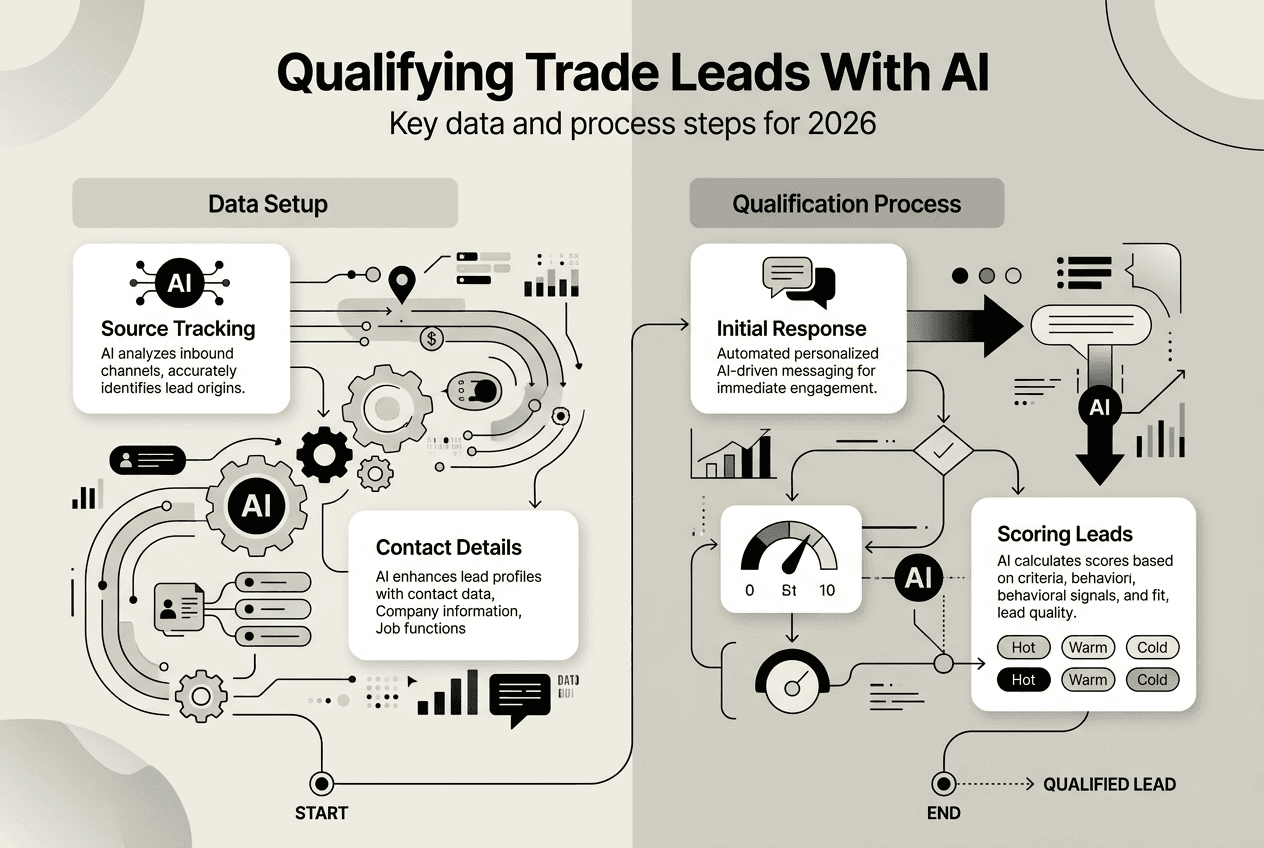
Essential data requirements for AI implementation
| Data Type | Minimum Standard | Purpose |
|---|---|---|
| Lead source | Tracked for every enquiry | Identifies which marketing channels produce quality leads |
| Service category | Standardised labels | Allows AI to match leads with appropriate team members |
| Geographic location | Postcode or town | Filters leads outside service areas automatically |
| Contact timeline | Urgency indicators | Prioritises emergency work over routine maintenance |
| Historical outcomes | Win/loss/unqualified | Trains AI to recognise patterns in successful conversions |
Implementing AI tools for lead qualification in trades
Successful implementation follows a structured approach. Start by selecting AI platforms designed specifically for trade businesses rather than generic marketing tools. AI automation audit services can evaluate your current systems and recommend solutions that integrate smoothly with Irish trade workflows. Look for voice agents capable of handling regional accents and industry terminology specific to plumbing, HVAC, or electrical work.
-
Define your qualification criteria explicitly. List every factor that indicates a quality lead for your business. Urgency, budget, location, and service type form the foundation, but add nuanced criteria like property type, previous customer status, or seasonal timing. An HVAC business might score summer enquiries about heating lower than winter requests.
-
Configure lead scoring thresholds. Assign point values to each criterion based on importance. A caller within your service area might receive 20 points, whilst someone 50 kilometres away gets 5 points. Emergency requests could earn 30 points, routine maintenance 10 points. Set minimum scores for automatic acceptance, manual review, or immediate rejection.
-
Integrate AI voice agents with your phone system. Modern AI can handle initial calls, asking qualifying questions naturally whilst capturing responses in your CRM. The agent identifies caller intent, extracts key details, and routes qualified leads to appropriate team members. This happens 24/7, ensuring you never miss opportunities outside business hours.
-
Connect AI outputs to your job management platform. Qualified leads should flow automatically into your scheduling system with all relevant data pre populated. This eliminates double entry and ensures your team sees complete information when following up. Integration might require API connections or middleware, but the efficiency gains justify the setup effort.
-
Establish escalation protocols for edge cases. AI won't perfectly handle every situation initially. Create clear rules for when the system should transfer calls to humans or flag leads for manual review. Complex commercial projects or unusual service requests might need human judgement even after AI qualification.
Pro Tip: Run a parallel pilot for your first month. Let AI qualify leads whilst your team continues manual processes. Compare results weekly to identify gaps in AI configuration before fully switching over. This approach minimises disruption and builds team confidence in the technology.
Comparison of AI qualification approaches
| Approach | Best For | Implementation Time | Accuracy Rate |
|---|---|---|---|
| Voice agent only | High call volume businesses | 2-3 weeks | 85-90% |
| Form plus AI analysis | Online lead generation focus | 1-2 weeks | 80-85% |
| Omnichannel AI | Multiple lead sources | 4-6 weeks | 90-95% |
| Hybrid human plus AI | Complex service offerings | 3-4 weeks | 92-97% |
Troubleshooting common mistakes and optimising AI lead qualification
Even well implemented AI systems encounter problems. Recognising these issues early prevents costly mistakes and maintains lead quality. The most frequent error involves insufficient data quality at launch. AI trained on incomplete or inaccurate historical data develops flawed scoring models. If your AI consistently misclassifies leads, audit your training dataset. Look for patterns in misclassified leads. Are they all from a specific source? Do they share common characteristics your criteria missed?
Ignoring human feedback creates a dangerous blind spot. Your sales team interacts with leads after AI qualification and knows which prospects actually convert. Establish weekly review sessions where team members flag leads the AI scored incorrectly. Use this feedback to refine criteria and retrain models. A plumber might discover AI overvalues enquiries mentioning "emergency" when many callers use that term loosely.
Inadequate criteria tuning leaves performance gains on the table. Initial scoring rules rarely capture all nuances of your ideal customer profile. Monitoring and continuous adjustment of algorithms improve performance and ROI. Schedule monthly reviews of conversion rates by lead score bracket. If leads scoring 60-70 convert as well as those scoring 80-90, your thresholds need adjustment.
- Data quality issues: Implement validation rules in your CRM to prevent incomplete records. Require minimum fields before saving new leads.
- Over reliance on AI: Maintain human oversight for high value opportunities. AI assists decisions but shouldn't make final calls on major projects.
- Static criteria: Update scoring rules quarterly based on seasonal patterns, market changes, and business growth.
- Poor integration: Ensure seamless data flow between AI, CRM, and job management systems. Manual data transfer defeats automation benefits.
- Insufficient training: Educate your team on how AI scores leads and when to override recommendations. Understanding builds trust and improves outcomes.
Team resistance often stems from fear AI will replace jobs or make poor decisions. Address this by positioning AI as a tool that handles tedious qualification work, freeing humans for relationship building and complex problem solving. Share success metrics showing how AI improves their close rates by delivering better qualified prospects.
Technical integration challenges require patience and expertise. APIs don't always connect smoothly, data formats conflict, and legacy systems resist modern tools. Work with providers offering dedicated implementation support. Budget extra time for testing and refinement. Most integration problems resolve within the first month if you address them systematically.
Expected results and measuring AI lead qualification success
Trade businesses implementing AI lead qualification typically see measurable improvements within 60-90 days. Effective AI lead qualification boosts lead conversion rates and operational efficiency for trades businesses. Conversion rates often increase 15-25% as your team focuses energy on genuinely interested prospects rather than wasting time on poor fits. Qualification speed improves dramatically, with AI processing initial enquiries in seconds versus the hours or days manual review requires.

Quantitative KPIs provide concrete evidence of AI value. Track lead conversion rate before and after implementation, segmented by lead score. Calculate cost per qualified lead by dividing total marketing spend by the number of leads meeting your criteria. Measure average time from enquiry to first contact, which should decrease significantly. Monitor the percentage of leads requiring manual review, aiming for steady reduction as AI learns.
Qualitative benefits matter equally. Customer experience improves when AI responds instantly to enquiries, even outside business hours. Prospects appreciate immediate acknowledgement and clear next steps. Your team experiences reduced workload stress, spending less time on dead end conversations and more on productive sales activities. Job satisfaction typically increases when staff focus on meaningful work rather than administrative screening.
Performance metrics comparison
| Metric | Pre AI Baseline | Post AI Target | Typical Timeline |
|---|---|---|---|
| Lead conversion rate | 12-18% | 20-28% | 90 days |
| Qualification time | 2-4 hours | Under 5 minutes | 30 days |
| Cost per qualified lead | £45-65 | £25-40 | 60 days |
| After hours response rate | 0-15% | 95-100% | Immediate |
Establish baseline measurements before launching AI. Document current conversion rates, qualification times, and costs for at least one month. This data proves AI impact and justifies continued investment. Create a simple dashboard tracking key metrics weekly, making trends visible to stakeholders.
- Set realistic improvement targets: Expect 20-30% gains in first six months, not overnight transformation.
- Compare lead quality by source: AI reveals which marketing channels produce genuinely qualified prospects versus high volume, low quality leads.
- Track team productivity: Measure how many qualified leads each team member can handle before and after AI implementation.
- Calculate ROI monthly: Total AI costs divided by revenue from additionally converted leads shows clear financial benefit.
- Document case examples: Collect specific stories of leads AI qualified correctly that might have been missed or delayed manually.
Continual measurement drives ongoing improvement. AI performance doesn't plateau at initial implementation levels. As the system learns from more interactions and you refine criteria based on results, accuracy and efficiency keep improving. Businesses treating AI as a static tool miss opportunities for compounding gains over time.
Explore AI solutions tailored for Irish trades businesses
Apex Emerald AI specialises in AI voice agents and automation solutions designed specifically for Irish plumbing, HVAC, and electrical businesses. Our platform integrates seamlessly with popular job management systems used across Ireland, delivering 24/7 lead qualification that captures opportunities your competitors miss. We understand the unique challenges trade businesses face, from managing emergency callouts to scheduling complex installation projects.
Our strategic AI audit services evaluate your current lead management processes, identify automation opportunities, and create implementation roadmaps tailored to your business goals. We've helped Irish trades businesses achieve measurable ROI within 90 days through improved lead quality and conversion rates. Many clients access state funded AI transformation programmes that significantly reduce implementation costs, making enterprise grade AI accessible to growing businesses. Explore how AI can transform your lead qualification process and free your team to focus on delivering exceptional service.
FAQ
What data is needed for effective AI lead qualification?
Effective AI lead qualification requires clean, structured lead data collected from customer interactions, enquiries, and historical sales records. Your system needs at least six months of lead history with complete fields for service type, location, budget indicators, urgency level, and conversion outcomes. The more consistent and accurate your historical data, the better AI can identify patterns distinguishing quality leads from poor prospects. Start by auditing your current CRM to ensure 80% or higher completeness across critical fields before implementing AI tools.
How does AI improve lead scoring for trade businesses?
AI analyses multiple data points simultaneously, evaluating factors like caller urgency, service requirements, location, budget signals, and historical patterns to assign quality scores in real time. This process happens in seconds rather than the hours manual review requires, ensuring immediate response to high value opportunities. AI eliminates human bias and inconsistency, applying your qualification criteria uniformly to every enquiry. As the system learns from outcomes, scoring accuracy improves continuously, adapting to seasonal patterns and market changes your team might miss.
What are key indicators of AI lead qualification success?
Lead conversion rate, qualification time reduction, cost per qualified lead, and enhanced customer responsiveness serve as primary success indicators. Track how conversion rates improve for AI qualified leads compared to your baseline, aiming for 15-25% increases within 90 days. Measure the reduction in time from initial enquiry to first contact, which should drop from hours to minutes. Calculate cost savings by dividing marketing spend by qualified lead volume, expecting 30-40% efficiency gains. Monitor customer satisfaction through response time improvements and after hours availability.
How can trade businesses start using AI for lead qualification?
Start with an audit of current lead processes, documenting baseline metrics like conversion rates, qualification times, and data quality. Choose AI voice agents and automation solutions designed for trade businesses with proven integration capabilities for Irish job management platforms. Pilot test with a subset of leads whilst maintaining existing processes, comparing results weekly to refine configuration. Gradually expand AI coverage as your team builds confidence and you optimise scoring criteria based on real outcomes. Most businesses achieve full implementation within 60-90 days following this structured approach.