
Irish trade businesses lose an estimated 30% of potential revenue through missed calls, inefficient scheduling, and slow response times. Many plumbing, HVAC, and electrical business owners assume AI is prohibitively expensive or complex, suited only for large corporations. This misconception costs small and medium enterprises thousands annually in lost opportunities. Scalable AI offers a practical, affordable pathway to automate customer interactions, optimise dispatch, and grow revenue without proportionally increasing operational costs. This guide explains what scalable AI means for Irish trades, how it works in practice, and actionable steps to implement it successfully in 2026.
Table of Contents
- What is scalable AI and why does it matter for Irish trade businesses?
- Core scalable AI components and workflows empowering trade businesses
- Challenges, nuances, and practical considerations in deploying scalable AI in trades
- How Irish trade business owners can start and scale AI effectively in 2026
- Explore AI solutions tailored for Irish trade businesses
- Frequently asked questions about scalable AI in Irish trades
Key takeaways
| Point | Details |
|---|---|
| Scalable AI drives growth | AI systems handle increasing workloads without proportional cost rises, enabling sustainable business expansion. |
| Core applications boost revenue | Voice agents, automated scheduling, and data pipelines can increase revenue by 21-35% for Irish trade businesses. |
| Start modular and frugal | Pilot projects using targeted AI modules reduce risk and demonstrate ROI before full deployment. |
| Funding reduces barriers | Enterprise Ireland grants and state programmes lower upfront costs for AI adoption in Irish SMEs. |
| Scaling challenges exist | Only 16-25% of AI projects scale successfully, requiring careful planning and realistic expectations. |
What is scalable AI and why does it matter for Irish trade businesses?
Scalable AI refers to artificial intelligence systems that handle increased workloads without proportional cost as your business grows. For Irish plumbing, HVAC, and electrical firms, this means deploying technology that manages more customer calls, schedules additional jobs, and processes greater data volumes whilst maintaining or reducing per-unit costs. Traditional business growth often requires hiring more staff, expanding office space, and increasing overhead proportionally. Scalable AI breaks this pattern by automating repetitive tasks and augmenting human capabilities rather than replacing them.
Why does scalability matter specifically for Irish trade businesses? Most operate with tight margins and seasonal demand fluctuations. During peak periods, you might miss valuable customer calls or struggle to dispatch technicians efficiently. During quieter months, fixed labour costs eat into profits. Scalable AI adapts to these variations, providing 24/7 customer service through voice agents, optimising technician routes based on skills and location, and maintaining consistent service quality regardless of call volume. This flexibility directly impacts your bottom line by capturing leads that would otherwise go to competitors and maximising billable hours per technician.
Common misconceptions prevent many trade business owners from exploring AI solutions. The first is cost. Whilst enterprise AI systems can require substantial investment, modular solutions designed for trades businesses start from €149 monthly. The second is complexity. Modern AI voice agents and automation solutions integrate with existing job management software through straightforward APIs, requiring minimal technical expertise. The third is relevance, with owners believing AI suits only large corporations. In reality, small and medium enterprises gain proportionally greater benefits because automation addresses their most significant constraint: limited administrative capacity.
Pro Tip: Begin with high-ROI use cases like after-hours call handling and appointment booking to build confidence and justify expansion. These applications deliver measurable results within weeks, providing concrete evidence of AI's value before committing to broader deployment.
Core scalable AI components and workflows empowering trade businesses
Successful scalable AI for trades businesses relies on several interconnected components working together. AI voice agents serve as the frontline, answering customer calls 24/7, capturing lead information, and qualifying job requirements through natural conversation. Call triage systems analyse customer needs and urgency, categorising jobs by priority and required expertise. Automated scheduling engines match jobs to available technicians based on skills, location, and current workload. Data pipelines collect information from every customer interaction, feeding into knowledge systems that improve service quality over time. These "second brain" systems store technical documentation, past job details, and customer preferences, making this information instantly accessible to technicians and office staff.
The call triage and dispatch workflow demonstrates how these components create scalable efficiency. When a customer rings, the AI voice agent answers immediately, regardless of time or existing call volume. Through conversational interaction, it gathers essential details: the nature of the problem, property type, urgency level, and customer availability. AI dispatch analyses 100+ variables per job, including technician certifications, current location, traffic conditions, parts inventory, and historical performance with similar jobs. This analysis happens in seconds, producing optimised schedules that maximise billable hours whilst minimising travel time and ensuring appropriate skill matching.

Compare traditional versus AI-enhanced dispatch workflows:
| Variable | Traditional Dispatch | AI-Enhanced Dispatch |
|---|---|---|
| Response time | 2-24 hours | Immediate |
| Variables considered | 5-10 (manual assessment) | 100+ (automated analysis) |
| Skill matching accuracy | 70-80% (limited visibility) | 95%+ (complete data access) |
| Schedule optimisation | Basic geographic clustering | Real-time traffic and priority weighting |
| After-hours coverage | Voicemail or answering service | Full qualification and booking |
The benefits extend beyond efficiency metrics. Conversational AI is preferred by 51% of customers for service interactions, particularly younger demographics who value instant responses and self-service booking. Reducing missed calls directly impacts revenue, as each unanswered call represents a potential job lost to competitors. AI systems never experience fatigue, maintain consistent quality regardless of call volume, and learn from every interaction to improve future performance.
Pro Tip: Communicate transparently with technicians about AI's role as a support tool, not a replacement. Frame it as technology that handles administrative burden, allowing them to focus on skilled work and customer relationships. This approach builds trust and encourages collaboration rather than resistance.
Challenges, nuances, and practical considerations in deploying scalable AI in trades
Despite promising capabilities, scalable AI deployment faces significant challenges that Irish trade businesses must understand and navigate. The deployment gap between laboratory performance and real-world results represents the most common pitfall. AI systems trained on clean, structured data often struggle with the messy reality of field operations: background noise during calls, regional accents, incomplete customer information, and unexpected edge cases. Only 16-25% of AI projects scale successfully, with many failing due to brittleness when confronting scenarios outside their training data. This brittleness stems from scarce context, where AI lacks the common sense and situational awareness humans apply instinctively.
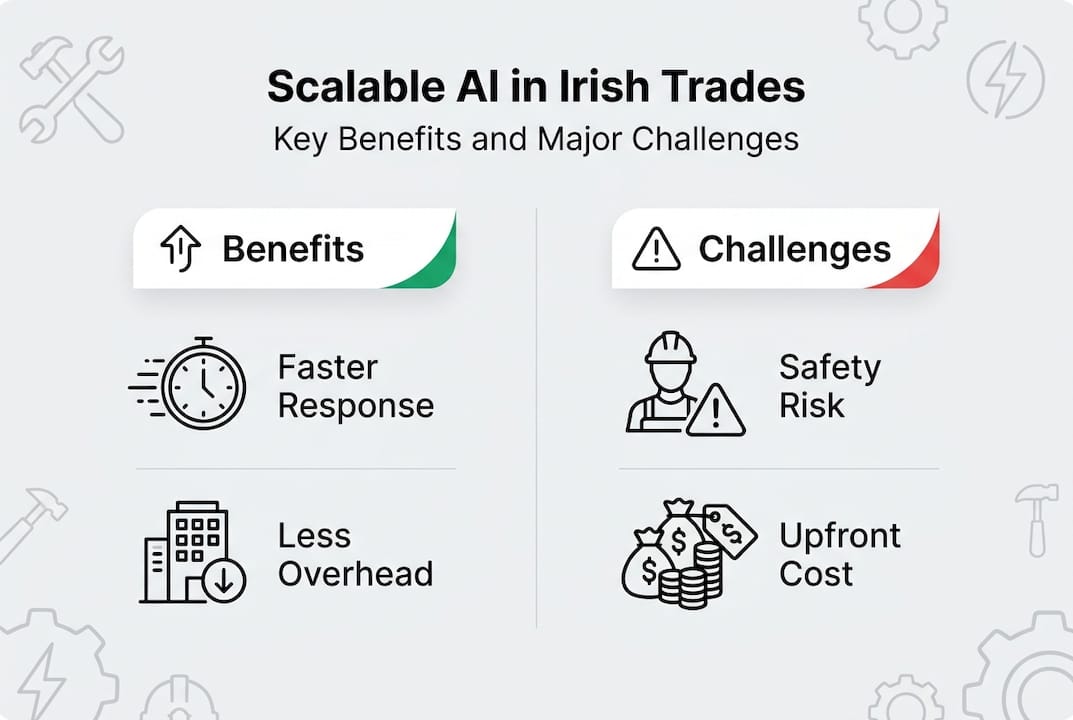
Safety and reliability concerns matter particularly for trades businesses where poor decisions carry physical and financial consequences. An AI system that misclassifies an emergency plumbing situation or dispatches an unqualified technician to a gas fitting job creates liability risks. Human oversight remains essential, with AI serving augmentation rather than full autonomy. Runtime safety layers, escalation protocols for uncertain situations, and regular performance audits ensure AI enhances rather than compromises service quality.
Financial considerations require careful planning. Upfront costs combined with 5.9% average ROI mean businesses must approach AI strategically rather than impulsively. Pilot projects reduce risk by testing AI in controlled scenarios before full deployment. Modular implementation allows you to start with one high-value application, measure results, and expand incrementally. This approach also spreads costs over time, making AI accessible to businesses without substantial capital reserves.
The contrast between autonomy hype and augmentation reality shapes realistic expectations:
| Aspect | Full Autonomy Hype | Augmentation Reality |
|---|---|---|
| Human role | Eliminated entirely | Enhanced with AI support |
| Decision making | AI operates independently | AI recommends, humans approve |
| Error handling | AI resolves all issues | Escalation to human expertise |
| Implementation cost | High upfront investment | Modular, incremental spending |
| Risk profile | Significant liability exposure | Managed through oversight |
Frugal, narrow AI tailored to specific trade business needs offers the most practical path forward. Rather than pursuing general-purpose AI that handles everything, focus on targeted applications where automation delivers clear value: call answering, appointment scheduling, invoice generation, parts ordering. These narrow applications achieve higher accuracy, require less training data, and integrate more easily with existing systems. They also cost significantly less than comprehensive AI platforms, making them accessible to small and medium enterprises.
Practical considerations for safe, scalable deployment include:
- Start with pilot projects in low-risk areas to validate performance before broader rollout
- Implement modular AI components that integrate with existing job management software
- Establish runtime safety layers that flag uncertain situations for human review
- Create clear escalation protocols for scenarios outside AI capabilities
- Train staff on working alongside AI systems to maximise collaborative benefits
- Monitor performance metrics continuously and adjust configurations based on results
- Document AI decision-making processes to maintain transparency and accountability
Irish businesses can leverage Enterprise Ireland grants and innovation funding to reduce financial risk during pilot phases. Approximately 70% of Irish manufacturers remain at pilot stage, indicating widespread experimentation but cautious scaling. Learning from these experiences, trade businesses should prioritise proven use cases with clear ROI metrics over ambitious but unproven applications.
How Irish trade business owners can start and scale AI effectively in 2026
Implementing scalable AI successfully requires a structured approach that balances ambition with pragmatism. Follow this process to initiate AI adoption in your trade business:
- Identify specific pain points where AI delivers measurable value, such as missed calls, scheduling conflicts, or slow quote turnaround.
- Research modular AI solutions designed for trades businesses, evaluating integration capabilities with your existing software.
- Launch a pilot project in one high-impact area, establishing clear success metrics before committing to broader deployment.
- Measure ROI rigorously, tracking both cost savings and revenue increases attributable to AI implementation.
- Scale incrementally based on pilot results, expanding to additional use cases only after validating initial success.
- Train staff on collaborating with AI systems, emphasising how automation enhances rather than threatens their roles.
- Review and optimise continuously, adjusting AI configurations based on performance data and user feedback.
Irish AI tools and services tailored for trades businesses provide practical starting points. CallCrewAI and Quantum AI Receptionist offer voice agent services from €149 monthly, handling after-hours calls and basic appointment scheduling. These solutions integrate with popular job management platforms like Jobber, ServiceTitan, and Fergus, minimising implementation complexity. For businesses requiring more sophisticated capabilities, custom AI implementations through Irish consultancies typically range from €5,000 to €20,000 depending on scope and integration requirements.
Leveraging grants and incentives significantly reduces financial barriers to AI adoption. Enterprise Ireland provides innovation funding for SMEs exploring digital transformation, covering up to 50% of eligible costs. The Digital Transition Fund supports technology investments that improve operational efficiency and competitiveness. Local Enterprise Offices offer mentoring and financial support for businesses implementing new technologies. These programmes make AI accessible to businesses that couldn't justify full commercial pricing, reducing risk during experimental phases.
Best practices for sustainable AI scaling include:
- Integrate AI with existing software systems rather than replacing functional tools
- Focus on high-ROI areas where automation delivers immediate, measurable benefits
- Maintain human oversight for complex decisions and customer relationship management
- Invest in staff training to build AI literacy and collaborative capabilities
- Establish data management practices that protect customer privacy whilst enabling AI learning
- Document processes and decision criteria to maintain service consistency
- Build relationships with AI vendors who understand trades business requirements
Pro Tip: Choose frugal AI modules tailored to your specific trade rather than pursuing comprehensive platforms. A plumber needs different AI capabilities than an electrician, and targeted solutions deliver better results at lower cost than generic systems.
Working with AI consultants accelerates successful implementation by aligning technology choices with business goals. Consultants assess your current operations, identify optimal AI applications, manage vendor selection, and oversee implementation. They also provide training and ongoing support, ensuring your team maximises AI benefits. When evaluating consultants, prioritise those with trades industry experience who understand your operational realities and customer expectations. The investment in expert guidance typically pays for itself through faster deployment, better vendor negotiation, and avoiding costly mistakes.
Explore AI solutions tailored for Irish trade businesses
Apex Emerald AI specialises in scalable voice agents and automation solutions designed specifically for Irish plumbing, HVAC, and electrical businesses. Our platform integrates seamlessly with your existing job management software, providing 24/7 customer service, intelligent call triage, and automated scheduling that adapts to your business volume. We understand the unique challenges facing Irish trades businesses, from seasonal demand fluctuations to tight margin pressures, and configure AI systems that address your specific operational needs.
Our clients leverage funding through Enterprise Ireland programmes to reduce upfront costs and accelerate ROI. We provide comprehensive audits and consultation services to assess your AI readiness, identify optimal applications, and create implementation roadmaps aligned with your growth objectives. With measurable results typically emerging within 90 days, our AI voice agents and automation solutions deliver the scalable efficiency Irish trade businesses need to compete effectively in 2026. Discover how audit and consultation services can transform your operations whilst maintaining the personal service your customers value.
Frequently asked questions about scalable AI in Irish trades
What types of AI solutions are most effective for small trade firms?
Voice agents handling after-hours calls and appointment booking deliver the highest immediate ROI for small trade businesses. Automated dispatch optimisation and customer follow-up systems provide additional value once initial AI implementations prove successful. Top AI tools for plumbers include modular solutions starting from €149 monthly that integrate with existing job management platforms.
How do I ensure AI systems remain safe and compliant in the field?
Implement runtime safety layers that flag uncertain situations for human review rather than autonomous AI decisions. Establish clear escalation protocols defining when AI should defer to human expertise, particularly for emergency situations or complex technical assessments. Regular audits of AI performance and decision-making ensure ongoing compliance with safety standards and customer service expectations.
What funding options support AI adoption for Irish SMEs?
Enterprise Ireland innovation funding covers up to 50% of eligible AI implementation costs for qualifying businesses. The Digital Transition Fund supports technology investments improving operational efficiency. Local Enterprise Offices provide mentoring and financial assistance for digital transformation projects. These programmes significantly reduce financial barriers to AI experimentation and adoption.
How do I measure ROI from scalable AI investment?
Track both cost savings and revenue increases attributable to AI implementation. Key metrics include reduced missed call rates, increased booking conversion percentages, improved technician utilisation rates, and decreased administrative labour hours. Compare performance data from before and after AI deployment, isolating AI impact from other business changes. Most businesses see measurable results within 60-90 days of implementation.
What are common pitfalls to avoid when starting AI projects in trades?
Pursuing full autonomy rather than augmentation creates unrealistic expectations and safety risks. Implementing AI without staff training generates resistance and undermines adoption. Choosing generic platforms over trades-specific solutions results in poor fit and wasted investment. Neglecting pilot projects before full deployment increases financial risk. AI automation setup steps for Irish trades emphasise modular, incremental approaches that validate value before scaling.