
Many trade business owners recognise AI's potential to transform operations, yet a significant skills gap holds them back. In Ireland, accessible AI qualifications now bridge this divide, offering practical, accredited learning tailored for busy managers. These micro-credentials and certificates equip you with the knowledge to automate processes, comply with regulations, and drive measurable revenue growth. Understanding what AI qualifications are available, how they fit your schedule, and how to apply them can unlock competitive advantages and operational efficiency. This guide explains the landscape of AI qualifications in Ireland, helping you choose the right path to enhance your trades business with confidence and clarity.
Table of Contents
- Key Takeaways
- What are AI qualifications and why do they matter for trades businesses
- Key AI courses tailored for trade businesses in Ireland
- Understanding micro-credentials and their advantages for SMEs
- Practical AI qualifications for trade business owners and managers
- Applying AI qualifications to transform your trade business
- Boost your trades business with AI solutions from Apex Emerald
- Frequently asked questions
Key Takeaways
| Point | Details |
|---|---|
| Subsidised AI qualifications | Subsidised AI qualifications are available through SOLAS Skills to Advance via Education and Training Boards, making AI learning affordable. |
| Levels 4 to 6 explained | The framework runs from Level 4 foundations to Level 6 strategic planning, covering practical AI use, ethics and regulatory considerations. |
| Short stackable modules | Short stackable modules teach practical automation of scheduling, lead qualification and inventory tasks to boost productivity. |
| Ethics and compliance focus | Ethics and compliance are emphasised to support responsible AI use and alignment with the EU AI Act. |
What are AI qualifications and why do they matter for trades businesses
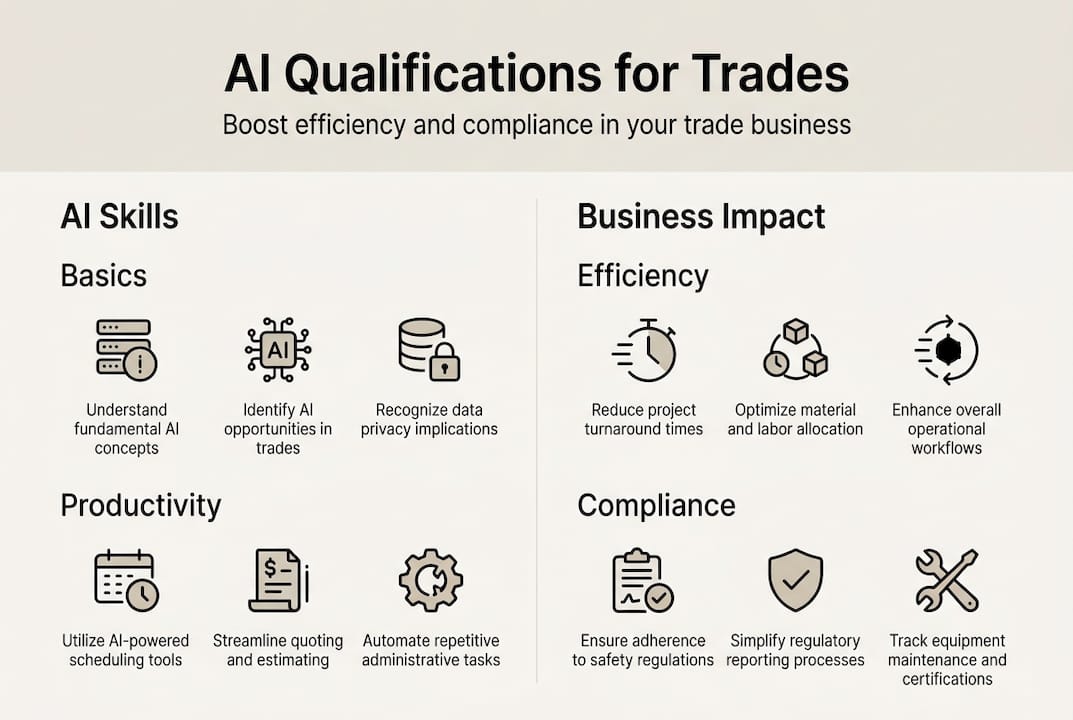
AI qualifications are formal, accredited learning credentials that validate your skills in artificial intelligence applications, strategy, and compliance. In Ireland, AI micro-qualifications launched by SOLAS under Skills to Advance are accredited by Quality and Qualifications Ireland at NFQ Levels 4 to 6. These levels suit trade managers and business owners who need practical AI knowledge without deep technical programming expertise. Level 4 introduces foundational AI literacy, Level 5 focuses on applying AI ethically to boost productivity, and Level 6 addresses legal, ethical, and strategic AI planning.
These qualifications matter because they directly impact operational efficiency and revenue. Automating routine tasks such as appointment scheduling, lead qualification, and inventory tracking frees your team to focus on high-value work. AI skills enable you to identify processes ripe for automation, pilot solutions confidently, and scale successful projects across your business. Understanding ethical AI use and EU AI Act compliance protects your reputation and ensures regulatory readiness as legislation evolves.
The Skills to Advance initiative delivers these courses through Education and Training Boards, offering subsidised or free access for eligible learners. This makes AI education affordable and accessible, removing financial barriers that might otherwise prevent small trades businesses from upskilling. Flexible delivery modes including evening classes, online modules, and blended learning fit around demanding work schedules, allowing you to learn without disrupting daily operations.
Gaining AI qualifications also positions your business competitively. Clients increasingly expect digital responsiveness and efficiency. Demonstrating AI capabilities can differentiate your brand, attract quality leads, and justify premium pricing. Moreover, staff development in AI fosters innovation culture, improves retention, and builds internal capacity to adapt as technology advances.
Pro Tip: Prioritise qualifications combining practical AI knowledge with ethical and legal awareness to comply with evolving regulations and build customer trust.
For broader strategic guidance on integrating AI into your operations, explore our AI consulting guide for trades.
Key AI courses tailored for trade businesses in Ireland
Ireland's AI micro-qualification landscape offers three core courses designed for SME owners and managers. The Introduction to AI at Level 4 provides foundational literacy, covering what AI is, how it works, and where it applies in everyday business contexts. This entry-level course suits anyone new to AI, requiring no prior technical background. It typically runs over a few weeks with flexible scheduling.
Enhancing Productivity with AI at Level 5 builds on foundational knowledge, teaching you to identify productivity bottlenecks and apply AI tools ethically to streamline operations. This course emphasises practical use cases relevant to trades: automating customer communications, optimising job scheduling, and improving quote accuracy. Ethical considerations and data privacy are woven throughout, ensuring you adopt AI responsibly. Delivery formats include in-person workshops, online modules, and blended options via local ETBs.
The forthcoming Level 6 course on AI Legal, Ethical, and Strategic Planning will address compliance with the EU AI Act, risk management, and long-term AI strategy development. This advanced qualification prepares you to lead AI initiatives confidently, navigate regulatory landscapes, and align AI investments with business goals. While not yet widely available, it represents the next step for those completing Levels 4 and 5.
| Course name | NFQ level | Focus area | Duration | Delivery format |
|---|---|---|---|---|
| Introduction to AI | Level 4 | Foundational literacy | 4-6 weeks | Online, in-person, blended |
| Enhancing Productivity with AI | Level 5 | Ethical productivity applications | 6-8 weeks | Online, in-person, blended |
| AI Legal/Ethical Considerations | Level 6 | Compliance, strategic planning | Coming soon | TBC |
These courses are designed with SME realities in mind: short duration, practical content, and minimal jargon. They address real challenges such as limited budgets, tight schedules, and non-technical backgrounds. By completing one or more, you gain portable, industry-recognised credentials that signal competence to clients, partners, and funders.
Pro Tip: Choose courses matching your current knowledge level and business priorities, balancing foundational skills with strategic insight as you progress.
To complement formal qualifications with hands-on tools, review our guide on AI tools for trades managers.
Understanding micro-credentials and their advantages for SMEs
Micro-credentials are short, flexible, stackable awards aligned with EU recommendations for lifelong learning. They represent targeted learning units with assessed outcomes, typically smaller in volume than traditional qualifications. In Ireland, micro-credentials integrate into the National Framework of Qualifications, meaning they carry recognised academic weight and can accumulate towards larger certificates or diplomas. This stackability reduces time and cost barriers, allowing you to build skills incrementally without committing to lengthy programmes upfront.
Industry collaboration ensures relevance. For example, partnerships with organisations such as Microsoft inform course content, keeping it current with technological developments and employer needs. This means the AI skills you learn directly apply to tools and platforms you might already use or plan to adopt. Micro-credentials are learner-owned: once earned, they remain valid and portable across roles, sectors, and geographic locations, enhancing career mobility and business adaptability.
| Feature | Benefit for trades businesses |
|---|---|
| Short duration | Fits around busy work schedules without long absences |
| Flexible delivery | Online and blended options accommodate diverse learning preferences |
| Assessed outcomes | Validates competence with recognised credentials |
| Stackable | Build towards larger qualifications incrementally, reducing financial risk |
| Portable | Credentials recognised nationally and across EU, supporting business growth |
| Funded | Government schemes such as Skills to Advance and Digital Transition Fund subsidise costs |
Key advantages for SMEs include compatibility with operational demands. You can complete a micro-credential in weeks rather than months, minimising disruption. Flexibility allows team members to learn at their own pace, accommodating varying literacy levels and prior experience. Assessment validates learning, giving you confidence that skills are genuinely acquired and applicable.
Government funding support makes micro-credentials affordable. The Digital Transition Fund and Skills to Advance initiative cover substantial training costs for eligible businesses and individuals, reducing out-of-pocket expenses. This financial accessibility democratises AI education, enabling smaller trades businesses to compete with larger firms in adopting advanced technologies.
Micro-credentials also address ethical and regulatory demands. Courses emphasise responsible AI use, data privacy, and compliance with emerging legislation such as the EU AI Act. This proactive approach protects your business from legal risks and builds customer trust, positioning you as a responsible, forward-thinking operator.
For practical steps to implement AI automation once you've gained foundational skills, see our guide on AI automation setup steps.
Practical AI qualifications for trade business owners and managers
Beyond micro-credentials, longer certificate programmes offer comprehensive AI education tailored for SMEs. The MTU Certificate in AI Fundamentals for SMEs is a Level 6 qualification worth 20 ECTS credits, delivered entirely online over several months. Priced at €2750, it covers AI communication strategies, EU AI Act compliance, identifying business processes suitable for AI improvement, and strategic AI planning. This certificate suits trade business owners ready to develop holistic AI strategies rather than simply adopting isolated tools.
Modules include practical, non-technical content designed for managers without programming backgrounds. You learn to evaluate AI vendors, assess ROI, communicate AI benefits to stakeholders, and navigate regulatory requirements. The strategic planning component helps you align AI investments with long-term business goals, ensuring technology serves your vision rather than dictating it. Flexible online delivery accommodates busy schedules, with recorded lectures and asynchronous assignments allowing you to progress at your own pace.

Alternative workshops such as CMIT's AI for Business Professionals and IACT's AI for Managers focus on operational applications. These shorter programmes emphasise immediate use cases: automating customer service, optimising resource allocation, and improving decision-making with data analytics. They provide hands-on exposure to AI tools commonly used in trades, such as scheduling software, CRM automation, and predictive maintenance platforms.
Benefits of these practical qualifications include strategic insight, regulatory readiness, and improved operational efficiency. You gain confidence to lead AI initiatives, communicate value to your team, and make informed technology investments. Completing a certificate signals to clients and partners that your business is digitally mature and future-ready, enhancing credibility and competitive positioning.
Pro Tip: Start with a foundational micro-qualification to build confidence, then progress to comprehensive certificates to develop strategic capacity and leadership skills.
For ongoing strategic support, consider exploring our AI consulting guide for trades.
Applying AI qualifications to transform your trade business
Despite optimism, 80% of SMEs say AI can transform their business but lack skills keeping adoption rates low. Gaining AI qualifications addresses this gap, but practical application determines real impact. Start by piloting one process, such as inventory management or appointment scheduling, to demonstrate AI's ROI before scaling. This benchmark-driven approach reduces risk, builds internal confidence, and provides measurable evidence to justify further investment.
Ethical and regulatory compliance must underpin every AI initiative. The EU AI Act introduces legal obligations for transparency, accountability, and risk management. Your qualifications equip you to navigate these requirements, ensuring AI deployments protect customer data, avoid bias, and maintain human oversight. Proactive compliance safeguards your reputation and avoids costly legal issues as enforcement intensifies.
Practical steps to apply AI qualifications include:
- Select a qualification matching your current knowledge level and business priorities, starting with foundational courses if new to AI.
- Pilot AI in one process such as lead qualification or scheduling, measuring impact on efficiency, cost, and customer satisfaction.
- Engage staff early, communicating benefits clearly and involving them in selecting processes to automate, reducing resistance and fostering ownership.
- Measure impact rigorously, tracking KPIs such as time saved, error reduction, and revenue growth to quantify ROI and inform scaling decisions.
- Scale gradually, expanding successful pilots to additional processes while refining approaches based on lessons learned.
Government grants and funds support AI training and digital upgrades. The Digital Transition Fund offers financial assistance for technology adoption, including AI tools and staff training. Skills to Advance provides subsidised qualifications, reducing barriers for smaller businesses. Leveraging these resources maximises return on investment and accelerates digital transformation.
"Benchmark-driven adoption involves piloting processes like inventory automation for measurable returns, leveraging government grants for training and technology, ensuring sustainable AI integration."
Pro Tip: Engage staff early in AI adoption, clearly communicating benefits and involving them in process selection to smooth implementation and build enthusiasm.
For funding options to support your AI journey, explore our AI funding solutions.
Boost your trades business with AI solutions from Apex Emerald
Understanding AI qualifications is the first step; implementing AI effectively transforms that knowledge into measurable results. Apex Emerald specialises in AI voice agents and automation tailored for Irish trades businesses, helping you capture leads, qualify prospects, and book appointments 24/7. Our solutions integrate seamlessly with popular job management systems, delivering operational efficiency and revenue growth without disrupting existing workflows.
We offer transparent pricing designed for fast return on investment, giving you budget clarity from day one. Our case studies demonstrate real-world impact: significant increases in conversions, lead quality, and revenue for plumbing, HVAC, and electrical businesses. Whether you're ready to pilot your first AI project or scale proven solutions, our AI voice agents and automation solutions provide the technology and strategic support to succeed.
Frequently asked questions
What types of AI qualifications are available for trade managers?
Ireland offers AI micro-qualifications at NFQ Levels 4 to 6, covering foundational literacy, ethical productivity applications, and strategic planning. Longer certificates such as MTU's AI Fundamentals for SMEs provide comprehensive training in compliance, communication, and business strategy. All are designed for non-technical managers and delivered flexibly online or in-person.
How do AI micro-qualifications fit into the Irish National Framework of Qualifications?
AI micro-qualifications are accredited by QQI and aligned with the NFQ at Levels 4 to 6. They are stackable, meaning you can accumulate credits towards larger awards such as certificates or diplomas. This integration ensures recognition across education and employment sectors, supporting career progression and business credibility.
Are these qualifications suitable for non-technical business owners?
Yes, all AI qualifications discussed are designed for business owners and managers without programming backgrounds. Content focuses on practical applications, ethical considerations, and strategic planning rather than coding or deep technical detail. Clear language and real-world examples make learning accessible and immediately applicable.
What government supports exist for AI training?
The Skills to Advance initiative offers subsidised or free AI micro-qualifications through Education and Training Boards. The Digital Transition Fund provides grants for technology adoption and staff training. Eligible businesses can access substantial financial support, reducing training costs and accelerating digital transformation.
How soon can AI qualifications impact my business operations?
You can apply learning immediately after completing foundational courses, typically within weeks. Piloting one AI process such as appointment scheduling or lead qualification demonstrates ROI quickly, often within 90 days. Scaling successful pilots and refining strategies based on measured outcomes accelerates impact, driving efficiency and revenue growth over the following months.