
Trades businesses in Ireland lose significant revenue every day through missed calls. Research shows that 40 to 60% of incoming calls go unanswered during working hours, representing lost leads and opportunities. AI voice agents offer a practical solution to this costly problem, transforming how plumbing, HVAC, and electrical businesses handle customer enquiries. These intelligent systems answer every call, qualify leads, and capture essential information whilst tradespeople focus on delivering excellent service. This guide explains what AI voice agents are, how they work, and why Irish trades managers should consider them for boosting efficiency and lead generation.
Table of Contents
- What is an AI voice agent and how does it work?
- The impact of AI voice agents on trades businesses in Ireland
- Comparing AI voice agents with human callers: cost, efficiency, and ROI
- Implementing AI voice agents in your trades business: practical steps and best practices
- Discover AI voice agent solutions tailored for Irish trades businesses
- Frequently asked questions
Key takeaways
| Point | Details |
|---|---|
| Eliminate missed calls | AI voice agents reduce missed calls from 40 to 60% down to 0%, capturing every potential lead |
| High caller satisfaction | Early deployments show 92% caller satisfaction with AI phone agents handling initial enquiries |
| Significant cost savings | AI agents cost a fraction of human staff whilst recovering €3,000+ monthly in revenue from converted calls |
| Faster lead response | AI technology enables sub-60-second response times, improving lead-to-demo conversions by 40% |
What is an AI voice agent and how does it work?
An AI voice agent is an automated phone system using artificial intelligence to answer incoming calls, engage with customers, and capture essential information for trades businesses. Unlike traditional voicemail or basic auto-attendants, these systems conduct natural conversations with callers, understanding their needs and responding appropriately. The technology fundamentally changes how trades businesses manage customer enquiries without requiring additional staff.
The core functions of AI voice agents include answering every call instantly, qualifying leads by asking relevant questions, booking simple appointments, and performing emergency triage. The AI isn't expected to solve complex technical queries or replace human expertise. Instead, it collects essential caller information so tradespeople can make informed decisions about which jobs to prioritise. This approach respects the reality that busy electricians or plumbers need quick, actionable summaries rather than lengthy call transcripts.
AI voice agents integrate seamlessly with existing phone systems and deliver information through SMS summaries, which tradespeople prefer over email notifications. The technology uses natural language processing to understand caller intent and respond conversationally. When booking appointments, successful implementations offer simple time slots rather than complex calendar integrations that confuse callers. This practical approach ensures smooth adoption and immediate value.
Key capabilities of AI voice agents include:
- 24/7 availability without breaks or holidays
- Instant call answering with zero wait times
- Lead qualification through structured conversations
- Emergency prioritisation based on caller urgency
- Integration with voice agent workflows and existing business systems
- SMS delivery of call summaries to mobile devices
The impact on missed calls is remarkable. Trades businesses typically miss 40 to 60% of incoming calls, but AI voice agents reduce this to 0%. Every potential customer receives immediate attention, dramatically improving lead capture rates. The technology works alongside human teams rather than replacing them, handling routine enquiries whilst tradespeople focus on skilled work.
Pro Tip: Start by deploying AI voice agents for emergency triage calls first, as this delivers the highest immediate value and helps your team build confidence in the technology before expanding to other call types.
The impact of AI voice agents on trades businesses in Ireland
The financial and operational benefits of AI voice agents are substantial for Irish trades businesses. Historically, the 40 to 60% of calls that went unanswered represented direct revenue loss and missed growth opportunities. Each unanswered call could be a high-value job or a long-term customer relationship that never materialises. AI voice agents eliminate this waste by capturing every enquiry.
Early Irish deployments demonstrate impressive results. Caller satisfaction reaches 92% when interacting with AI phone agents, dispelling concerns that customers might reject automated systems. More importantly, businesses recover €3,000+ monthly in revenue by converting previously missed calls into booked jobs. This represents significant income that was simply disappearing before AI implementation.

Lead response time improvements are equally dramatic. Traditional human-only operations might take hours or days to return calls, particularly during busy periods. AI voice agents respond in under 60 seconds, capturing caller details whilst interest remains high. This speed translates to measurable business outcomes, with some implementations seeing 40% improvements in lead-to-demo conversion rates through faster, more consistent follow-up.
| Impact Area | Before AI Voice Agent | After AI Voice Agent | Improvement |
|---|---|---|---|
| Missed calls | 40 to 60% | 0% | 100% reduction |
| Caller satisfaction | Variable | 92% | Consistent quality |
| Monthly revenue recovery | €0 | €3,000+ | New revenue stream |
| Lead response time | Hours to days | Under 60 seconds | 95%+ faster |
Key impacts for trades businesses include:
- Eliminated revenue loss from missed calls
- Increased monthly income through better lead capture
- Enhanced customer experience with instant responses
- Freed tradesperson time for skilled work rather than phone management
- Improved customer service efficiency across all enquiry types
Pro Tip: Focus your AI voice agent on emergency triage during initial deployment to maximise early benefits and demonstrate clear ROI to your team, building support for broader implementation.
Comparing AI voice agents with human callers: cost, efficiency, and ROI
The economics of AI voice agents versus human staff reveal compelling advantages for trades businesses. Human sales development representatives cost between $70,000 and $105,600 annually, equivalent to roughly €65,000 to €98,000 in Ireland when accounting for salary, taxes, benefits, and training. AI voice agents operate at a fraction of this expense, typically ranging from €9,700 to €16,700 annually including subscription fees and setup costs. This represents savings of over 80% compared to equivalent human coverage.
Efficiency metrics favour AI voice agents across multiple dimensions. Businesses using voice AI achieve faster lead responses, higher conversion rates, and reduced costs compared to traditional methods. AI agents respond to every call within seconds, never take breaks, and maintain consistent quality regardless of call volume or time of day. Human staff, whilst valuable for complex interactions, cannot match this availability or consistency for routine enquiries.
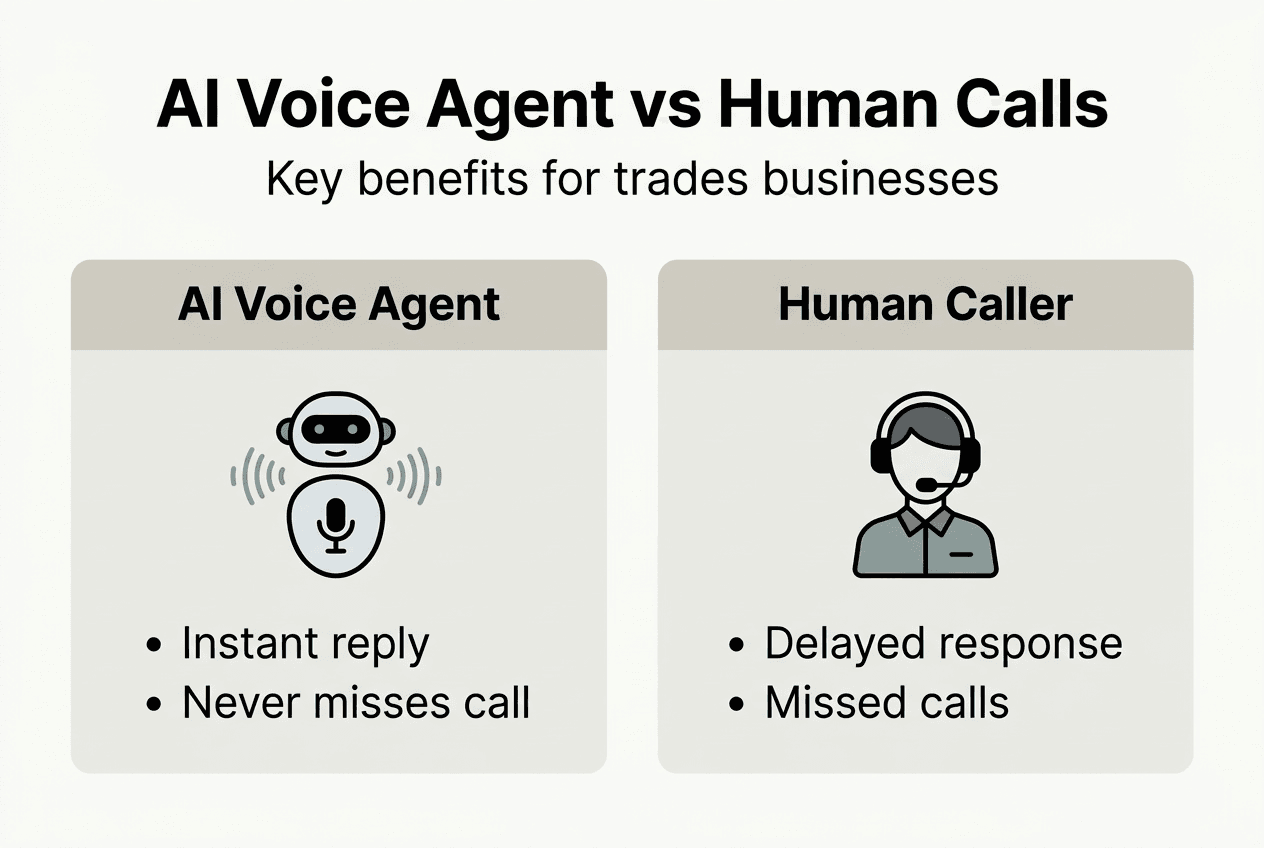
The ROI framework for AI voice agents extends beyond simple cost comparison. Successful implementations measure three dimensions: operational metrics like call answer rates and response times, financial metrics including revenue recovery and cost per lead, and experience metrics such as caller satisfaction and conversion rates. This comprehensive view reveals the full value of AI deployment.
Traditional cost-per-call thinking misses the bigger picture. The relevant metric is cost per outcome, measuring what each lead or booked appointment actually costs the business. AI voice agents excel here because they handle unlimited calls at fixed monthly costs whilst improving conversion rates. A human receptionist might answer 50 calls daily at significant salary cost, whilst an AI agent handles 200 calls at lower total expense and higher conversion efficiency.
| Parameter | Human Sales Staff | AI Voice Agent | Advantage |
|---|---|---|---|
| Annual cost | €65,000 to €98,000 | €9,700 to €16,700 | 80%+ savings |
| Availability | 40 hours weekly | 168 hours weekly | 4x coverage |
| Lead response time | Minutes to hours | Under 60 seconds | 95%+ faster |
| Conversion rate impact | Baseline | +40% improvement | Significant lift |
| Scalability | Limited by headcount | Unlimited calls | Infinite scale |
Key efficiency benefits include:
- Dramatic cost reduction versus human equivalents
- Consistent quality across all interactions
- Scalable capacity without proportional cost increases
- Measurable ROI through automation setup and tracking
- Freed human staff for high-value customer interactions
The shift from viewing AI as an expense to recognising it as a revenue generator changes the entire calculation. When an AI voice agent recovers €3,000+ monthly in previously lost revenue whilst costing under €1,400 monthly, the ROI becomes obvious. Trades businesses gain both cost savings and revenue growth simultaneously.
Implementing AI voice agents in your trades business: practical steps and best practices
Successful AI voice agent deployment follows a structured approach that maximises ROI whilst minimising disruption. These practical steps guide trades businesses through effective implementation:
- Evaluate your current call handling needs by tracking missed calls, peak volume times, and common enquiry types for at least two weeks
- Choose a vendor specialising in trades businesses who understands industry-specific requirements and Irish market conditions
- Define core call tasks the AI should handle, focusing initially on lead capture and emergency triage rather than complex technical support
- Select emergency triage as your priority feature, as starting with emergency calls delivers highest value and builds team confidence
- Plan integration with your existing phone system, CRM, and job management software to ensure seamless data flow
- Configure the AI with your business information, common questions, and appropriate responses that reflect your brand voice
- Train your team on receiving and acting on AI-generated call summaries efficiently
- Monitor performance metrics including answer rates, caller satisfaction, and conversion rates to identify improvement opportunities
- Adjust AI responses based on real-world caller interactions and feedback from your team
- Scale gradually by adding more call types and capabilities as confidence and ROI become clear
Best practices for trades-specific implementation include prioritising SMS summaries over email notifications, as tradespeople check texts more reliably whilst on job sites. Use simple appointment slot offers rather than complex calendar integrations that confuse callers and reduce booking completion rates. Focus AI deployment on emergency triage first, where the value is immediately obvious and measurable.
Measuring ROI requires tracking multiple dimensions simultaneously. Operational metrics include call answer rates, average response times, and percentage of calls successfully handled by AI. Financial metrics cover revenue recovered from previously missed calls, cost per lead, and overall profitability impact. Customer experience metrics track caller satisfaction, conversion rates, and feedback quality. This comprehensive measurement reveals the full business impact.
Common pitfalls to avoid include overcomplicated booking flows that frustrate callers, expecting AI to replace human judgement on complex technical decisions, and failing to train your team on effectively using AI-generated information. The AI should enhance human capabilities, not attempt to replicate expert tradesperson knowledge. Keep the implementation focused on what AI does best: consistent, immediate response and accurate information capture.
Pro Tip: Start small by focusing on your highest-impact feature, typically emergency triage, before expanding to other call types, ensuring early wins build team confidence and demonstrate clear ROI.
Successful implementation also requires attention to your AI readiness across systems, processes, and team capabilities. Ensure your phone system supports the necessary integrations, your CRM can receive and organise AI-captured data, and your team understands how to prioritise and respond to AI-generated leads. This preparation prevents technical obstacles from undermining an otherwise sound deployment.
Discover AI voice agent solutions tailored for Irish trades businesses
Apex Emerald AI specialises in AI voice agents and automation solutions designed specifically for Irish trades businesses. Our platform eliminates missed calls, qualifies leads automatically, and integrates seamlessly with your existing systems to boost efficiency and revenue. We understand the unique challenges facing plumbing, HVAC, and electrical businesses in Ireland, from managing emergency calls to maximising conversion rates during peak demand periods.
Our transparent pricing ensures you understand exactly what AI voice agent implementation costs, with no hidden fees or unexpected charges. We also offer comprehensive AI and automation audit services to assess your current readiness and identify the highest-value opportunities for AI deployment. Whether you're just beginning to explore AI voice agents or ready to implement a complete automation strategy, our team provides the expertise and support Irish trades businesses need to succeed. Explore our tailored solutions today and discover how AI voice agents can transform your lead generation and operational efficiency.
Frequently asked questions
What is an AI voice agent?
An AI voice agent is an intelligent automated phone system that answers calls, conducts natural conversations with customers, and captures essential information for businesses. Unlike basic voicemail, it actively engages callers, qualifies leads, and can book appointments or triage emergencies.
How much does an AI voice agent cost for a trades business?
AI voice agents typically cost between €9,700 and €16,700 annually including subscription fees and setup, representing over 80% savings compared to hiring human reception or sales staff. Monthly costs usually range from €800 to €1,400 depending on call volume and features required.
How long does it take to implement an AI voice agent?
Most trades businesses can deploy a basic AI voice agent within two to four weeks, including system integration, configuration, and team training. Starting with a focused feature like emergency triage accelerates implementation and delivers immediate value whilst building towards more comprehensive capabilities.
Are AI voice agents secure for handling customer data?
Reputable AI voice agent platforms use enterprise-grade security including encryption, secure data storage, and compliance with European data protection regulations. Customer information captured during calls receives the same protection as data in your CRM or job management systems.
Can AI voice agents replace human staff in trades businesses?
AI voice agents complement rather than replace human staff, handling routine enquiries and lead capture so tradespeople focus on skilled work and complex customer interactions. The technology excels at consistent, immediate response whilst humans provide expertise, judgement, and relationship building that AI cannot replicate.
What ROI can trades businesses expect from AI voice agents?
Typical ROI includes €3,000+ monthly revenue recovery from converted missed calls, 40% improvement in lead conversion rates, and elimination of 40 to 60% missed call rates. Most businesses see positive ROI within 60 to 90 days through combined revenue gains and operational cost savings.