
Running a plumbing, HVAC, or electrical business in Ireland means juggling service calls, scheduling conflicts, late invoices, and missed follow-ups that cost you real revenue. Many trade business owners spend more time on administrative tasks than growing their operations. AI-driven automation offers a practical solution to streamline scheduling, dispatch, invoicing, and customer communication whilst measurably increasing revenue. This guide walks you through implementing automation step-by-step, from identifying your biggest operational bottlenecks to deploying AI voice agents and scaling systems that deliver ROI within 90 days.
Table of Contents
- Key Takeaways
- Identifying automation needs in your trade business
- Setting up AI voice agents and communication automation
- Leveraging AI for follow-ups, reviews, and revenue growth
- Implementing and scaling AI automation: a 90-day roadmap
- Discover AI automation solutions tailored for Irish trades
- Frequently asked questions
Key Takeaways
| Point | Details |
|---|---|
| Automate core operations | Automating scheduling, dispatching, invoicing and follow ups reduces admin time and boosts revenue with measurable ROI. |
| Start with simple tools | Begin by automating your most time consuming task first, as quick wins build momentum and demonstrate value to your team. |
| AI voice agents | Provide round the clock availability to answer calls, qualify leads, book appointments and route emergencies, reducing missed opportunities. |
| Irish SME support | The Irish AI strategy supports SME adoption with compliance guidance and funding aids. |
| Measure ROI early | Track weekly time savings and revenue gains to guide scaling decisions and confirm ROI within ninety days. |
Identifying automation needs in your trade business
Every plumbing, HVAC, and electrical business faces unique operational challenges, but certain inefficiencies appear consistently across the sector. Manual scheduling creates double-bookings and gaps in your calendar. Dispatch coordination requires constant phone calls and text messages. Invoicing delays stretch payment cycles and hurt cash flow. Missed follow-ups mean lost leads that never convert into paying customers.
The tasks that consume most of your administrative time are precisely where automation delivers the greatest impact. Prioritising scheduling, dispatching, invoicing, and customer follow-ups using tools like Jobber, ServiceTitan, Housecall Pro, and n8n integrations addresses these pain points directly. These platforms connect with your existing systems to automate repetitive workflows without requiring complete operational overhauls.
Start by tracking where your team spends time each week. Which tasks require multiple manual steps? Where do errors occur most frequently? Which processes cause customer frustration? Your answers reveal automation priorities that will deliver immediate relief and measurable improvements.
Pro Tip: Begin with automating your most time-consuming administrative task first, even if it's not the most complex. Quick wins build momentum and demonstrate value to your team, making larger automation projects easier to implement.
Consider the typical service call workflow. A customer rings, you check availability, schedule the appointment, send confirmation, dispatch the technician, complete the work, generate an invoice, and follow up for payment. Each step involves manual coordination that automation can handle seamlessly. Modern tools integrate these functions into unified systems that reduce errors and accelerate service delivery.
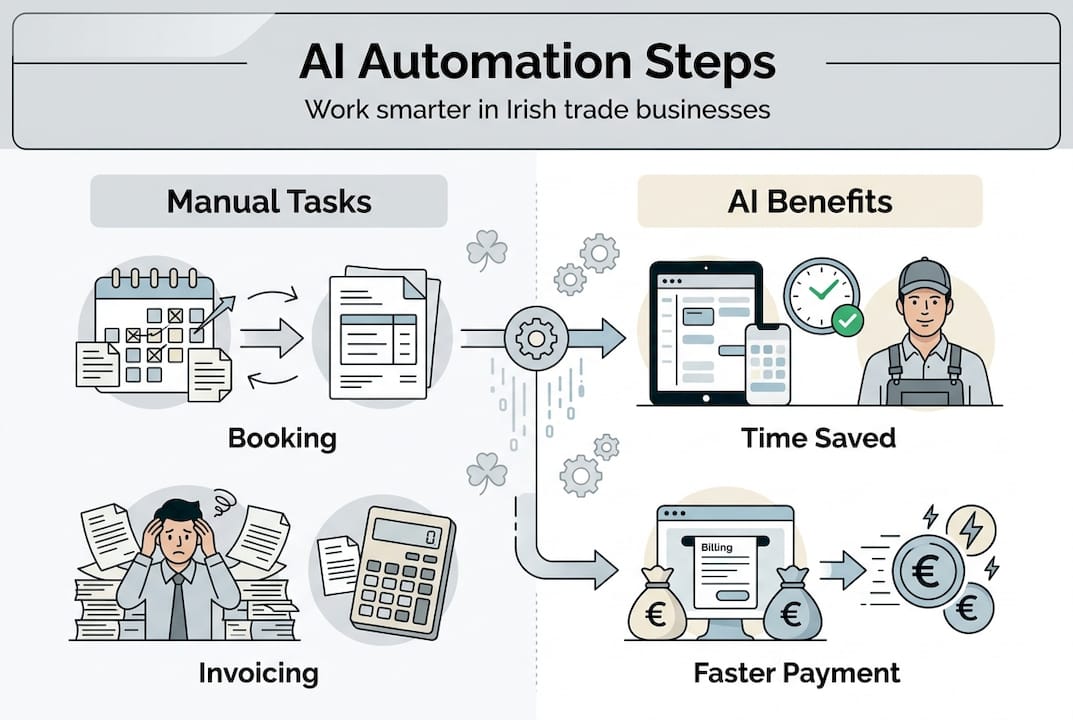
For Irish trade businesses, choosing automation tools that align with local market needs matters. Look for platforms supporting euro currency, Irish phone formats, and GDPR compliance requirements. Many international solutions now offer regional configurations specifically designed for the Irish market, ensuring smooth integration with your existing business practices.
The goal isn't replacing your expertise with technology. Automation handles repetitive administrative work so you can focus on delivering quality service and growing your business. Understanding AI for trade business growth helps you identify which processes benefit most from technological support whilst maintaining the personal touch that differentiates your brand.
Setting up AI voice agents and communication automation
AI voice agents transform how trade businesses handle customer communication by providing 24/7 availability without hiring additional staff. These systems answer calls, qualify leads, book appointments, and route emergencies to on-call technicians. AI voice agents handle after-hours calls, qualify leads, book appointments, and route emergencies, preventing missed opportunities that cost Irish trades thousands in lost revenue annually.
Implementing AI voice agents follows a straightforward process:
- Assess your current call volume and identify peak times when you miss calls due to staff availability
- Choose a provider offering Irish English voice options and GDPR-compliant data handling
- Integrate the system with your existing calendar and job management software
- Configure call routing rules for different scenarios, including emergency protocols
- Train your team on monitoring AI interactions and handling escalated calls
- Test the system thoroughly before full deployment, using real scenarios your business encounters
The technology behind AI voice agents has matured significantly. Modern systems understand context, handle interruptions naturally, and adapt responses based on customer needs. They recognise urgency indicators and route emergency calls to human staff immediately whilst handling routine enquiries autonomously.
Pro Tip: Configure your AI voice agent to collect specific qualifying information relevant to your trade. For plumbers, this might include property type and problem severity. For electricians, whether power is completely out or partially functioning. This data helps you prioritise jobs and prepare appropriately.
GDPR compliance remains essential when implementing AI communication systems in Ireland. Ensure your chosen platform stores customer data within EU servers, provides transparent data usage policies, and allows customers to request data deletion. Configure your AI to inform callers that conversations may be recorded and explain how their information will be used.
"Implementing AI call handling saved our electrical business 10 hours weekly in administrative work. We capture every lead now, even during busy installation days, and our professional image improved dramatically because customers always reach someone knowledgeable."
Emergency call routing deserves special attention. Configure your system to recognise keywords indicating urgent situations and immediately connect those callers to your emergency contact. This ensures genuine emergencies receive human attention whilst routine enquiries benefit from AI efficiency.
The investment in understanding AI voice agents pays dividends through improved lead capture and customer satisfaction. Customers appreciate immediate responses, even outside business hours, and your team benefits from pre-qualified leads with relevant information already collected.
Leveraging AI for follow-ups, reviews, and revenue growth
Automated follow-up systems represent one of the highest-ROI automation opportunities for trade businesses. Automated SMS texting recovered 12-18% of cold leads, whilst AI texting increased HVAC sales by 22% and booked 56% of new leads. These numbers demonstrate the substantial revenue impact of systematic follow-up automation.
Customer follow-ups serve multiple purposes beyond immediate sales. They nurture leads who aren't ready to commit immediately, request reviews from satisfied customers, remind clients about maintenance schedules, and recover abandoned quotes. Manual follow-up processes fail because they require consistent effort that gets deprioritised during busy periods.
AI-driven follow-up systems operate continuously without supervision. They send personalised messages at optimal times, adjust messaging based on customer responses, and escalate engaged leads to your sales team. The technology tracks which messages generate responses and refines its approach over time.

| Metric | Before AI automation | After AI automation | Improvement |
|---|---|---|---|
| Cold lead recovery rate | 8% | 18% | +125% |
| New lead booking rate | 35% | 56% | +60% |
| Sales conversion | Baseline | +22% | +22% |
| Review request response | 12% | 34% | +183% |
Best practices for automated follow-ups include:
- Send initial follow-up within 5 minutes of enquiry for maximum engagement
- Space subsequent messages 2-3 days apart to avoid overwhelming recipients
- Personalise messages with customer name, specific service discussed, and relevant details
- Include clear calls-to-action with simple booking links or phone numbers
- Monitor response rates and adjust messaging based on what generates engagement
- Set automatic escalation to human staff when customers show buying signals
Timing matters significantly in follow-up effectiveness. Studies show response rates drop dramatically after the first hour following initial contact. Automated systems ensure immediate engagement whilst maintaining consistent follow-through over weeks or months as needed.
Review generation through automated requests builds your online reputation systematically. Configure your system to send review requests 24-48 hours after job completion, when customer satisfaction peaks. Include direct links to your preferred review platforms and make the process effortless.
The AI automation ROI in trades becomes evident quickly through improved conversion metrics and recovered revenue. Track lead response rates, booking conversions, and sales values before and after implementing automation to quantify your return on investment accurately.
SMS automation particularly suits trade businesses because text messages achieve 98% open rates compared to 20% for emails. Customers prefer text communication for service-related updates, making it the ideal channel for appointment confirmations, technician arrival notifications, and follow-up engagement.
Implementing and scaling AI automation: a 90-day roadmap
Successful AI automation requires phased implementation that allows you to validate results before expanding investment. 90-day implementation schedules start with AI voice handling after-hours calls in week one, activate follow-ups in week two, integrate operational AI by month two, and measure ROI before scaling further.
Your implementation roadmap should follow this structure:
- Days 1-7: Deploy AI voice agent for after-hours calls only, maintaining existing daytime processes
- Days 8-14: Activate automated SMS follow-ups for new leads and quotes
- Days 15-30: Integrate AI with your job management system for automated scheduling confirmations
- Days 31-60: Expand AI voice agent to handle daytime overflow calls during peak periods
- Days 61-75: Implement automated review requests and maintenance reminders
- Days 76-90: Analyse comprehensive data, calculate ROI, and plan next automation phase
This phased approach minimises disruption whilst building confidence in AI systems. Your team adapts gradually, customers experience consistent service quality, and you gather data proving automation value before committing to larger investments.
Measuring ROI at each phase provides crucial validation. Track lead capture rates, booking conversions, time saved on administrative tasks, and revenue generated from recovered leads. Compare these metrics against your automation costs to calculate payback periods and justify expansion.
| Approach | Implementation speed | Risk level | Staff adaptation | ROI visibility |
|---|---|---|---|---|
| Phased 90-day | Gradual | Low | Excellent | Clear milestones |
| All-in immediate | Fast | High | Challenging | Delayed |
| Pilot single process | Very gradual | Very low | Easy | Limited scope |
| Department-by-department | Moderate | Moderate | Good | Segmented |
The phased approach outperforms all-in implementation because it allows course corrections based on real-world performance. You might discover that certain customer segments prefer human interaction for specific enquiry types, allowing you to refine AI routing rules before full deployment.
Staff training throughout the implementation process ensures smooth adoption. Explain how automation helps rather than threatens their roles. Show them time savings in administrative work that allows more focus on skilled trade tasks. Involve team members in configuring AI responses based on their customer service expertise.
Pro Tip: Celebrate automation wins with your team by sharing metrics showing reduced administrative burden and improved customer satisfaction. This builds enthusiasm for technology adoption and encourages staff to suggest additional automation opportunities.
Scaling decisions should be data-driven. If your AI voice agent handles 85% of after-hours calls successfully, expand to daytime overflow. If SMS follow-ups generate 20% conversion rates, invest in more sophisticated nurture sequences. Let results guide your automation expansion rather than implementing technology for its own sake.
The AI automation setup steps provide detailed guidance on technical integration, but the strategic approach matters more than specific tools. Focus on solving real operational problems, measure impact rigorously, and scale what works whilst abandoning what doesn't.
Discover AI automation solutions tailored for Irish trades
Apex Emerald AI specialises in delivering automation solutions designed specifically for Irish plumbing, HVAC, and electrical businesses. Our AI voice agents integrate seamlessly with popular job management systems used throughout Ireland, ensuring smooth implementation without disrupting your existing workflows.
Explore our AI voice agents and automation solutions to discover how we've helped trade businesses achieve measurable revenue growth within 90 days. Our AI implementation case studies showcase real-world results from Irish trades businesses, demonstrating the tangible benefits of strategic automation adoption. We offer transparent AI pricing that aligns with SME budgets whilst delivering rapid ROI through improved lead capture, operational efficiency, and customer satisfaction.
Frequently asked questions
How long does it take to see results from AI automation in trades?
Most trade businesses observe measurable improvements within 30-90 days after implementing key AI tools such as voice agents and automated follow-ups. Initial results often appear within the first week as missed calls decrease and lead response times improve. ROI depends on your initial automation scope and business size, with smaller operations sometimes seeing faster percentage gains whilst larger businesses achieve greater absolute revenue increases.
Is AI automation compliant with Irish and EU data protection laws?
AI solutions achieve GDPR compliance when properly implemented with EU-based data storage and transparent privacy policies. Ireland supports SME adoption through EU-aligned AI strategies and sandbox testing programmes that help businesses validate compliance before full deployment. Trade businesses should choose vendors adhering to these legal frameworks and verify that customer data remains within EU jurisdictions. Understanding AI voice agent compliance requirements protects your business whilst building customer trust.
Can AI automation replace skilled tradespeople?
AI improves administrative efficiency but cannot replace the skilled physical work that defines trade services. Labour demand for skilled trades increases alongside AI infrastructure growth, as automation handles paperwork whilst human expertise remains essential for quality installations, repairs, and customer relationships. Technology augments your capabilities rather than substituting for years of training and hands-on experience that customers value.
What's the typical cost of implementing AI automation for a small trade business?
Implementation costs vary based on scope and existing systems, but entry-level AI voice agents start around €100-200 monthly with setup fees of €500-1000. SMS automation platforms typically cost €50-150 monthly depending on message volume. Most Irish trade businesses recover these costs within 2-3 months through improved lead conversion and time savings. Phased implementation allows you to validate ROI before expanding investment.
Do customers prefer AI interaction or speaking with humans?
Customer preferences vary by situation and demographic. Research shows customers appreciate AI for immediate responses to routine enquiries, appointment booking, and after-hours availability. They prefer human interaction for complex problems, emergency situations, and detailed consultations. Effective automation balances both by using AI for initial contact and qualification whilst seamlessly transferring to human staff when appropriate. This hybrid approach delivers superior customer experience compared to either solution alone.