Most Irish trades business owners assume that adopting AI means buying a new software tool, switching on a chatbot, and waiting for the leads to roll in. That assumption is costing businesses real money. True AI value requires structured preparation across your entire operation, not just a new app. According to the Cisco AI Readiness Index, only 13% of organisations globally are fully prepared to deploy and scale AI. For Irish plumbers, HVAC contractors, and electricians, understanding what readiness actually means is the difference between wasted spend and measurable growth.
Table of Contents
- Defining AI readiness: what it really means for trades businesses
- The six pillars of AI readiness: Cisco framework explained
- Assessing AI maturity: where does your business stand?
- Practical steps to enhance AI readiness in Irish trades
- Ready to move from readiness to results?
- Frequently asked questions
Key Takeaways
| Point | Details |
|---|---|
| AI readiness is strategic | True AI adoption requires preparedness across multiple business pillars, not just technology upgrades. |
| Benchmark your maturity | Use established frameworks to assess where your trade business stands and identify growth opportunities. |
| Practical steps matter | Follow actionable steps in strategy, infrastructure, and talent to boost efficiency and revenue with AI. |
| Irish context is key | Tailor your readiness plan to Irish trades sector specifics for maximum impact. |
Defining AI readiness: what it really means for trades businesses
AI readiness is not a single checkbox. It is a structured measure of how prepared your business is to adopt, integrate, and scale AI solutions across every part of your operation. Think of it less like buying a new van and more like making sure your entire workshop, team, and scheduling system are set up before the van arrives.
For trades businesses in Ireland, this matters enormously. You might have the budget to invest in AI tools, but if your data is scattered across WhatsApp threads and paper job sheets, or your team has no idea how to use new systems, the investment will stall. As the Cisco AI Readiness Index defines it, AI readiness measures an organisation's preparedness across strategy, infrastructure, data, governance, talent, and culture.
Here is what genuine AI readiness covers for a trades business:
- Strategy: A clear plan for where AI fits into your business goals
- Infrastructure: The digital systems and connectivity to support AI tools
- Data: Clean, organised, and accessible records of jobs, customers, and outcomes
- Governance: Policies for how AI is used, monitored, and kept compliant
- Talent: Your team's ability and willingness to work alongside AI
- Culture: A business mindset that embraces continuous improvement through technology
"AI readiness is the measure of an organisation's preparedness across strategy, infrastructure, data, governance, talent, and culture." — Cisco AI Readiness Index 2025
If you want a deeper grounding in how AI consulting fits into this picture, the AI consulting guide for trades is a practical starting point. You can also use the Microsoft AI Readiness Wizard to get an initial benchmark of where your business currently sits.
The six pillars of AI readiness: Cisco framework explained
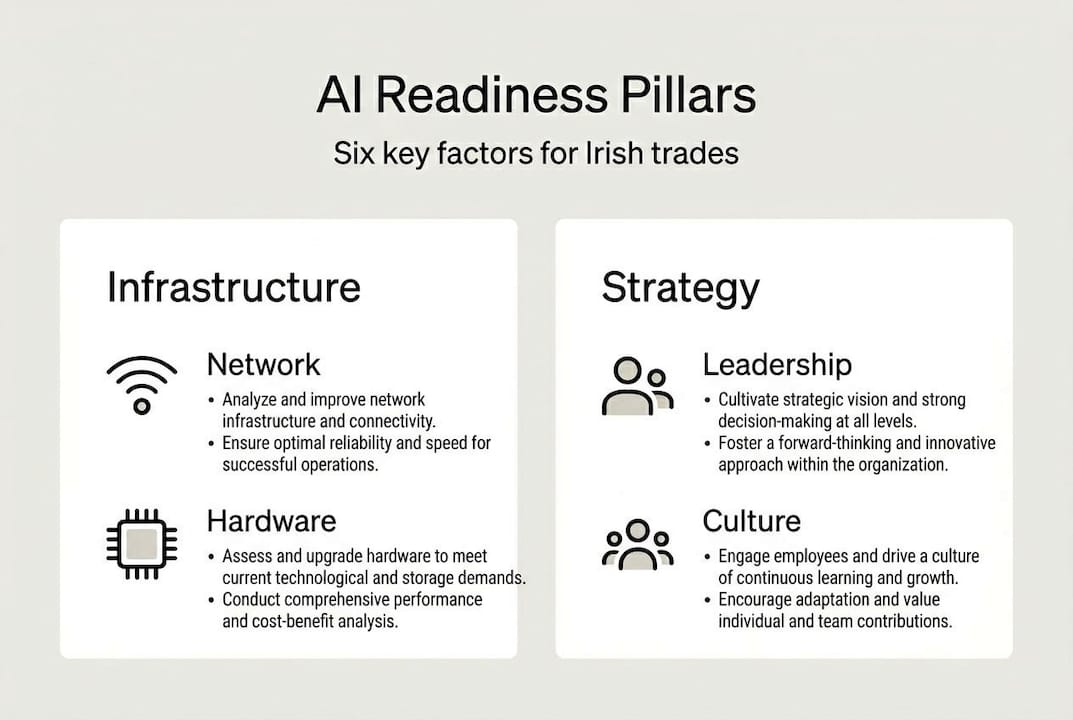
Now that we have defined AI readiness, let us explore the six building blocks that underpin successful AI business integration. The Cisco AI Readiness Index assesses organisations on six pillars: Strategy, Infrastructure, Data, Governance, Talent, and Culture. Each one plays a distinct role in whether your AI investment delivers results or gathers dust.

| Pillar | What it means for your trades business | Priority action |
|---|---|---|
| Strategy | AI goals aligned with revenue and efficiency targets | Define one AI use case to solve a real problem |
| Infrastructure | Cloud systems, broadband, and job management software | Audit your current digital tools and connectivity |
| Data | Quality and accessibility of customer and job records | Centralise records into one job management system |
| Governance | Rules for AI use, data privacy, and compliance | Draft a simple AI usage policy for your team |
| Talent | Staff skills and confidence with digital tools | Run a short training session on your chosen AI tool |
| Culture | Openness to change and technology-led improvement | Share early AI wins with your team to build momentum |
Cisco categorises businesses into four maturity groups based on how well they perform across these pillars:
- Pacesetters (13%): Fully prepared, actively scaling AI with measurable results
- Chasers (27%): Strong foundations but gaps in one or two pillars
- Followers (40%): Partial readiness, inconsistent adoption across the business
- Laggards (17%): Early stage, significant gaps across most pillars
The striking reality is that only 13% of organisations globally sit in the Pacesetter category. For Irish trades businesses, this means the competitive window is wide open. Getting your infrastructure right is a foundational step, and the guide on AI infrastructure for trades breaks this down in practical terms. Once your foundations are solid, reviewing AI deployment best practices will help you avoid the most common rollout mistakes.
Assessing AI maturity: where does your business stand?
Having explored the pillars, it is time to find out how your own business stacks up and where you can improve. Both Cisco and Microsoft offer structured frameworks for this. Microsoft's maturity model ranges from early stage through to leader, evaluating five sequential drivers including strategy, technology, and people. Cisco's model, as noted above, places organisations into Pacesetters, Chasers, Followers, and Laggards based on cross-pillar performance.
Here is a practical way to gauge where you sit right now:
- You are likely a Laggard if: Jobs are tracked on paper or WhatsApp, you have no CRM, and your team has never used an AI tool
- You are likely a Follower if: You use some digital tools but they do not connect to each other, and AI adoption is ad hoc
- You are likely a Chaser if: You have a job management system, some automation in place, but no clear AI strategy or governance
- You are likely a Pacesetter if: AI tools are integrated across lead capture, scheduling, and customer communication, with measurable results tracked regularly
Pro Tip: Do not try to fix every pillar at once. Cisco's research shows that businesses which focus on their weakest pillar first make faster progress up the maturity ladder than those who spread effort evenly.
For trades businesses ready to move from Follower to Chaser, the AI automation setup steps guide offers a clear sequence to follow. If your primary goal is revenue growth, the AI automation guide for revenue connects readiness improvements directly to income outcomes.
Practical steps to enhance AI readiness in Irish trades
With your current maturity in mind, here is how you can actively elevate your readiness and unlock tangible results. The Microsoft AI Readiness Wizard highlights that readiness improvement follows sequential drivers, meaning each step you take builds the foundation for the next.
-
Audit your current tools. List every digital system you use, from invoicing software to WhatsApp groups. Identify where data lives and whether it is accessible. This single step reveals your biggest infrastructure and data gaps immediately.
-
Centralise your customer and job data. Move records into a single job management platform such as Jobber, ServiceM8, or similar. Clean data is the fuel that makes AI tools work. Without it, even the best AI system will produce poor results.
-
Define one AI use case. Do not try to automate everything at once. Pick one high-value problem, such as missed calls after hours, slow lead response times, or manual appointment booking. Solve that one problem well before expanding.
-
Train your team on the chosen tool. A 30-minute walkthrough session is often enough to get buy-in. Show your team how the tool saves them time personally, and adoption resistance drops significantly.
-
Set simple governance rules. Decide how customer data is stored, who can access AI outputs, and how you will review AI performance monthly. This does not need to be complex, but it does need to exist.
-
Measure and iterate. Track one or two key metrics from day one, such as lead response time or booking conversion rate. Use these numbers to justify further investment and identify the next improvement.
Common pitfalls to avoid include purchasing AI tools before your data is organised, skipping team training to save time, and failing to assign ownership of AI performance to a specific person in your business.
Pro Tip: Irish trades businesses that start with AI-powered call handling and lead capture tend to see the fastest ROI because these tools address the single biggest revenue leak in most trades operations: unanswered calls and slow follow-up.
For a broader view of what tools are available, the guide on AI tools for trade managers covers the landscape well. If you run a plumbing business specifically, AI tools for plumbers gives you sector-specific recommendations. To understand the wider commercial opportunity, AI growth opportunities for Irish trades is worth reading alongside this article. And if customer service is your primary focus, the piece on AI in trade customer service shows exactly how AI changes the client experience.
Ready to move from readiness to results?
Understanding AI readiness is the first step. Acting on it is where the revenue gains actually happen. At Apex Emerald AI, we work specifically with Irish trades businesses, including plumbers, HVAC contractors, and electricians, to assess your current readiness across all six pillars and build a deployment plan that delivers measurable ROI within 90 days.
Our platform combines AI voice agents, omnichannel automation, and conversion-optimised websites into one integrated system built for the trades industry. We do not sell generic software. We build infrastructure that fits how your business actually operates, from after-hours call handling to automated appointment booking and lead qualification. If you are ready to stop leaving revenue on the table and start scaling with AI, visit Apex Emerald AI to book a technical audit and find out exactly where your business stands today.
Frequently asked questions
What is AI readiness and why is it crucial for Irish trades businesses?
AI readiness measures your business's ability to adopt and scale AI solutions across strategy, data, infrastructure, and culture, ensuring you avoid wasted investment and unlock genuine operational gains. Without it, even well-funded AI projects stall before delivering results.
How can I assess my business's AI maturity?
You can benchmark against the Cisco maturity categories (Pacesetters, Chasers, Followers, Laggards) or use the Microsoft AI Readiness Wizard to evaluate five sequential drivers and identify your specific gaps.
What are the practical steps to improve AI readiness?
Start by auditing your current tools and centralising your data, then define one AI use case, train your team, and set simple governance rules. Strategy, technology, and data are the three pillars that move the needle fastest for most trades businesses.
Can small Irish trades businesses become pacesetters in AI adoption?
Absolutely. Cisco identifies Pacesetters as fully prepared organisations regardless of size, meaning a two-person plumbing firm with clean data, a clear strategy, and the right tools can outperform a much larger competitor that has not addressed its readiness gaps.