TL;DR:
- AI is transforming small Irish trade businesses by improving scheduling, dispatch, and customer communication.
- It enables proactive maintenance, route optimization, and after-hours call handling without increasing headcount.
- Challenges include data quality and staff trust, but proper implementation enhances efficiency and service.
AI is not just for tech giants with deep pockets and dedicated IT departments. For Irish plumbers, HVAC engineers, and electricians, it is already reshaping how jobs get booked, dispatched, and completed. From capturing emergency calls at midnight to routing technicians more efficiently across county roads, AI is delivering measurable gains for small and medium trade businesses right now. This article breaks down what AI actually does in field service, how to use it well, and what pitfalls to avoid so you can grow revenue without burning out your team.
Table of Contents
- What AI means for field service in Irish trades
- How AI-powered tools are transforming field service operations
- Addressing challenges: Data, trust, and technician shortages
- Getting started: Best practices for AI adoption in trades
- A fresh perspective: Why AI success in field service starts with people, not just tech
- Take the next step: AI solutions for Irish trades
- Frequently asked questions
Key Takeaways
| Point | Details |
|---|---|
| AI drives efficiency | Automated scheduling and dispatch slash planning time and enable trade businesses to serve more customers daily. |
| Start with people | Successful adoption depends more on team engagement and process change than on technology itself. |
| Overcome practical challenges | Prioritise clean data and staff training to address the common pitfalls of poor recommendations and low trust. |
| Solutions scale for all trades | AI tools now fit SME trade businesses in Ireland, making advanced operations accessible without huge investment. |
What AI means for field service in Irish trades
AI, in plain terms, means software that learns from data and makes decisions or recommendations without needing a human to do it manually every time. In field service, that translates to tools that handle scheduling, dispatch, customer communication, and even fault prediction automatically. For an Irish plumbing or HVAC business, this is not abstract. It means fewer missed calls, faster job assignment, and less time spent on admin that used to eat into your evenings.
Field service management (FSM) refers to the systems that coordinate your workforce, jobs, parts, and customers. AI layers on top of FSM to make those systems smarter. Instead of manually checking who is available and closest to a job, the system does it instantly. Instead of a customer calling back three times to confirm an appointment, an AI voice agent handles it automatically.
Here are the core AI features now available to Irish trade businesses:
- Smart scheduling and dispatch: Matches the right technician to the right job based on skills, location, and availability
- Route optimisation: Reduces drive time between jobs so more work gets done each day
- After-hours AI receptionist: Captures calls, logs jobs, and books appointments outside business hours
- Predictive maintenance: Analyses equipment data to flag issues before they become callouts
- AR and VR support: Lets remote experts guide on-site technicians through complex repairs
- Automated job updates: Sends customers real-time status messages without manual input
As one industry analysis puts it, AI-powered scheduling, real-time dispatching, predictive maintenance and AR/VR are now accessible to businesses of all sizes, not just large enterprises.
"AI shifts field service from reactive to proactive. For trade owners facing technician shortages and aiming for efficiency and revenue growth, this is the single biggest operational lever available."
The critical insight here is that AI decouples labour from value. You do not need to hire another dispatcher or admin person to handle more volume. The system scales with demand. For Irish trades grappling with a well-documented skills shortage, that is a genuine competitive advantage. You can read more about practical applications in our AI automation guide for Irish trade businesses.
How AI-powered tools are transforming field service operations
The numbers tell a compelling story. AI scheduling cuts dispatch planning from 30 minutes to one click, and route optimisation reduces drive time so technicians can fit more jobs into a single day. For a business running five vans, that could mean one or two additional jobs completed daily across the fleet.
Here is a direct comparison of traditional versus AI-powered field service operations:
| Operation | Traditional approach | AI-powered approach |
|---|---|---|
| Dispatch planning | 20 to 30 minutes per day | Automated in seconds |
| Job completion rate | Limited by manual scheduling | Increased by 15 to 25% |
| Customer response time | Business hours only | 24/7 via AI voice agent |
| Route planning | Manual map checks | Real-time optimised routing |
| After-hours lead capture | Missed or voicemail | Logged and booked automatically |
For scalable FSM solutions, platforms like IFS and ServiceNow are already being used by Irish engineering and trades firms to manage labour shortages and complex job pipelines. These are not tools reserved for multinationals.
Here is how a typical AI-powered job assignment works from enquiry to completion:
- Customer calls or submits a request online, outside business hours
- AI voice agent captures the details, qualifies the job type, and logs it
- Scheduling algorithm assigns the best available technician based on skill and location
- Technician receives job details on their mobile app with optimised routing
- Customer receives automated confirmation and arrival window by text
- On completion, the system triggers invoicing and a follow-up satisfaction message
Pro Tip: Do not try to automate everything at once. Pick one workflow, such as after-hours call capture or morning dispatch, and run a four-week pilot. Measure the time saved and jobs gained. A small, clear win builds the confidence to scale further.
For a deeper look at how this plays out in practice, our guide on AI in job management covers the specifics, and our roundup of top AI tools for trades in 2026 is worth bookmarking.
Addressing challenges: Data, trust, and technician shortages
The gains are clear, but what challenges await? Let us tackle the practical issues you need to plan for before committing to AI adoption.
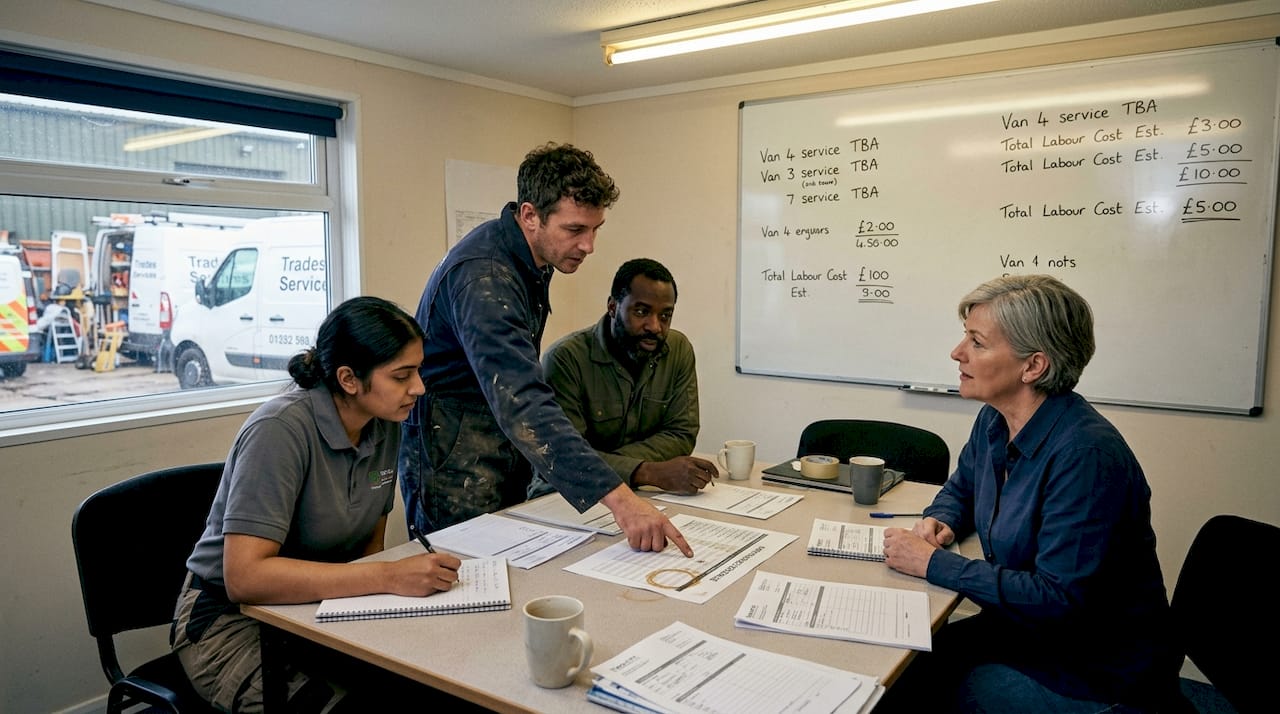
The most common obstacles Irish trade businesses face when implementing AI are not technical. They are operational and human. Poor data quality leads to bad recommendations, patchy rural connectivity can disrupt real-time tools, and agentic AI systems require a level of explainability and trust that takes time to build.
Here is a breakdown of the key challenges and practical solutions:
- Poor or incomplete data: Clean your job history and customer records before going live. Garbage in, garbage out applies here more than anywhere else
- Rural connectivity gaps: Use edge computing solutions that process data locally on the device, not just in the cloud
- Staff resistance: Involve your team early. Show them how AI removes the tasks they dislike most, not their jobs
- High-stakes misdiagnosis risk: Ensure AI recommendations are always reviewed by a qualified technician for complex or safety-critical jobs
- Contractor integration: AI systems need to account for subcontractors, not just employed staff, to manage capacity accurately
- Customer trust: Be transparent that AI handles initial contact. Most customers care about speed and accuracy, not whether a human or AI answered first
"Technician shortages require contractor integration into AI systems. Agentic AI can operate autonomously, but it requires explainability and trust from both leadership and frontline teams."
Building that trust internally is often the hardest part. Change management is not a soft skill. It is the difference between a tool that gets used and one that collects dust. Our guide on AI deployment best practices goes into detail on this, and our article on AI for customer service covers the customer-facing side.
Pro Tip: Share early wins with your team publicly. If AI saved your dispatcher two hours on a Monday morning, say so at the next team meeting. Small visible improvements build buy-in faster than any training session.
Getting started: Best practices for AI adoption in trades
Once you know the possible pitfalls, the right roadmap makes adoption straightforward. The most important framework to understand is the 10-20-70 rule: 10% of your AI investment goes into technology, 20% into data and integration, and 70% into people and process change. Most businesses get this backwards and wonder why their tools are not delivering results.
Here is a sample framework for piloting AI adoption in an Irish trade business:
| Step | Owner | Resource needed | Key metric |
|---|---|---|---|
| Define pilot scope | Business owner | 2 hours planning | Workflow selected |
| Clean existing data | Admin lead | 1 to 2 days | Data accuracy rate |
| Select AI tool | Owner and IT | Vendor demos | Feature fit score |
| Train team | Operations manager | Half-day session | Staff confidence score |
| Run four-week pilot | All staff | Live operations | Time saved per day |
| Review and scale | Owner | Monthly review | Revenue per technician |
Here is a six-step adoption roadmap to follow:
- Secure leadership sponsorship so the initiative has authority and budget
- Build a unified data layer by consolidating customer, job, and technician records
- Select one high-impact workflow to pilot, such as scheduling or after-hours capture
- Train your team on the tool with a focus on what it does for them, not to them
- Measure outcomes weekly against a clear baseline from before the pilot
- Scale to additional workflows once the first pilot shows consistent results
Ethics matter here too. Use AI tools that can explain their recommendations in plain language. If a system cannot tell you why it assigned a particular technician to a job, that is a problem. Responsible data use and transparent AI are not optional extras. They protect your business and your customers. For more on scaling this approach, see our article on AI automation for customer gains.
A fresh perspective: Why AI success in field service starts with people, not just tech
Here is an uncomfortable truth most AI vendors will not tell you: the majority of AI implementations that fail do not fail because the technology was wrong. They fail because the people and processes around the technology were not ready.
Irish trade businesses are relationship-driven. Your reputation is built on whether you showed up on time, communicated clearly, and fixed the problem properly. AI can support all three of those things, but only if your team understands and trusts it. The businesses seeing the strongest results from AI are not the ones with the most sophisticated tools. They are the ones that upskilled their staff, encouraged curiosity about new ways of working, and focused first on customer-facing wins that everyone could see.
Real value emerges when AI reduces the admin burden and frees your technicians to do what they are actually good at. That is where the human touch in service delivery becomes stronger, not weaker. If you want to see what that looks like in practice, our article on AI efficiency in Irish trades is a good place to start.
Take the next step: AI solutions for Irish trades
The results covered in this article are not theoretical. Irish trade businesses are already using AI to capture more leads, dispatch faster, and deliver better customer experiences without adding headcount.
At Apex Emerald AI, we build AI voice agents and automation specifically for plumbing, HVAC, and electrical businesses in Ireland. Our tools handle after-hours calls, qualify leads, book appointments, and integrate with the job management systems you already use. We offer measurable ROI within 90 days, and our transparent AI pricing means no surprises. If you are ready to move from reading about AI to running it in your business, book a demo and see what it does for your numbers.
Frequently asked questions
How does AI handle after-hours and emergency customer calls for trades?
AI voice receptionists can capture after-hours and emergency calls, log jobs, and ensure follow-up without human staff present. AI receptionists boost engagement by making sure no call or lead goes unanswered, regardless of the time.
Is AI suitable for small and medium Irish trade businesses, or just large companies?
AI field service tools scale to all sizes, and many Irish trade SMEs already use AI for scheduling, workflow, and customer engagement. Scalable FSM platforms like IFS and ServiceNow are designed to support businesses facing labour shortages at any scale.
What is the biggest challenge with implementing AI in field service?
The main hurdles are poor data quality and staff reluctance, both of which require good data practices and early team engagement. Poor data quality leads directly to bad AI recommendations, so clean records are the foundation of any successful rollout.
Can AI help with technician shortages in Ireland?
AI can automate admin tasks and enable contractor integration, maximising available technician capacity for trade businesses. Agentic AI for autonomy means your existing team handles more volume without additional hires.