
TL;DR:
- Irish trade businesses can use affordable AI tools like chatbots and knowledge search to improve efficiency.
- Proper governance, continuous training, and aligning AI with business goals are essential for success.
- Starting small, measuring KPIs, and following a structured deployment plan ensures ROI and compliance.
Many Irish trade business owners assume AI belongs to global tech giants with unlimited budgets. That assumption is costing them real money. AI voice agents, automated customer workflows, and intelligent knowledge tools are now accessible to plumbing, HVAC, and electrical businesses across Ireland, regardless of headcount or technical expertise. The shift is not about replacing your team. It is about giving them leverage. This guide walks you through how enterprise AI works in practice, what infrastructure you actually need, and how to measure returns, so you can move from curiosity to confident deployment.
Table of Contents
- What makes enterprise AI practical for Irish trades?
- How operational automation and customer AI agents work
- Building enterprise-ready AI: Infrastructure, safety and orchestration
- ROI, metrics and the implementation playbook
- A practical perspective: What most Irish trade businesses miss about AI
- Connect with trusted AI solutions for Irish trades
- Frequently asked questions
Key Takeaways
| Point | Details |
|---|---|
| Start with simple automation | Chatbots and knowledge search deliver quick wins and reduce manual work with minimal risk. |
| Build modular and safe | Enterprise AI needs robust infrastructure, guardrails, and ongoing task evaluation for best results. |
| Measure and comply | Irish trades should track key metrics and follow the EU AI Act for secure, compliant growth. |
| Iterate for efficiency | Continuous improvement beats static benchmarks; manage AI agents like digital staff and keep humans involved. |
What makes enterprise AI practical for Irish trades?
Having set the context, let us clarify what enterprise AI actually means for Irish trade businesses. The word "enterprise" puts a lot of people off. It sounds expensive and complicated. In practice, enterprise AI simply means AI that is governed, integrated, and managed with the same rigour you would apply to a skilled employee, not just installed and forgotten.
The Irish AI business outlook shows that AI adoption in Ireland enhances operational efficiency and customer experience, but faces real barriers including talent shortages and data security concerns. The businesses that succeed are the ones that invest in robust governance and strategic alignment from the start.
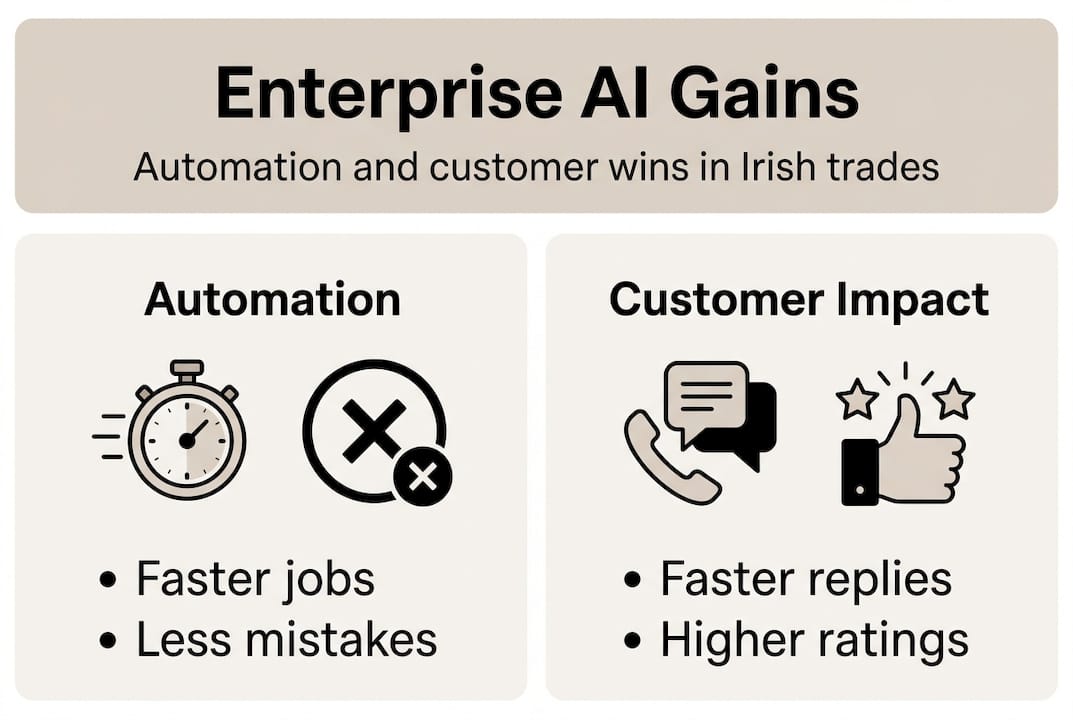
Think of it this way: a chatbot with no oversight is like hiring a new apprentice and never training them. You get inconsistent results and frustrated customers. But a well-governed AI agent, trained on your service catalogue and integrated with your job management system, behaves more like a reliable senior operator.
Here are the core areas where Irish trade businesses are already seeing measurable gains:
- Customer enquiry handling: Automated agents answer calls and messages 24/7, qualifying leads before your team gets involved
- Appointment scheduling: AI books jobs directly into your calendar without manual back-and-forth
- Knowledge retrieval: Technicians in the field can query internal documents and get precise answers instantly
- Invoice and job management: Automation reduces admin time and human error across billing workflows
The smartest approach is to start with trade efficiency with AI in high-volume, low-risk areas first. Chatbots and automated knowledge search are ideal entry points because they deliver fast results without touching your core operational systems.
"The businesses achieving the strongest ROI are not those with the biggest AI budgets. They are the ones that treat AI as a managed capability, align it tightly with business goals, and build governance structures before scaling."
For Irish trades, boosting revenue with AI starts with picking the right first use case and measuring it properly, not trying to automate everything at once.
How operational automation and customer AI agents work
With the basics in place, it is time to look at how practical automation and customer agents deliver measurable results. Not all AI agents are the same, and understanding the differences will help you choose the right tool for the right job.
AI automation case studies confirm that businesses starting with chatbots for customer support can deflect 30 to 60% of support tickets, while retrieval-augmented generation (RAG) tools, which search and return answers from your internal knowledge base, achieve 90 to 95% precision.

Here is how the three main types of AI agents compare:
| Agent type | Best use case | Complexity | Speed to deploy |
|---|---|---|---|
| Chatbot | FAQ handling, lead capture | Low | 1 to 2 weeks |
| RAG knowledge agent | Field support, internal search | Medium | 2 to 4 weeks |
| Autonomous workflow agent | End-to-end job booking, billing | High | 4 to 8 weeks |
For most Irish trade businesses, the practical sequence looks like this:
- Audit your highest-volume customer touchpoints (calls, web enquiries, repeat questions)
- Deploy a chatbot to handle the top 10 to 15 recurring questions
- Add a RAG agent to give your team instant access to product specs, compliance documents, and service guides
- Layer in autonomous agents once the simpler tools are stable and delivering consistent results
Following AI deployment best practices at each stage prevents the most common failure: scaling complexity before you have the basics working reliably.
Pro Tip: Focus on the "jobs to be done" rather than trying to automate entire roles. Ask yourself, "What specific task takes the most time and produces the most friction?" Automate that first. You will see returns faster and build confidence across your team.
Building enterprise-ready AI: Infrastructure, safety and orchestration
Understanding the use cases, the next step is knowing what is required technically and how to build with safety at the centre. You do not need a data science team to get this right, but you do need to understand the building blocks.
AI architecture insights show that effective AI agents require a modular setup: a large language model (LLM) for generating responses, a vector store such as FAISS for storing and retrieving your knowledge base, APIs to connect with your existing tools, and guardrails to prevent unsafe or inaccurate outputs. Orchestration platforms like AWS Step Functions can coordinate these components and reduce manual effort by 50 to 80%.
Here is a practical breakdown of the infrastructure decisions you will face:
| Component | Options | Trade-off |
|---|---|---|
| Model size | 7B to 70B parameters | Larger = more accurate, slower, costlier |
| Latency | Edge vs cloud hosted | Edge = faster, cloud = more flexible |
| Orchestration | AWS Step Functions, LangChain | Complexity vs control |
| Guardrails | Content filters, PII detection | Safety vs speed |
The safety layer is not optional. Key risks to address include:
- Hallucinations: The AI generates plausible but incorrect answers, which in a trade context could mean wrong product specs or incorrect compliance advice
- PII exposure: Customer data, addresses, and payment details must be handled within GDPR-compliant boundaries
- Task drift: Agents that are not scoped properly start attempting tasks outside their design, creating unpredictable behaviour
The AI infrastructure overview for trade businesses does not need to be complex at the start. A well-configured chatbot with basic guardrails and a clean knowledge base will outperform a sophisticated but poorly governed system every time.
Pro Tip: Start with what we call "boring workflows", repetitive, predictable tasks with clear inputs and outputs. These are easiest to evaluate and least likely to cause problems. Review the setup steps for trade businesses before committing to any platform.
ROI, metrics and the implementation playbook
Building infrastructure is only part of the equation; tracking impact and following a proven playbook ensure you stay compliant and reap ROI. Here is the sequence that works for Irish trade businesses.
The implementation playbook follows a clear structure:
- Phase 1 (weeks 1 to 2): Assess your highest-volume enquiry types and map current handling time
- Phase 2: Select a vendor aligned to your job management system and data environment
- Phase 3: Prepare your knowledge base, curate FAQs, and define human handoff triggers
- Phase 4: Configure the agent, test edge cases, and set escalation rules
- Phase 5: Pilot with a subset of real traffic, measure against KPIs, then launch
The KPIs that matter most are ticket containment rate (target 30 to 50%), customer satisfaction score (CSAT), first contact resolution (FCR), and average handling time (AHT) reduction. Track these weekly during the first 90 days.
| KPI | Baseline target | Strong result |
|---|---|---|
| Ticket containment | 30% | 50%+ |
| CSAT score | Maintained | Improved by 10%+ |
| AHT reduction | 15% | 30%+ |
| FCR rate | 60% | 80%+ |
On compliance, Irish trade businesses must follow the EU AI Act, which takes a risk-based approach. Systems are classified as unacceptable, high, or minimal risk, with phased obligations running from 2024 through 2027. For most trade automation tools, you will fall into the minimal risk category, but customer-facing agents that influence decisions may require additional documentation.
"Organisations with CEO-led AI transformation programmes and tailored generative AI metrics are achieving two to three times the ROI of those treating AI as an IT project, typically within two to four years."
For driving profits with AI, the discipline of measuring AI ROI from day one is what separates the businesses that scale from those that stall.
A practical perspective: What most Irish trade businesses miss about AI
Now let us step back and take an honest look at what really works and what most businesses get wrong.
The biggest mistake we see is treating AI like traditional software: install it, configure it once, and expect it to run indefinitely without attention. That mindset produces poor results. AI agents need continuous training, regular evaluation, and human oversight, especially when customer expectations or service catalogues change.
Ireland actually has a structural advantage here. GDPR and the Data Protection Commission (DPC) have forced Irish businesses to develop stronger data governance habits than many of their European counterparts. That foundation makes compliant AI deployment significantly easier if you harness it proactively rather than treating regulation as a burden.
The businesses we see winning are the ones that treat their AI agents as evolving digital employees. They run weekly reviews, update knowledge bases when products or prices change, and keep humans in the loop for anything involving money or safety. Following AI deployment perspective principles, the goal is not full automation. It is intelligent augmentation, where your team handles the work that genuinely needs human judgement, and AI handles everything else.
Start simple. Iterate fast. Trust builds from results, not promises.
Connect with trusted AI solutions for Irish trades
Ready to put these insights into action? The gap between knowing what AI can do and actually deploying it in your business is where most trade owners get stuck. That is exactly the gap Apex Emerald AI is built to close.
Explore the full range of voice agents & automation solutions built specifically for Irish plumbing, HVAC, and electrical businesses. If you want to understand the investment involved before committing, the transparent AI pricing page gives you a clear picture with no surprises. For businesses that want expert guidance before deploying, the AI audit consultation is the fastest way to identify your highest-value starting point and build a safe, compliant roadmap.
Frequently asked questions
What is the easiest AI solution for Irish trade businesses to implement?
Chatbots for support and retrieval-based knowledge search are the easiest starting points, capable of deflecting 30 to 60% of tickets with minimal technical complexity. Both deliver measurable impact within weeks of deployment.
How long does AI implementation take in an Irish enterprise?
Most trade businesses can complete initial assessment and first deployment within one to two weeks, with piloting and full launch following shortly after. The timeline depends on how well-organised your existing data and knowledge base are.
What are the main compliance rules for AI in Ireland?
Irish trade businesses must follow the EU AI Act, which applies a risk-based framework with phased obligations running from 2024 through 2027. Most trade automation tools fall into the minimal risk category.
How do you measure ROI for AI automation?
ROI is tracked through KPIs including containment rate, customer satisfaction score, first contact resolution, and average handling time reduction. Reviewing these weekly during the first 90 days gives you the clearest picture of performance.
What common mistakes should Irish trade businesses avoid when adopting AI?
The most costly mistake is treating AI as static software rather than as evolving digital employees that require continuous training, evaluation, and human oversight to remain effective and trustworthy.