
Irish trade businesses are sitting on a productivity goldmine, and most haven't touched it yet. Mid-size construction firms in Ireland using AI are already seeing 20% productivity gains over competitors who haven't adopted it. For electricians, plumbers, and HVAC contractors, AI-driven job management isn't a distant tech fantasy. It's a practical set of tools that cuts admin time, captures missed calls, and fills your diary without adding headcount. This article breaks down exactly what AI job management looks like in practice, what the numbers say, where the risks lie, and how to get started without wasting money.
Table of Contents
- What is AI-driven job management in Irish trades?
- Proven benefits: Productivity, revenue, and customer impact
- Common pitfalls: What can go wrong with AI job management?
- Comparison: Human reception, standard software, and AI-powered solutions
- Getting started: Steps to implement AI job management in your business
- Why most Irish trades undervalue AI's impact (and how to change that))
- Unlock AI-driven growth for your Irish trade business
- Frequently asked questions
Key Takeaways
| Point | Details |
|---|---|
| AI delivers proven ROI | Irish trade businesses see productivity and revenue jump quickly with AI job management. |
| Avoid common pitfalls | Success with AI depends on keeping data quality high and pairing automation with human oversight. |
| 24/7 service advantage | AI voice agents capture bookings and enquiries even after hours or when staff are busy on-site. |
| Easy to get started | Implementing AI involves clear, step-by-step actions for Irish trades — with fast benefits. |
What is AI-driven job management in Irish trades?
To understand AI's value, we need to clarify what it actually does for job management in Irish trades. It isn't a robot replacing your team. It's software that automates the repetitive, time-consuming tasks that eat into your working day.
For a typical Irish electrical or plumbing business, that means:
- Automated scheduling that assigns jobs based on location, skill, and availability
- 24/7 AI reception that answers calls and books appointments while you're on-site
- Intelligent dispatch that reduces travel time and eliminates bottlenecks
- Automated follow-ups for quotes, reminders, and customer satisfaction checks
- Admin automation covering invoicing, job notes, and CRM updates
The pain points AI solves are very specific. Around 40% of calls to Irish trade businesses go unanswered because the owner or team is on-site. Those missed calls are missed revenue. After-hours enquiries go straight to voicemail and often to a competitor by morning. Dispatch decisions made manually slow everything down.
AI receptionists built for Irish trades, available from €99 to €399 per month, handle inbound calls, qualify leads, and book jobs directly into your calendar. They understand Irish accents, local terminology, and your service area. You can read more about how this works in our AI voice agent guide or explore the top AI tools for trades available in 2026.
The key distinction is this: AI handles volume and repetition. Your team handles judgement and craft. That division of labour is where the efficiency gains come from.
Proven benefits: Productivity, revenue, and customer impact
Now that we know what AI can handle, let's look at what it actually delivers in numbers and why Irish trades can't afford to lag.
| Metric | Before AI | After AI |
|---|---|---|
| Dispatch time | 2.5 hours | 40 minutes |
| Overtime costs | Baseline | 30% reduction |
| No-show rate | Baseline | 20 to 40% reduction |
| Missed call revenue | Lost | Up to €500/month recovered |
| Productivity (mid-size firms) | Baseline | +20% increase |
Those aren't projections. They're benchmarks from Irish and comparable European trade businesses already using AI tools in 2025 and 2026.
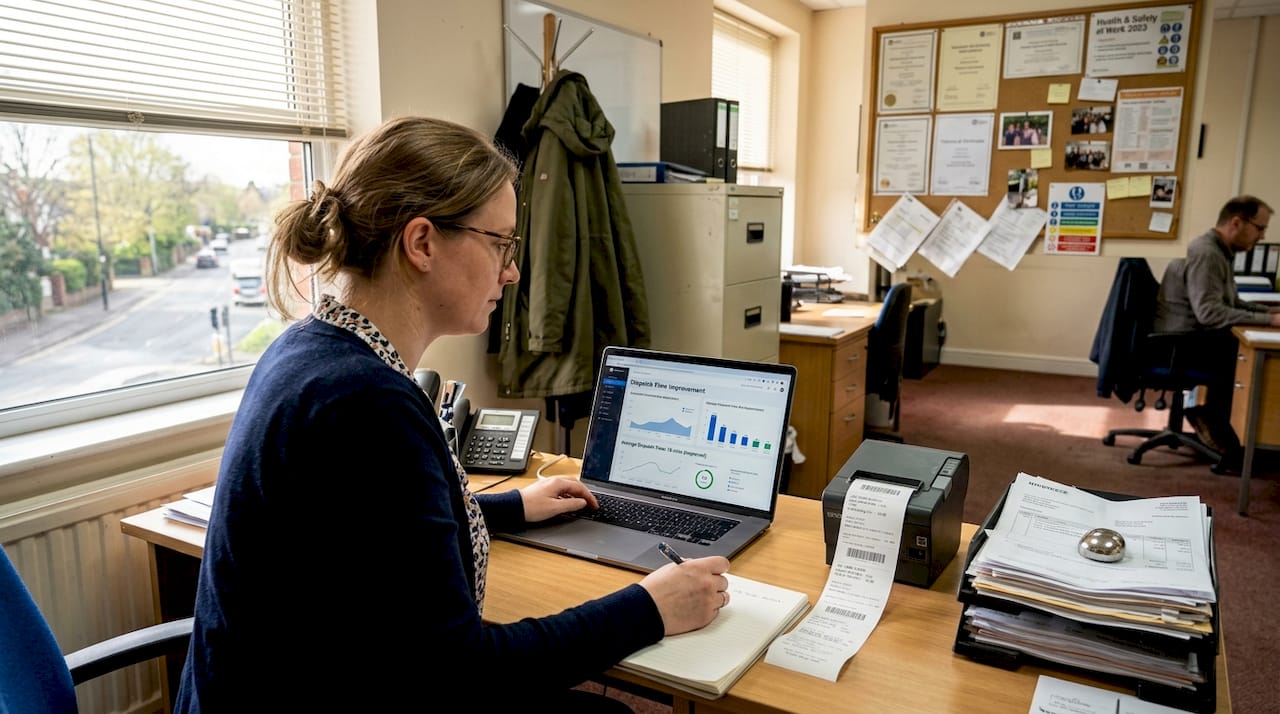
The dispatch time improvement alone is striking. Cutting the time to assign and route a job from two and a half hours to forty minutes means your team spends more time doing billable work and less time waiting for instructions. For a firm running five or more operatives, that adds up to significant labour savings every single week.
No-show rates dropping by up to 40% is equally powerful. Automated appointment reminders sent via SMS or WhatsApp keep customers accountable and reduce the dead time that costs your business money.
The numbers are clear: a €99/month AI receptionist can recover over €500/month in revenue that would otherwise walk out the door.
Pro Tip: Track your missed call rate for two weeks before implementing AI. That baseline figure becomes your most compelling ROI argument when reviewing results at 90 days.
For a deeper look at how these gains translate across different trade categories, the AI automation for trades guide covers sector-specific scenarios. You can also review AI growth case studies from Irish businesses that have already made the move.
Common pitfalls: What can go wrong with AI job management?
But adopting AI isn't risk-free. Here's what Irish trade owners must watch for.
The most common failure point is poor data quality. AI systems learn from your existing job records, customer data, and scheduling history. If that data is incomplete, inconsistent, or outdated, the AI will make poor recommendations. Garbage in, garbage out is a real problem here.
Other pitfalls to watch for include:
- Over-reliance without oversight: AI handles routine decisions well, but unusual jobs, complex customer situations, or multi-trade projects still need a human eye
- Skipping staff training: If your team doesn't understand how to work alongside the AI, they'll either ignore it or override it constantly, defeating the purpose
- Choosing the wrong platform: Generic software not built for Irish trades may miss local compliance requirements, VAT rules, or simply not understand regional accents
- Ignoring the competitive gap: Mid-size Irish firms that adopt AI are pulling ahead, and the gap widens every month that others wait
"AI accelerates inequality between firms that adopt it and those that don't. The window to act without losing ground is narrowing."
The human oversight point deserves emphasis. AI is excellent at pattern recognition and volume processing. It is not good at reading between the lines of a difficult customer conversation or recognising that a job description sounds routine but is actually complex. Build in a review step for low-confidence decisions, particularly for high-value or first-time customers.
For a structured approach to avoiding these mistakes, the AI setup steps guide walks through the technical and operational safeguards worth putting in place before you go live.
Comparison: Human reception, standard software, and AI-powered solutions
With opportunities and benefits clear, how does AI-powered management stack up against what Irish trades already use?
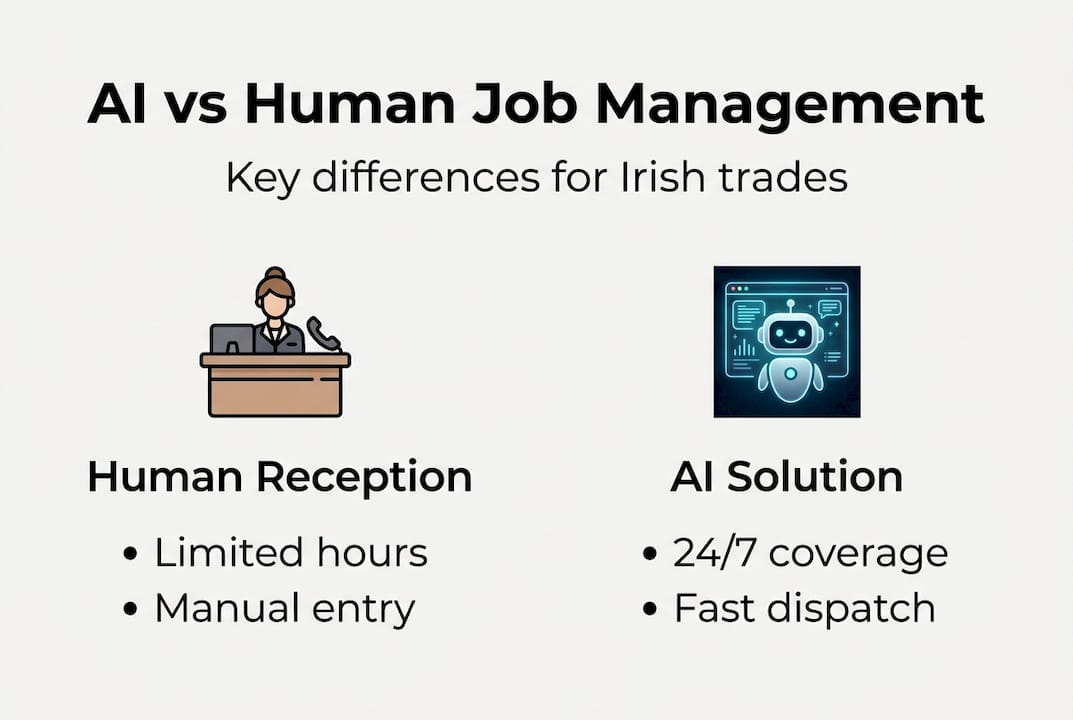
| Feature | Human receptionist | Standard software | AI-powered solution |
|---|---|---|---|
| After-hours coverage | No | No | Yes, 24/7 |
| Irish accent recognition | Yes | N/A | Yes |
| Cost per month | €2,000+ | €30 to €100 | €99 to €399 |
| Automated follow-ups | No | Limited | Yes |
| Appointment booking | Yes | Manual | Fully automated |
| Scales with call volume | No | Partially | Yes |
The cost comparison is stark. A full-time receptionist in Ireland costs upwards of €2,000 per month when you factor in salary, PRSI, and holiday cover. Standard job management software handles scheduling but won't answer the phone. 23% of trade calls come in after hours, and neither a part-time receptionist nor basic software captures those.
Here's how the three options rank for a typical Irish trade business with five to fifteen employees:
- AI-powered solution: Best overall value, 24/7 coverage, scales automatically, lowest monthly cost relative to output
- Human receptionist: Best for complex customer relationships, but expensive and limited to business hours
- Standard software: Useful for scheduling but leaves significant revenue gaps from missed and after-hours calls
Pro Tip: If you're not ready to go fully AI, start with an AI voice agent for after-hours calls only. You'll capture that 23% of missed bookings at minimal cost and build confidence in the technology before expanding.
For a step-by-step breakdown of how to automate your job management processes, see our guide on job management automation. Electricians specifically will find the AI solutions for electricians article highly relevant.
Getting started: Steps to implement AI job management in your business
Ready to act? Here's how Irish trades can transition to AI-driven job management, step by step.
-
Audit your current pain points: Spend one week logging missed calls, forgotten follow-ups, and admin tasks that eat your time. This gives you a clear baseline and helps you prioritise which AI tools to deploy first.
-
Set measurable goals: Define what success looks like before you start. Examples include reducing dispatch time by 50%, recovering five missed bookings per week, or cutting overtime by 25%. Vague goals produce vague results.
-
Choose a platform built for Irish trades: Generic tools often fall short on accent recognition, local compliance, and integration with Irish-specific job management systems. Look for platforms that explicitly support Irish businesses.
-
Start with one use case: Don't try to automate everything at once. Begin with AI reception or automated reminders, measure the impact over 30 days, then expand.
-
Train your team: Explain what the AI does, what it doesn't do, and how staff should handle escalations. Buy-in from your team is essential for smooth adoption.
-
Review and refine regularly: Dispatch time reductions from 2.5 hours to 40 minutes don't happen overnight. Review your KPIs monthly and adjust your AI settings as your business data improves.
The AI automation guide provides detailed checklists for each of these steps, tailored specifically for Irish plumbing, electrical, and HVAC businesses.
Why most Irish trades undervalue AI's impact (and how to change that)
Here's the uncomfortable truth: most Irish trade owners who haven't adopted AI aren't sceptical because they've looked at the evidence. They're sceptical because they haven't looked at it at all.
The assumption is that AI is expensive, complicated, and built for tech companies. That assumption is costing them money right now. Irish mid-size construction firms using AI are 20% more productive than those that aren't. That gap compounds over time.
We've seen trade owners spend months deliberating over a €99/month tool while losing €500/month in missed calls. The maths doesn't support hesitation. The real risk isn't adopting AI too soon. It's adopting it too late, when competitors have already locked in the customers you're losing today.
The businesses exploring AI opportunities for trades now are the ones that will dominate their local markets in two to three years. The window for early-mover advantage is still open, but it won't stay open indefinitely.
Unlock AI-driven growth for your Irish trade business
The evidence is clear and the tools are ready. If you're running a trade business in Ireland and you're still managing calls, scheduling, and follow-ups manually, you're leaving measurable revenue on the table every single week.
At Apex Emerald AI, our AI voice agents are built specifically for Irish trades, with native accent support, 24/7 availability, and direct integration with your existing job management systems. Our AI automation solutions cover everything from lead capture to appointment booking, and our clients typically see measurable ROI within 90 days. Check our AI pricing to find the right plan for your business size, and book a demo to see exactly what your operation could look like with AI running in the background.
Frequently asked questions
How much does an AI receptionist cost for Irish trades?
AI receptionists tailored for Irish trades start at €99/month, and most businesses recover up to €500/month in revenue that would otherwise be lost to missed calls.
Will AI job management work with Irish accents and after-hours calls?
Yes, modern AI voice agents are specifically designed for Irish accents and operate around the clock, capturing the 23% of trade calls that come in outside business hours.
What practical benefits will AI bring to my trade business's job management?
AI reduces overtime by up to 30%, shortens dispatch times dramatically, cuts no-show rates by up to 40%, and delivers 20% productivity gains for mid-size Irish firms.
Are there risks to relying on AI for job management?
The primary risks are poor input data and insufficient human oversight; building in regular review processes ensures your AI decisions stay accurate and your business stays in control.