TL;DR:
- Irish trades businesses miss 40-60% of calls, leading to significant revenue loss, which AI can quickly recover. Practical AI tools like voice agents and automated scheduling deliver rapid ROI, often within weeks. Success depends on selecting solutions tailored to Irish accents, trade vocabulary, and regional needs, with proper implementation and ongoing support.
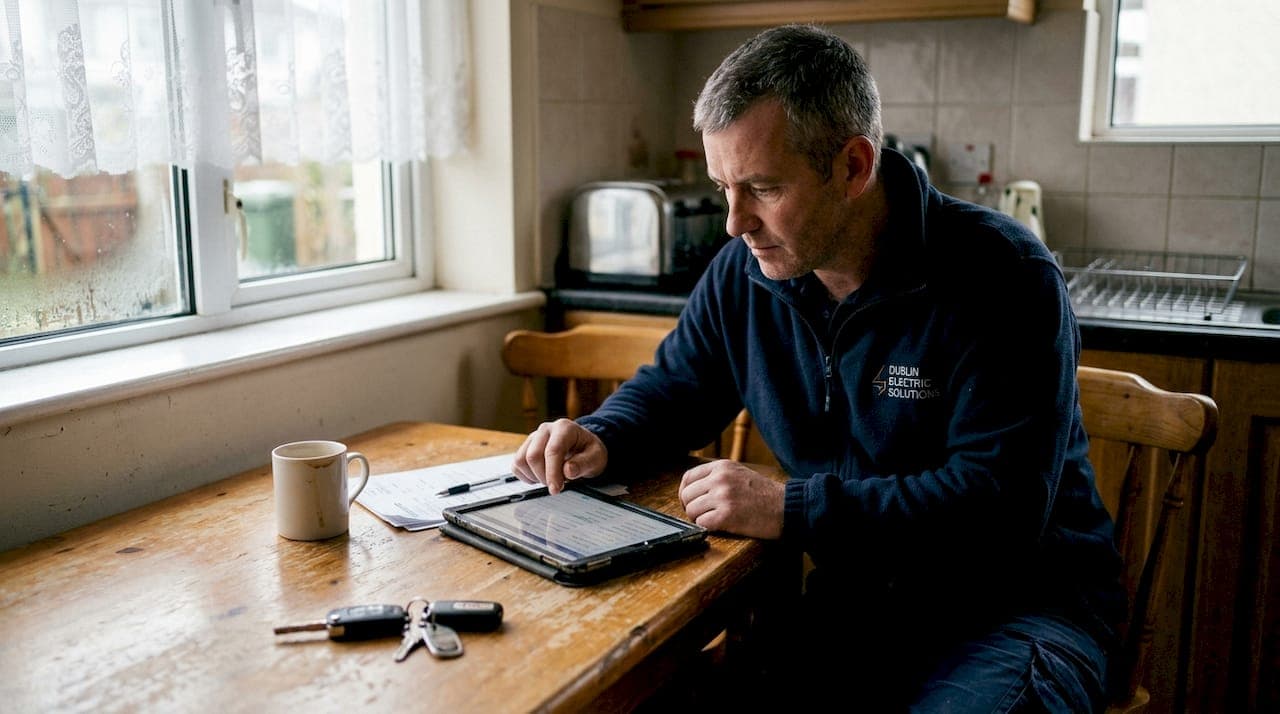
Trades businesses across Ireland are losing thousands of euros every month to a problem that most owners barely notice. When you are on-site fitting a boiler or rewiring a consumer unit, your phone rings and nobody answers. Trades miss 40-60% of calls on-site, yet AI can reduce that figure to under 5%. That is not a marginal improvement. That is a structural change in how your business captures revenue. This article breaks down exactly where AI delivers the fastest wins for plumbing, HVAC, and electrical businesses in Ireland, what makes an AI solution actually work for local trades, and how to get started without wasting budget on tools that were never built for your context.
Table of Contents
- The current landscape of AI adoption in Irish trades
- Where AI delivers the fastest wins for plumbing, HVAC, and electrical trades
- Critical success factors: What Irish trades need from AI
- Practical steps to implement AI solutions in your trade business
- Our perspective: What most Irish trades miss about AI adoption
- Explore AI solutions tailored for Irish trades
- Frequently asked questions
Key Takeaways
| Point | Details |
|---|---|
| Rapid ROI is possible | AI solutions have helped tradespeople recover thousands in revenue with payback in days. |
| Practical tools outperform generic | Irish trades get the most value from solutions tailored to their workflow and vocabulary. |
| Adoption is rising, but nuanced | AI use is expanding among Irish businesses, but trades focus on proven, efficient approaches. |
| Implementation steps are simple | Starting with call handling or scheduling provides a low-risk, high-reward entry to AI. |
The current landscape of AI adoption in Irish trades
Ireland has moved faster on AI than most people realise. Across the broader economy, 74% of Irish businesses are already using AI in production environments. That is a striking number, and it tells you that AI is no longer an experiment reserved for large corporations. However, the trades sector is a different story.
Plumbing, HVAC, and electrical businesses have historically focused on tools that solve immediate, physical problems. A new van, a better pipe bender, a faster diagnostic kit. Digital infrastructure has often come second. The result is that many trade businesses are sitting on a significant competitive gap, and the owners who close it first will pull ahead.
Here is what the current picture looks like for Irish trades:
- Call handling remains largely manual, with most businesses relying on a single mobile number and no overflow system
- Job scheduling is often done through spreadsheets or basic calendar apps, creating bottlenecks during busy periods
- Lead qualification happens informally, meaning staff spend time on enquiries that will never convert
- Customer follow-up is inconsistent, with callbacks depending on individual memory rather than automated workflows
- After-hours coverage is essentially non-existent for the majority of small and medium trade businesses
The AI in Ireland report from the Department of Enterprise highlights that policy and skills gaps remain a real barrier. Many trade business owners want practical tools, not theoretical frameworks. They want to know what the tool does, what it costs, and when they will see a return. That instinct is exactly right, and it is why job management efficiency is one of the clearest entry points for AI in this sector.
The AI adoption survey from AI Ireland confirms that trades prioritise practical tools over innovation for its own sake. That is not a weakness. It is a filter that keeps you focused on solutions with measurable outcomes. Understanding the full AI infrastructure breakdown helps you see where each tool fits before you commit budget.
Statistic to note: Irish businesses adopting AI in production now represent nearly three quarters of the economy. Trades that move now enter a less crowded space with clearer ROI benchmarks to follow.
Where AI delivers the fastest wins for plumbing, HVAC, and electrical trades
Not all AI use cases are equal. Some deliver results in the first week. Others require months of integration before you see any measurable change. For Irish trade businesses, the fastest wins come from a short list of targeted applications.
AI voice agents cut missed calls from 40-60% down to under 5%, and the revenue recovery is immediate. One plumber recovered €2,400 per month in previously lost bookings, against a monthly tool cost of €50. That is the kind of ROI that does not require a business case presentation.
Here are the highest-return AI applications, ranked by speed of impact:
- AI voice agents for call handling recover missed leads 24 hours a day, seven days a week, without additional headcount
- Automated job scheduling reduces the back-and-forth that wastes 30 to 60 minutes per booking on average
- Lead qualification workflows filter genuine enquiries from tyre-kickers before a human ever picks up the phone
- Automated follow-up sequences re-engage quotes that went cold, recovering jobs that would otherwise be lost
- After-hours booking systems capture emergency callout requests from customers who cannot wait until morning
| AI solution | Time to first ROI | Monthly cost range | Revenue impact |
|---|---|---|---|
| Voice agent (call handling) | Under 1 week | €50 to €150 | High |
| Automated scheduling | 2 to 4 weeks | €80 to €200 | Medium to high |
| Lead qualification | 2 to 3 weeks | €60 to €180 | Medium |
| Follow-up automation | 3 to 6 weeks | €50 to €120 | Medium |
For a deeper look at the numbers behind these tools, the AI ROI insights available for Irish trades show consistent patterns across plumbing, HVAC, and electrical businesses. The guide to boosting revenue with AI covers the full picture if you want to explore beyond call handling.
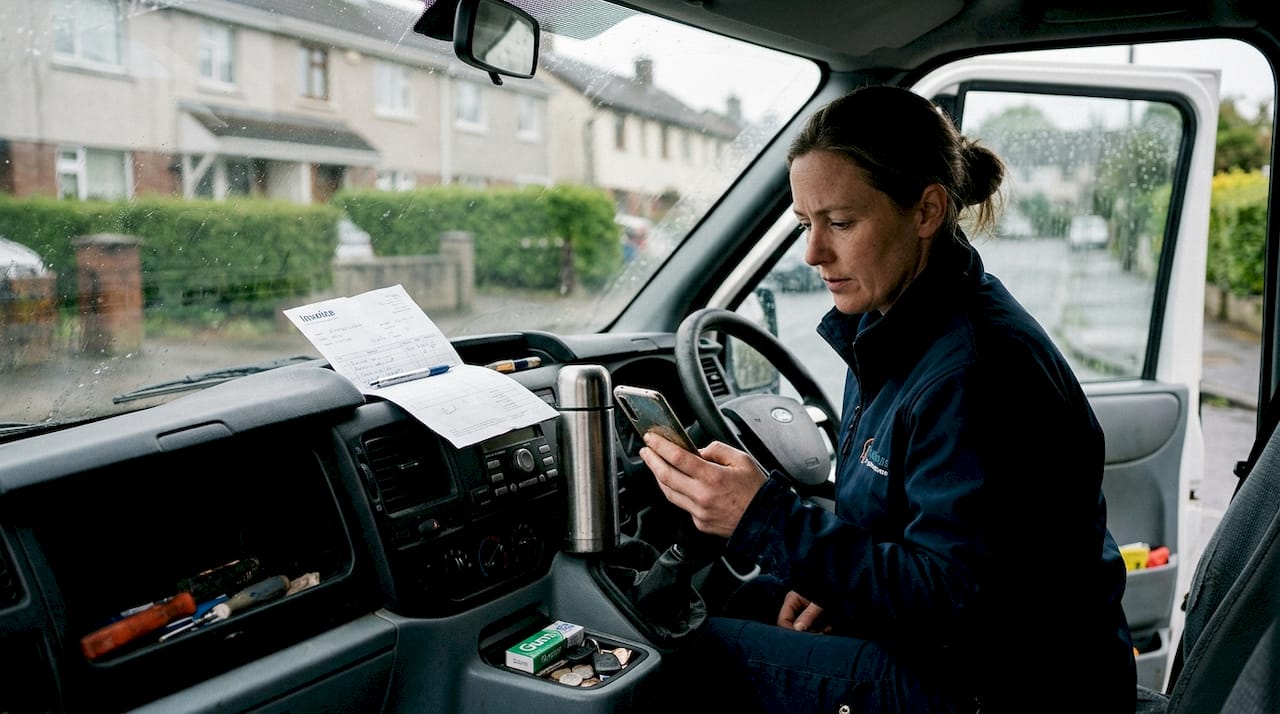
Pro Tip: Start with call handling before anything else. It is the single highest-impact, lowest-complexity entry point for most trade businesses, and it pays for the rest of your AI investment.
Critical success factors: What Irish trades need from AI
Choosing the wrong AI solution is worse than choosing none at all. A tool that misunderstands a Cork accent, stumbles over trade terminology, or responds with a two-second delay will frustrate customers and damage your reputation faster than a missed call ever would.
Low latency under 500 milliseconds, accent handling, and trade-specific vocabulary are not optional extras. They are the baseline requirements for any AI voice solution deployed in an Irish trades context. A generic chatbot trained on American English customer service scripts will not cut it when a customer in Galway rings about a burst pipe.
Here is what to assess before committing to any AI provider:
- Accent and dialect handling: Does the system perform well with Irish regional accents, including Munster and Ulster variations?
- Trade vocabulary: Can it correctly interpret terms like MCB, S-plan, zone valve, or three-phase supply without confusion?
- Response latency: Is the delay short enough to feel like a natural conversation rather than a robotic pause?
- Integration capability: Does it connect with the job management software you already use, such as Tradify or ServiceM8?
- Data compliance: Does the provider meet GDPR requirements relevant to Irish and EU data handling?
| Requirement | Why it matters | Red flag to watch for |
|---|---|---|
| Accent handling | Misunderstandings frustrate customers | Generic English-only training data |
| Trade vocabulary | Incorrect terms lose bookings | No domain-specific fine-tuning |
| Low latency | Delays feel unnatural | Response times above 700ms |
| GDPR compliance | Legal obligation in Ireland | Data stored outside EU without safeguards |
The AI adoption survey highlights that skills gaps remain a barrier, but the right provider mitigates this through onboarding support and ongoing training. Review AI deployment best practices before finalising any vendor decision, and consider how your needs may evolve as you look at scaling AI in trades over the next 12 to 24 months.
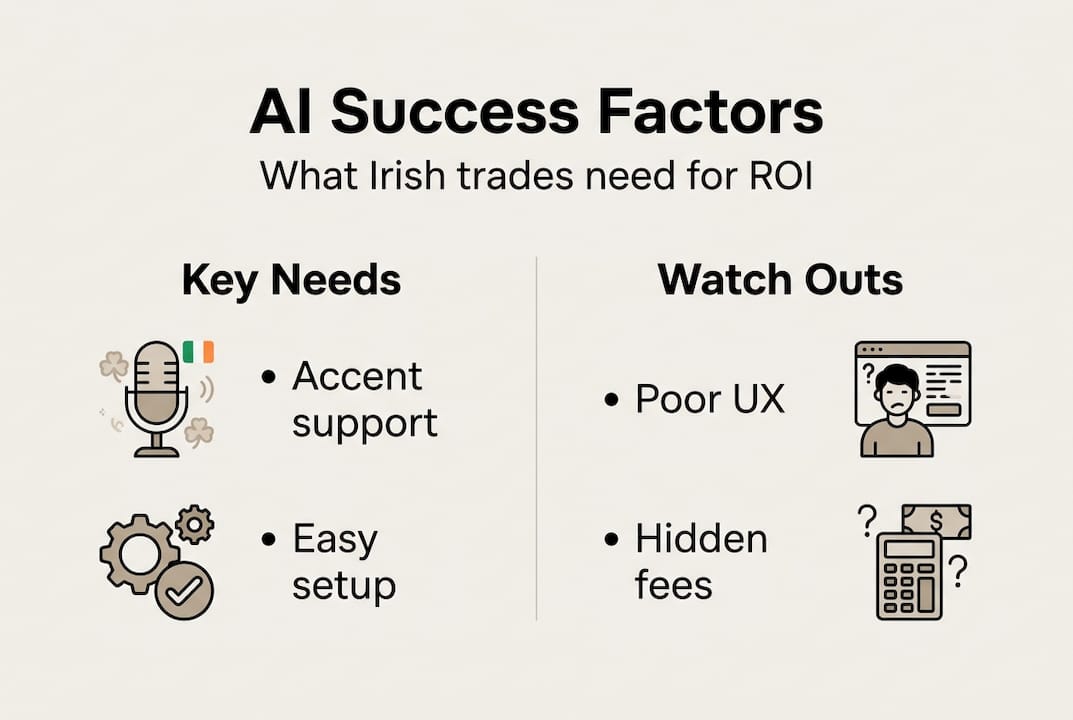
Pro Tip: Ask every AI vendor for a live demo using your actual trade terminology and a simulated Irish customer call. If they cannot demonstrate accent handling in a real scenario, move on.
Practical steps to implement AI solutions in your trade business
Knowing that AI works is not the same as knowing how to make it work for your specific business. Implementation is where most trade owners either gain a real advantage or waste money on tools they never fully deploy.
Here is a straightforward roadmap that works for plumbing, HVAC, and electrical businesses at any size:
- Identify your single biggest pain point. For most trades, this is missed calls. Start there. Do not try to automate everything at once.
- Set a baseline measurement. Count how many calls you miss in a typical week and estimate the average job value. This becomes your ROI benchmark.
- Choose a vendor with Irish trade experience. Generic solutions built for retail or hospitality will not serve your context. Verify that the provider has deployed in trades environments.
- Run a pilot for 30 days. Deploy the AI on one workflow only. Measure the outcome against your baseline before expanding.
- Review and document what changed. Show ROI proof with your cost-saving results before scaling to additional workflows. This keeps your investment disciplined.
- Expand to scheduling and follow-up. Once call handling is working, layer in automated scheduling and lead follow-up to compound your gains.
- Train your team on the new workflow. Even plug-and-play tools benefit from a short briefing session so staff understand what the AI handles and what still requires human input.
The detailed AI setup steps for Irish trades walk through each of these stages with specific tool recommendations. If you are thinking further ahead, the guide to AI growth opportunities maps out how early adopters are building sustainable competitive advantages.
Pro Tip: Budget for ongoing support, not just setup. The businesses that get the most from AI are the ones that treat it as a managed tool rather than a one-time installation.
Our perspective: What most Irish trades miss about AI adoption
Here is something most technology articles will not tell you. The AI tool itself is rarely the reason implementations fail. The reason is almost always a mismatch between what the tool was designed for and the specific context of the business using it.
Irish trade businesses have a distinct operating rhythm. Seasonal demand spikes, regional dialect variation, informal customer communication styles, and tight margins all shape how AI needs to behave. A solution that ignores these realities will underperform, and the business owner will conclude that AI does not work, when the real conclusion should be that that particular tool did not work.
The trade-specific nuance and ROI-first approach matters far more than chasing the latest industry headline. We have seen businesses invest in sophisticated AI platforms that their team never fully adopted, while a simpler, well-configured voice agent transformed their revenue in a fortnight.
The businesses winning with AI right now are not the ones with the most advanced tools. They are the ones who matched the right tool to a specific problem and measured the outcome honestly. That is the standard worth holding yourself to. Explore more on trade business AI growth to see how this plays out across different trade categories.
Explore AI solutions tailored for Irish trades
If this article has given you a clearer picture of where AI fits in your business, the next step is finding solutions that are actually built for your context, not adapted from a generic enterprise platform.
Apex Emerald AI offers tailored AI solutions designed specifically for plumbing, HVAC, and electrical businesses in Ireland. From AI voice agents to full omnichannel automation, every tool is configured for Irish trade environments. You can review transparent AI pricing without a sales call, and if you want an expert assessment of where your business stands, an AI audit consultation will map out exactly where to start and what to expect in return.
Frequently asked questions
How quickly can Irish trade businesses see a return on AI investments?
Many businesses see a return within the first week, particularly when starting with call handling. One plumber recovered €2,400/month in missed bookings against a €50 monthly tool cost.
Does AI handle Irish accents and trade-specific terms?
Modern AI solutions built for Irish trades are trained for regional accents and trade vocabulary. Low latency and accent handling are considered baseline requirements, not premium features.
What are the first steps in implementing AI in a trades business?
Identify your highest-impact pain point, usually missed calls, set a baseline measurement, then pilot a single AI workflow for 30 days before expanding to other areas of the business.
Are Irish trades required to upskill staff for AI adoption?
Some briefing is advisable, but many tools are designed for straightforward deployment. Skills gaps hinder broader adoption, but practical tools with ongoing provider support significantly reduce the training burden.