
Manual job management is quietly bleeding your business dry. Every missed call, scribbled job sheet, and double-booked appointment costs you time, money, and reputation. Irish trades businesses that have switched to automation are reporting 40% productivity boosts and eight fewer hours of admin every single month. This guide walks you through exactly what job management automation involves, what you need to get started, how to implement it step by step, and how to measure the results that matter to your bottom line.
Table of Contents
- What is job management automation?
- What you need to get started with automation
- Step-by-step: how to automate job management in Irish trades
- Common pitfalls and how to avoid them
- Measuring the impact: what results to expect
- How Apex Emerald AI can help streamline your job management
- Frequently asked questions
Key Takeaways
| Point | Details |
|---|---|
| Dramatic productivity gains | Automating job management typically delivers 30-40 percent more completed work and major time savings. |
| Quick results possible | Irish trades see reduced admin and improved customer experience within months of adoption. |
| Preparation is key | Successful automation relies on clean data, team buy-in, and the right technology match. |
| Start simple then expand | Begin with automating assignment and notifications for fast impact before adding advanced features. |
| Measure and refine | Continuously track admin hours, travel, and customer scores to optimise your setup. |
What is job management automation?
Job management automation means using software to handle the repetitive, time-consuming tasks that currently eat into your working day. Instead of manually scheduling jobs, phoning engineers, chasing invoices, and updating spreadsheets, the system does it for you in the background.
For a trades business in Ireland, the core functions typically automated include:
- Job scheduling and dispatch: Automatically assign jobs to the nearest or most available engineer.
- Customer notifications: Send automated texts or emails confirming appointments and arrival times.
- Invoicing and payments: Generate and send invoices the moment a job is marked complete.
- Job tracking: Monitor job status in real time from a single dashboard.
- Accounting integration: Sync completed jobs directly with platforms like Xero or Sage.
The results speak for themselves. ServiceM8 users complete 30% more work after adopting automation, which is a significant competitive edge in a busy market. If you want a broader view of how AI fits into this picture, the AI automation guide for trades is a solid starting point.
Pro Tip: Start with automating your job notifications first. It is the quickest win and immediately improves customer experience without requiring a full system overhaul.
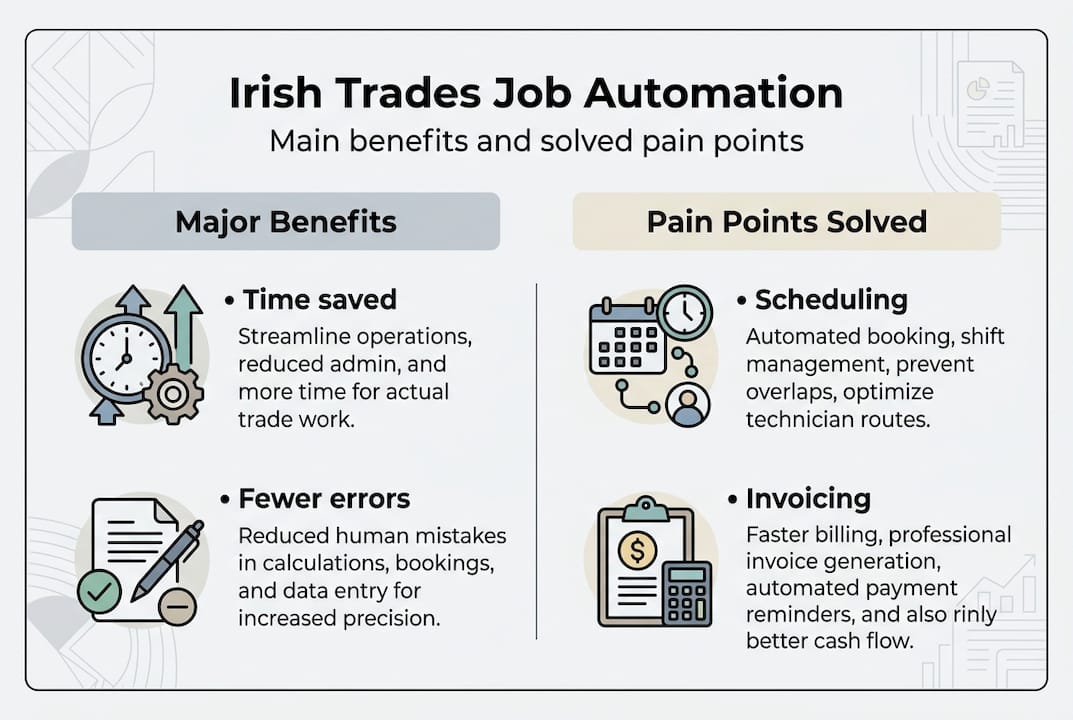
The main pain points automation solves are scheduling conflicts, lost paperwork, slow invoicing, and poor communication between office and field teams. These are not minor inconveniences. They are profit leaks.
What you need to get started with automation
Before you invest in any platform, you need to make sure your business is ready. Jumping straight into software without the right foundations is one of the most common reasons automation projects stall.
Here is what you need in place:
- Digital devices for your field team: Every engineer needs a smartphone or tablet. This is non-negotiable. The software is only as good as the people using it on the ground.
- Reliable internet connectivity: Cloud-based platforms require a stable connection. Check your team's coverage across the areas they work in.
- Clean client and job data: If you are migrating from spreadsheets or paper records, clean your data first. Duplicate contacts and incomplete job histories will cause problems from day one.
- Software compatibility: Check that your chosen platform integrates with your existing accounting or CRM tools.
- Team buy-in: Your staff need to understand why the change is happening and what is in it for them.
Tradify saves Irish trades 10+ hours per week on admin alone, which gives you a clear sense of the return on investment available. Before committing to a platform, run through the AI readiness checklist to identify any gaps, and review the AI infrastructure essentials to understand the technical groundwork required.
| Prerequisite | Why it matters | Common platforms that require it |
|---|---|---|
| Smartphones or tablets | Field access to jobs and updates | Tradify, ServiceM8, Niggle.ie |
| Cloud connectivity | Real-time sync between office and field | All major platforms |
| Clean job and client data | Accurate scheduling and invoicing | All major platforms |
| Accounting integration | Automated invoicing and reconciliation | Xero, Sage, QuickBooks |
| Staff training plan | Adoption and consistent usage | All major platforms |
Step-by-step: how to automate job management in Irish trades
Once your foundations are in place, follow these steps to implement automation effectively.
-
Map your current workflow. Write down every step from the moment a customer enquiry comes in to the moment an invoice is paid. Identify where time is lost, where errors happen, and where communication breaks down.
-
Choose the right platform. Match your workflow gaps to platform strengths. Niggle.ie streamlines job capture, assignment, and notifications specifically for Irish businesses, making it a strong local option. ServiceM8 and Tradify are also widely used across Irish trades.
-
Set up and customise your platform. Configure job types, assign user roles, and connect your accounting software. Most platforms offer templates to speed this up. Do not skip the customisation step. A generic setup will not reflect how your business actually operates.
-
Run a pilot with a small team. Before rolling out to everyone, test the system with two or three engineers for two weeks. Identify friction points and fix them before full deployment.
-
Train your staff and manage the change. Hold a briefing session, provide written guides, and assign a point of contact for questions. The setup automation for trades guide covers this in detail.
-
Go live and monitor closely. Launch the full rollout and check in daily for the first two weeks. Use the top AI tools for managers to complement your job management platform with broader operational oversight.
Pro Tip: Automate job assignment and engineer notifications in week one. This single change reduces missed jobs and cuts back-and-forth calls immediately.
The results from businesses that follow this process are compelling. vWork enabled Swyft Energy to double sales without adding extra staff, while achieving a 100% first-time install rate. That is the kind of outcome a structured rollout makes possible.

| Step | Key decision | Expected impact |
|---|---|---|
| Map workflow | Identify biggest time drains | Clarity on where automation adds most value |
| Choose platform | Match features to your gaps | Reduced admin from day one |
| Customise setup | Configure for your job types | Accurate scheduling and invoicing |
| Pilot with small team | Test before full rollout | Fewer problems at launch |
| Train staff | Invest in onboarding | Higher adoption and consistent usage |
| Go live and monitor | Track key metrics weekly | Measurable improvement within 90 days |
Common pitfalls and how to avoid them
Careful execution matters, but avoiding these common mistakes can be the difference between rapid success and costly setbacks.
- Under-communicating with your team. If your engineers do not understand why the system is changing, they will resist it. Brief everyone before launch, not after.
- Migrating dirty data. Incomplete job records, duplicate contacts, and missing addresses will corrupt your new system from the start. Audit your data before migration.
- Expecting instant results without process changes. Automation amplifies your existing processes. If your processes are broken, automation will make the problems faster and more visible.
- Relying on a single staff champion. If the one person who understands the system leaves, your automation collapses. Train at least two people to a high level.
ServiceM8 holds a 4.6 out of 5 rating among Irish users on the Xero App Store, which reflects how well it performs when implemented correctly. For businesses looking to scale further, the AI growth for trades resource outlines the next level of opportunity, and the voice agent workflow guide shows how AI voice tools can sit alongside your job management system.
'Most Irish trade businesses see the best results when every staff member is briefed and supported throughout the automation rollout.'
The businesses that struggle with automation are almost always the ones that treated it as a software installation rather than a business change. It is both.
Measuring the impact: what results to expect
After launching automation, it is critical to track and benchmark your results so improvements are visible and sustained.
The key metrics to monitor are:
- Admin hours saved per week: Compare time spent on scheduling, invoicing, and reporting before and after.
- First-time fix rate: Are engineers arriving with the right parts and information? Automation improves job briefing quality.
- Fuel and travel costs: Smarter scheduling reduces unnecessary mileage.
- Customer satisfaction scores: Faster responses and accurate ETAs improve reviews and repeat business.
- Jobs completed per week: The clearest measure of operational capacity.
The numbers from Irish businesses already using these tools are striking. WorkPal delivers a 40% productivity boost, a 10% fuel saving, and eight fewer hours of admin per month. These are not projections. They are documented results from businesses operating in the same market as yours. For a structured approach to calculating your return, the ROI with automation guide provides a practical framework.
Stat callout: Swyft Energy doubled sales and achieved a 100% first-time install rate without hiring additional staff, by implementing structured job management automation through vWork.
Set your baseline numbers before you go live. Record your current admin hours, weekly job count, fuel spend, and customer satisfaction rating. Revisit these figures at 30, 60, and 90 days post-launch. The pattern will be clear.
How Apex Emerald AI can help streamline your job management
You now have a clear picture of what automation involves, what it requires, and what it delivers. The next question is who can help you implement it properly in your business.

Apex Emerald AI specialises in tailored automation solutions for trades businesses across Ireland, from AI voice agents that capture leads around the clock to integrated job management systems that connect your field team, office, and accounting software in one place. The platform is built for Irish trades businesses that want measurable results within 90 days, not a lengthy IT project. Explore the AI case studies for trades to see how businesses like yours have cut admin, increased conversions, and grown revenue without adding headcount. If you are ready to move from manual to automated, this is the practical next step.
Frequently asked questions
Which job management platforms work best for small Irish trades businesses?
Popular choices include Tradify, ServiceM8, and Niggle.ie, all of which are proven to save time and boost efficiency for Irish field service companies.
How quickly can an Irish business start seeing results from automation?
Many businesses report noticeable gains, such as 30% more jobs completed, within the first three months of going live with automation.
What are the most common mistakes when automating job management?
Under-communicating with your team or migrating poor-quality data are the two issues that most often cause delays. Engaging all staff from the outset significantly improves outcomes.
How do I measure the financial impact of job automation?
Track admin time, fuel costs, staff output, and customer feedback before and after launch. WorkPal's documented results show measurable gains across all four areas for Irish businesses.
Is specialist training required for team members?
Most modern platforms are designed for straightforward onboarding, but a clear handover process matters. Swyft Energy's 100% first-time install rate demonstrates what proper setup and staff preparation can achieve.