TL;DR:
- Most Irish trades businesses have trialed AI but lack a fully embedded strategy.
- True AI readiness depends on skills, governance, and organizational culture.
- Government-backed Digital Innovation Hubs provide valuable support for scaling AI initiatives.
Nine out of ten Irish businesses claim to use AI, yet only 10% have a genuine embedded strategy. For business managers in Irish trades, that gap is not just a statistic — it is a warning. Having a chatbot on your website or a scheduling tool in your back office does not make your business AI-ready. True readiness means your people, processes, and governance structures can absorb AI and turn it into consistent operational gains. This article gives you a practical framework to understand where your business actually stands, what genuine readiness looks like, and the concrete steps to get there.
Table of Contents
- Setting the scene: AI adoption versus readiness in Irish trades
- Core pillars of AI readiness: Skills, governance, and culture
- Frameworks and support: Government-backed initiatives for Irish trades
- Practical steps for managers: Moving from pilot to scale
- Our perspective: What most managers miss in the AI readiness rush
- Next steps: Unlock AI solutions for your trades business
- Frequently asked questions
Key Takeaways
| Point | Details |
|---|---|
| Adoption isn’t readiness | Using AI tools does not guarantee operational integration or strategic value. |
| Skills are essential | Developing AI expertise and upskilling teams is the top readiness challenge for Irish managers. |
| Government support exists | Digital Innovation Hubs provide practical training, test-before-invest programmes, and resources for trades businesses. |
| Move beyond pilots | Managers must follow sequential steps to embed AI fully and scale its impact in their organisations. |
| Strategic vision drives success | A clear AI strategy and readiness mindset unlock sustainable gains for trades businesses. |
Setting the scene: AI adoption versus readiness in Irish trades
There is a meaningful difference between using AI and being ready for AI. Most trades businesses in Ireland have crossed the first threshold. They have trialled a tool, run a pilot project, or added an AI-powered feature to an existing system. But that is where progress tends to stall.
The AI Readiness Pulse report paints a clear picture: Irish businesses are enthusiastic adopters but cautious strategists. Pilot-stage projects dominate the landscape. Few organisations have moved beyond testing into full operational embedding. The result is a sector that looks progressive on paper but struggles to translate AI investment into measurable output.
To understand the distinction, consider this comparison:
| Dimension | AI adoption | AI readiness |
|---|---|---|
| Focus | Installing tools | Embedding strategy |
| Stage | Pilot or trial | Operational and scaled |
| Skills | Basic user knowledge | Trained, confident teams |
| Governance | Absent or informal | Documented policies |
| Outcomes | Occasional wins | Consistent ROI |
For trades managers, this table is a diagnostic. If your business sits mostly in the left column, you have adoption without readiness. That is a fragile position.
"The businesses that extract lasting value from AI are not necessarily the ones with the most tools. They are the ones with the clearest strategy for using them."
AI readiness for trades is not a technology problem. It is a business problem. The tools exist and are increasingly affordable. What is missing in most cases is the organisational infrastructure to support them. That means trained staff, clear policies, and a leadership team that understands what AI can and cannot do.
Understanding AI automation in trades at a strategic level, rather than a purely technical one, is what separates businesses that scale from those that stall. If your pilots keep producing promising results that never translate into operational change, the issue is almost certainly readiness, not the technology itself.
Core pillars of AI readiness: Skills, governance, and culture
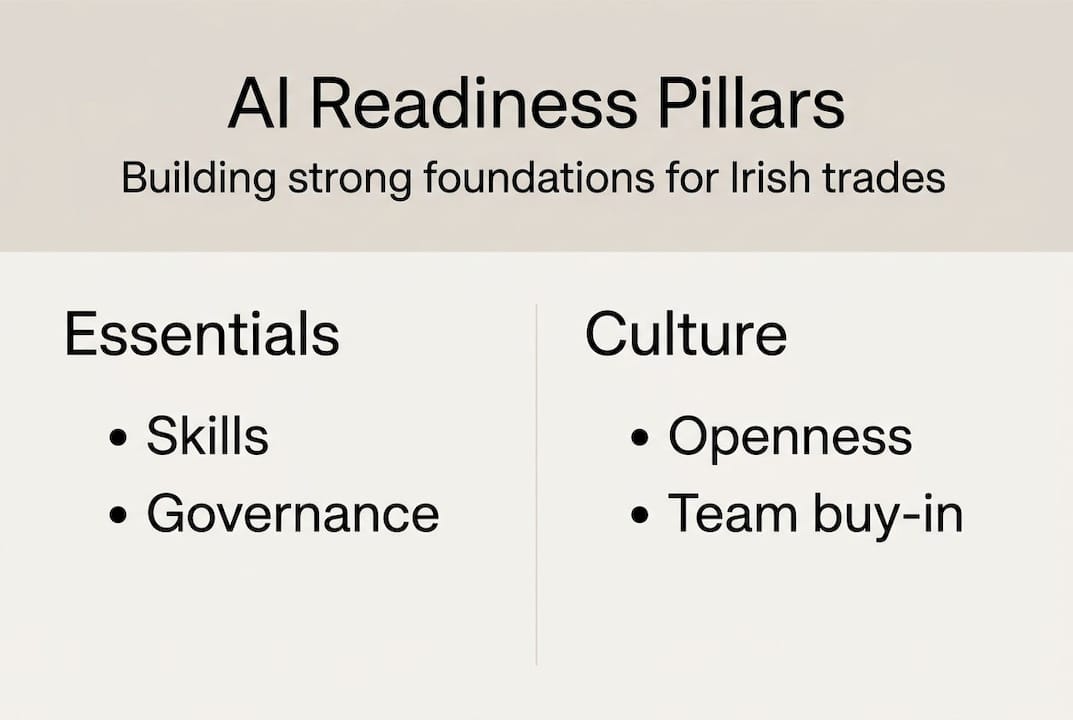
Genuine AI readiness rests on three interconnected pillars. Miss any one of them and your AI investments will underperform, regardless of how sophisticated the tools are.
Skills are the most visible gap. 40% of Irish businesses cite a lack of AI skills as their primary concern. In trades businesses, this often shows up as a reliance on one or two technically confident individuals while the rest of the team remains disengaged or uncertain. That creates fragility. If your AI champion leaves, the capability often leaves with them.
Building skills means more than sending staff on a one-day course. It requires:
- Role-specific training so each team member understands how AI affects their particular job
- Ongoing learning pathways rather than one-off workshops
- Leadership literacy so managers can make informed decisions about AI investment and deployment
- Practical application where staff use AI tools in real workflows, not just classroom simulations
Governance is the pillar most managers underestimate. Without clear policies covering data security, acceptable AI use, and compliance with Irish and EU regulations, you are exposed. A well-designed AI readiness checklist will always include governance as a non-negotiable foundation.
Good governance does not need to be complicated. Start with a simple AI use policy that defines what tools are approved, how customer data is handled, and who is responsible for oversight. Then build from there.
Culture is the hardest pillar to build and the easiest to overlook. AI-ready organisations are characterised by a willingness to experiment, a tolerance for early failures, and a genuine commitment to continuous improvement. In trades businesses, where operational pressure is constant, creating space for experimentation requires deliberate effort from leadership.
Pro Tip: Before investing in new AI tools, conduct an internal survey asking your team how confident they feel using current technology. The results will tell you more about your readiness than any vendor demo.
Following AI deployment best practices means treating skills, governance, and culture as a system. Strengthen one without the others and you will hit a ceiling quickly. Digital Innovation Hubs across Ireland offer structured support for building all three pillars simultaneously.
Frameworks and support: Government-backed initiatives for Irish trades
One of the most underused resources available to Irish trades managers is the network of government-backed Digital Innovation Hubs. These hubs were designed specifically to help businesses move from curiosity about AI to confident, operational use.
The Irish government has committed €23 million to Digital Innovation Hubs, funding nationwide training, test-before-invest projects, and over 200 courses aimed at businesses of all sizes. To date, the programme has recorded more than 3,000 business engagements. That scale matters because it means the infrastructure for support is already in place and accessible.
Here is what these hubs typically offer trades managers:
- Technology assessments to identify where AI can add the most value in your specific operations
- Test-before-invest projects allowing you to trial AI solutions in a supported environment before committing budget
- Training and upskilling programmes tailored to non-technical business owners and managers
- Expert guidance from advisors with direct experience in trades and SME environments
- Peer networks connecting you with other managers navigating similar challenges
The table below summarises the key support options and what they address:
| Support type | What it addresses | Who it suits |
|---|---|---|
| Technology assessment | Identifying AI opportunities | Managers at pilot stage |
| Test-before-invest | Reducing financial risk | Businesses cautious about cost |
| Training programmes | Skills and confidence gaps | All staff levels |
| Expert guidance | Strategy and governance | Leadership teams |
| Peer networks | Shared learning | Any stage of readiness |
For managers exploring top AI tools in 2026, these hubs provide a structured way to evaluate options without the pressure of a sales environment. They are also a practical entry point for businesses looking to understand the AI growth opportunities specific to their trade category.
The key message here is straightforward: you do not need to navigate the AI readiness journey alone. The government-backed hubs exist precisely to reduce the risk and cost of getting started.
Practical steps for managers: Moving from pilot to scale
Most trades managers know their AI pilots are not delivering at scale. The frustrating part is that the tools often work. The bottleneck is almost always organisational. Skills and organisation policy are consistently identified as the main obstacles to scaling AI across Irish businesses.
Here is a sequential approach that addresses those bottlenecks directly:
- Assess your current gaps across skills, governance, and data infrastructure before adding any new tools
- Prioritise one high-impact use case such as lead qualification, appointment booking, or job scheduling rather than trying to automate everything at once
- Upskill the team connected to that use case first, creating internal champions who can support wider rollout
- Document a basic AI policy covering data handling, approved tools, and escalation procedures
- Set measurable targets for the pilot, such as response time reduction or conversion rate improvement, so you have clear evidence to justify scaling
- Review and iterate at 30, 60, and 90-day intervals, adjusting based on real operational data
- Engage a Digital Innovation Hub for independent validation before committing to enterprise-wide deployment
The AI solutions for efficiency that deliver the strongest results in trades businesses are almost always those that solve a specific, well-defined operational problem rather than those that attempt broad transformation from day one.
Pro Tip: Map your current customer journey from first enquiry to completed job. Every point where information is manually transferred or a customer waits for a response is a candidate for AI automation. Start there.
For trades businesses managing complex field operations, AI in job management offers some of the clearest near-term gains. Scheduling, dispatch, and follow-up communications are all areas where AI can reduce friction and free up your team for higher-value work. The path from adoption to advantage is sequential, not sudden.
Our perspective: What most managers miss in the AI readiness rush
Here is what we see consistently: managers invest in AI tools and then wonder why the results are modest. The instinct is to blame the technology. In almost every case, the real issue is cultural and strategic, not technical.
The trades businesses that have genuinely embedded AI share one characteristic. Their leadership team made a deliberate decision to change how the business operates, not just what tools it uses. They treated AI readiness as an organisational development challenge, not a procurement exercise.
Most guides on AI readiness focus on tool selection and integration. That matters, but it is the easier part. The harder work is building a team that trusts AI-generated outputs, a culture that welcomes process change, and a governance structure that keeps the business protected as it scales.
We have seen businesses with modest budgets outperform well-funded competitors simply because their teams were genuinely prepared. Deeper readiness insights consistently point to the same conclusion: strategy and culture are the real differentiators. The managers who understand that early are the ones who build lasting competitive advantage.
Next steps: Unlock AI solutions for your trades business
If this article has clarified where your business stands on the readiness spectrum, the logical next step is to explore solutions built specifically for Irish trades operations.
Apex Emerald AI offers AI automation solutions designed to take trades businesses from pilot to scale without the guesswork. Whether you need to automate lead qualification, streamline appointment booking, or deploy a fully operational AI voice agent platform that handles customer enquiries around the clock, the platform is built to deliver measurable ROI within 90 days. Our team works directly with trades managers to assess readiness, design the right solution, and support deployment at every stage. You do not need to figure this out alone.
Frequently asked questions
What is AI readiness for Irish trades managers?
AI readiness means managers have the skills, governance, and strategy to embed AI tools across their operations, not just run pilots or trials. Practical readiness factors including skills, confidence, and governance are the dominant constraints for most Irish businesses.
What support is available for Irish trades managers to become AI ready?
Government-backed Digital Innovation Hubs offer test-before-invest schemes, training programmes, and expert guidance to support businesses nationwide. The Irish government has committed €23 million to this initiative, funding over 200 courses and thousands of business engagements.
How can managers move from pilot projects to fully embedded AI?
Use a step-by-step approach: assess gaps, upskill teams, develop policies, and leverage support hubs for operational scaling. Skills and organisation policy are the main bottlenecks, so addressing these first accelerates the path to scale.
What are the main barriers to AI readiness in Irish trades?
The biggest obstacles are a lack of AI skills, unclear governance policies, and insufficient data security measures. 40% of Irish businesses identify skills as their primary concern, making structured upskilling the most urgent priority for most trades managers.