
Automation promises efficiency gains for Irish trade businesses, but without precise ROI measurement, you cannot justify investment or scale confidently. Many plumbing, HVAC, and electrical firms adopt AI voice agents and workflow automation yet struggle to quantify actual savings versus costs. This guide walks you through preparing data, executing calculations with proven formulas, and verifying results over time. You will learn to distinguish hard financial returns from strategic benefits, avoid common pitfalls, and use actionable metrics tailored to Irish trades. By the end, you will have a clear framework to measure, optimise, and communicate the true value of automation in your business.
Table of Contents
- Key Takeaways
- Preparing to measure roi with automation in your trade business
- Executing the roi calculation with proven formulas and tools
- Verifying and optimising your roi results over time
- How Apex Emerald AI supports trades businesses in measuring roi with automation
- How do I measure roi with automation in my trade business?
Key Takeaways
| Point | Details |
|---|---|
| ROI formula clarity | A clear, reproducible ROI formula is essential to justify automation investments and measure true savings against costs. |
| Hard and soft ROI | Differentiate hard financial gains from soft strategic benefits to focus on measurable returns while acknowledging longer term value. |
| Baseline data gathering | Gather three to six months of baseline data before automation to create a trustworthy reference point for calculating true savings. |
| KPIs to track | Choose KPIs that capture cost reductions and operational improvements rather than vanity metrics to ensure profitability is prioritised. |
Preparing to measure roi with automation in your trade business
Before you calculate a single percentage, you must lay the groundwork. Start by defining clear business objectives for automation. Are you aiming to reduce call handling time, increase appointment bookings, or cut administrative labour costs? Each goal demands different KPIs. For example, if your HVAC firm wants to improve after-hours lead capture, track missed call rates and conversion rates outside business hours. If your plumbing business seeks to streamline scheduling, measure average time to book an appointment and scheduling errors per week.
Next, identify KPIs that reflect both cost savings and operational agility. Financial KPIs include labour cost per job, cost per lead, and revenue per technician. Operational KPIs cover response time, job completion rate, and customer satisfaction scores. Prioritising measurable KPIs over vanity metrics ensures you focus on outcomes that drive profitability, not just activity counts. Avoid tracking the number of automations deployed or total calls handled unless they tie directly to revenue or cost reduction.
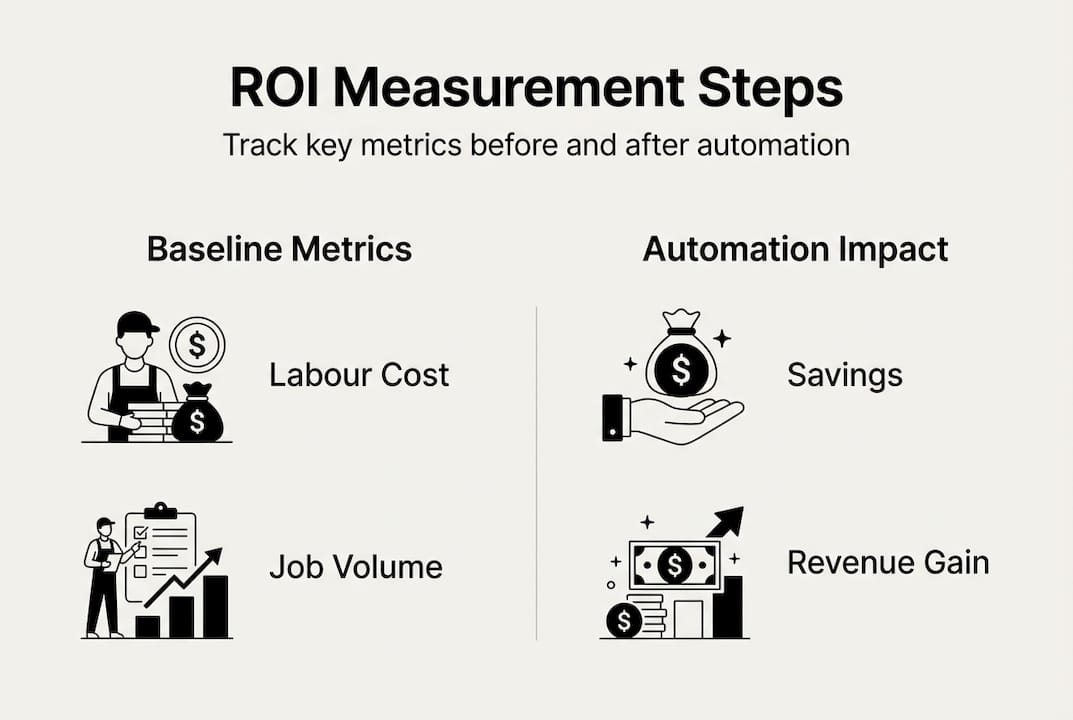
Gather baseline data across three to six months before automation. Document current operational costs such as receptionist wages, overtime for scheduling, and revenue lost to missed calls. Record productivity metrics like jobs completed per technician per week and average call-to-booking conversion rate. Capture error rates for manual scheduling or invoicing. This baseline becomes your reference point for calculating true savings.

Understand the difference between hard and soft ROI. Hard ROI includes direct financial gains like reduced payroll, increased billable hours, and higher conversion rates. Soft ROI covers strategic benefits such as faster response times, improved customer retention, and employee satisfaction. Both matter, but hard ROI is easier to quantify and communicate to investors or lenders. Soft ROI builds long-term resilience and competitive positioning.
Pro Tip: Create a simple spreadsheet to log baseline metrics weekly. Include columns for date, metric name, value, and notes. This habit makes it easy to compare pre-automation and post-automation performance without hunting through old records. For more on measuring AI automation ROI in trades, explore frameworks tailored to Irish businesses.
Executing the roi calculation with proven formulas and tools
Once you have baseline data and clear goals, execute the ROI calculation using the core formula. ROI equals Total Savings minus Automation Cost, divided by Automation Cost, times 100%. Total Savings includes labour cost reductions, revenue increases from higher conversion rates, and avoided costs like overtime or errors. Automation Cost covers software licences, integration fees, training, and ongoing maintenance.
Follow these steps to calculate ROI accurately:
- List all automation costs over the measurement period. Include upfront expenses like software purchase or setup fees, monthly subscription costs, integration with your job management system, and training hours multiplied by employee hourly rates. Do not forget ongoing costs such as support contracts or platform updates.
- Quantify total savings from automation. Calculate labour savings by multiplying hours saved per week by average hourly wage. Measure revenue gains from improved conversion rates or faster job turnaround. Include avoided costs like reduced scheduling errors or fewer missed appointments.
- Apply the ROI formula. Subtract total automation cost from total savings, divide by automation cost, and multiply by 100 to get a percentage. A positive ROI means the automation pays for itself and generates profit. A negative ROI signals the need to adjust or discontinue the automation.
- Compare scenarios using a data table. Model different automation investments to see which delivers the highest ROI. For example, compare an AI voice agent for after-hours calls versus automated invoicing software.
Here is a sample data table comparing two automation scenarios for a Dublin electrical firm:
| Automation type | Upfront cost | Monthly cost (12 months) | Total cost (Year 1) | Labour savings | Revenue gain | Total savings | ROI (%) |
|---|---|---|---|---|---|---|---|
| AI voice agent for after-hours calls | €1,200 | €150 | €3,000 | €4,800 (receptionist hours) | €6,000 (converted leads) | €10,800 | 260% |
| Automated invoicing software | €800 | €80 | €1,760 | €3,600 (admin hours) | €0 | €3,600 | 105% |
The AI voice agent delivers a 260% ROI because it captures revenue from previously missed calls, whilst automated invoicing saves admin time but does not directly generate new revenue. Both are profitable, but the voice agent offers higher returns.
Pro Tip: Account for indirect savings like reduced employee stress and improved customer retention. Whilst harder to quantify, these benefits compound over time. For example, faster response times can increase repeat business by 15 to 20%, adding significant lifetime value per customer. To explore detailed AI automation setup steps, review implementation guides designed for Irish trades businesses.
Verifying and optimising your roi results over time
Calculating ROI once is not enough. Continuous monitoring and verification ensure your automation investments remain profitable and scalable. Set a quarterly review schedule to compare actual savings and costs against projections. Use a comparison table to track performance over time and identify trends or anomalies.
Here is a sample quarterly comparison table for an Irish plumbing firm using an AI scheduling assistant:
| Quarter | Projected savings | Actual savings | Projected costs | Actual costs | Projected ROI (%) | Actual ROI (%) | Variance (%) |
|---|---|---|---|---|---|---|---|
| Q1 2026 | €5,000 | €4,700 | €2,000 | €2,100 | 150% | 124% | -26% |
| Q2 2026 | €5,000 | €5,400 | €2,000 | €1,950 | 150% | 177% | +27% |
| Q3 2026 | €5,000 | €5,600 | €2,000 | €1,900 | 150% | 195% | +45% |
In Q1, actual ROI fell short due to higher-than-expected integration costs and a learning curve for staff. By Q2, savings exceeded projections as technicians became proficient with the system. Q3 shows sustained improvement, validating the automation investment.
Energy-efficient automation can deliver exceptional ROI for trades businesses. Heat pump automation yields 81 to 87% energy and cost savings, approximately €116,000 per year, supporting strong ROI for HVAC firms offering smart heating solutions. Highlighting such savings in client proposals positions your business as a technology leader and justifies premium pricing.
Use KPIs to drive strategic agility and employee retention, not just immediate cost cuts. For example, tracking response time and customer satisfaction scores helps you identify when automation improves service quality, leading to higher retention and referrals. Monitoring employee feedback on automation tools reveals whether staff feel empowered or frustrated, impacting morale and turnover.
Adjust and optimise automation based on ROI feedback. If a particular automation underperforms, investigate root causes. Is the software poorly configured? Do staff need additional training? Are integration issues causing data errors? Address these issues promptly to restore ROI. Conversely, if an automation exceeds expectations, explore opportunities to scale it across other workflows or service lines.
Key strategies for ongoing optimisation include:
- Review automation performance dashboards weekly to catch issues early.
- Solicit feedback from technicians and administrative staff on usability and pain points.
- Benchmark your ROI against industry standards or peer businesses to identify gaps.
- Test incremental improvements such as refining AI voice agent scripts or adding new integrations.
- Document lessons learned and share best practises across your team.
For more on leveraging AI tools for plumbers or understanding the role of AI in trades customer service, explore resources tailored to Irish trades businesses.
How Apex Emerald AI supports trades businesses in measuring roi with automation
Apex Emerald AI specialises in AI voice agents and omnichannel automation designed for Irish plumbing, HVAC, and electrical businesses. Our solutions integrate seamlessly with popular job management systems, capturing leads 24/7, qualifying prospects, and booking appointments without human intervention. We focus on measurable ROI within 90 days, with case studies demonstrating significant increases in conversions, lead quality, and revenue.
Our AI voice agents and automation solutions are built on enterprise-grade infrastructure, ensuring reliability and security. We offer transparent pricing tailored to the needs and scale of Irish trades businesses, so you know exactly what you are investing and can calculate ROI with confidence. Explore our case studies to see how firms like yours have achieved 25% higher conversion rates, reduced missed calls by 90%, and increased revenue per technician. Whether you are launching your first automation or scaling an existing system, Apex Emerald AI provides the tools, support, and strategic consulting to maximise your ROI.
How do I measure roi with automation in my trade business?
What is the basic formula for calculating roi on automation?
The core formula is ROI equals Total Savings minus Automation Cost, divided by Automation Cost, times 100%. Total Savings includes labour cost reductions, revenue gains, and avoided costs. Automation Cost covers software, integration, training, and maintenance. A positive percentage means the automation is profitable.
What is the difference between hard roi and soft roi?
Hard ROI refers to direct financial benefits like reduced payroll, increased billable hours, or higher conversion rates. Soft ROI covers strategic advantages such as faster response times, improved customer retention, and employee satisfaction. Hard ROI is easier to quantify and communicate, whilst soft ROI builds long-term competitive strength.
How often should I review and update my roi calculations?
Review ROI quarterly to track performance against projections and identify trends. Weekly monitoring of automation dashboards helps catch issues early. Annual reviews allow you to assess long-term impact and plan strategic adjustments or scaling opportunities.
What are common mistakes when measuring automation roi?
Common pitfalls include ignoring hidden costs like training or integration, failing to establish a baseline before automation, focusing on vanity metrics instead of financial KPIs, and neglecting to track soft ROI benefits. Avoid these by documenting all costs, gathering baseline data, and using a comprehensive KPI framework.
Which automation costs should I include in my roi calculation?
Include upfront costs such as software purchase, setup fees, and integration with existing systems. Add ongoing costs like monthly subscriptions, support contracts, training hours, and platform updates. Do not overlook indirect costs such as staff time spent managing or troubleshooting the automation. For a complete guide on AI automation ROI, explore frameworks tailored to Irish trades businesses.