
TL;DR:
- Connected job management systems significantly increase efficiency and cash flow for Irish trades businesses.
- Proper API integration reduces manual errors, speeds up invoicing, and improves real-time communication.
- Most businesses see measurable ROI within 12 to 18 months by phased, strategic implementation.
Missed jobs, delayed invoices, and technicians arriving at the wrong site at the wrong time: these are not occasional hiccups for Irish trades businesses, they are the predictable result of disconnected job management systems. When your scheduling tool does not talk to your reporting software, and your field teams rely on phone calls and paper forms, every working day leaks revenue. API integrations save up to 50% in IT time and 40% in reporting efficiency, which means the cost of inaction is measurable and growing. This guide walks you through exactly how to build, implement, and optimise an AI-driven job management integration workflow built for the Irish trades market.
Table of Contents
- Why integrated job management is mission-critical for Irish trades
- What you need to set up an integration workflow
- How to implement an AI-driven job management integration workflow: a step-by-step guide
- How to measure, optimise, and troubleshoot your integration workflow
- Our view: why most Irish trades businesses underestimate workflow integration
- Ready to transform your job management integration?
- Frequently asked questions
Key Takeaways
| Point | Details |
|---|---|
| Integration boosts revenue | Connected workflows help Irish trades businesses lift revenue, increase cash flow, and cut errors. |
| Preparation ensures success | Having the right systems, open APIs, and staff buy-in makes AI workflow integration straightforward. |
| Measure and improve | Track real KPIs like completion time and first-time fix rates to keep unlocking value. |
| Long-term gains outweigh disruption | Short-term changes pay off with compounding operational benefits and competitive advantage. |
Why integrated job management is mission-critical for Irish trades
Siloed systems are quietly strangling trades businesses across Ireland. When your scheduler operates separately from your invoicing tool, your field technicians cannot see real-time job updates, and your managers are manually re-entering data across three platforms, you are not running a business efficiently. You are running a business on borrowed time.
The operational damage is real. Manual data entry introduces errors that delay payments. Poor coordination means jobs get double-booked or missed entirely. Cash flow suffers because invoices are raised days after job completion rather than automatically upon sign-off. These are not abstract risks; they are daily realities for plumbing, HVAC, and electrical contractors operating without connected systems.
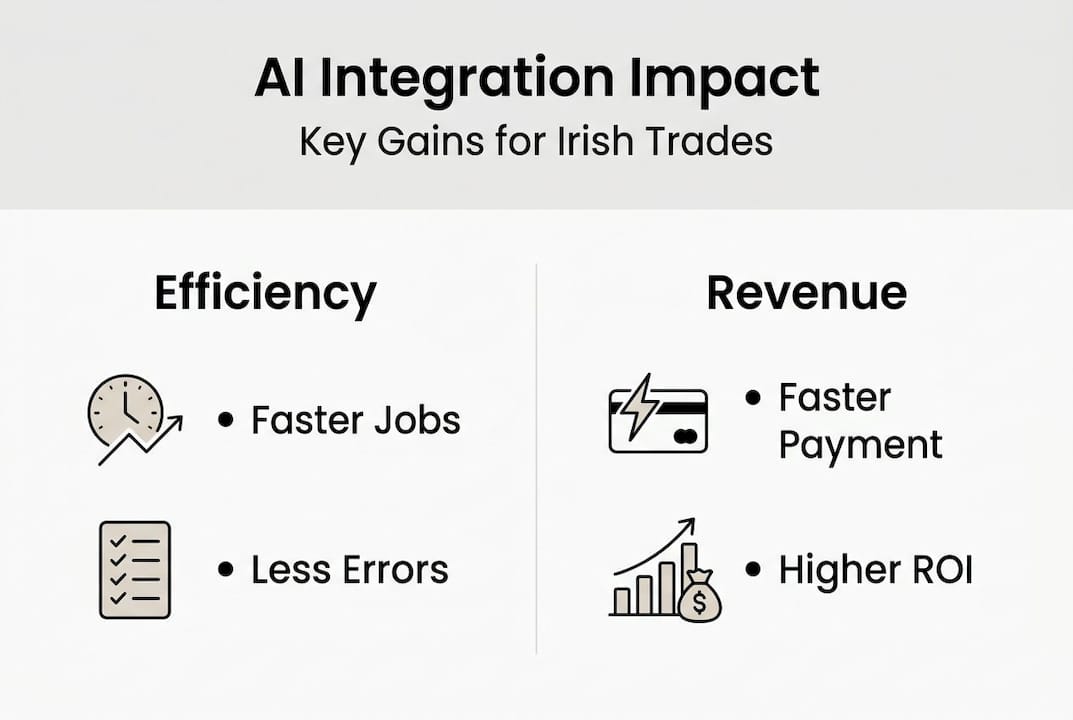
What a properly integrated workflow actually delivers is a different picture entirely. Consider what happens when your job management software (the system that handles scheduling, job tracking, and reporting) connects directly to your CRM, invoicing platform, and field communication tools via an API (an application programming interface, which is essentially a digital bridge allowing two software systems to share data automatically). Technicians receive job updates on their mobile devices. Managers see live job status. Invoices are triggered automatically on completion.
| Inefficiency (siloed systems) | Integrated outcome |
|---|---|
| Manual data re-entry across platforms | Automatic data sync in real time |
| Delayed invoicing after job completion | Instant invoice generation on job close |
| Poor technician coordination | Live job updates via mobile |
| Slow cash flow cycles | Up to 100% cash flow improvement |
| Low first-time fix rates | 5% improvement with workflow checklists |
The business case is not speculative. Explore automation for job management and you will find that integrated IT systems have led to a 59% increase in passenger mileage and a 27% boost in revenue per car in comparable service industries. The principle transfers directly to trades operations.
"The businesses that integrated their job management systems did not just save time. They fundamentally changed how revenue flows through their operation."
181% ROI over three years is the figure that should make every operational manager sit up. That is not a marketing claim; it is an empirical benchmark from smart system integrations. The question is not whether integration is worth it. It is how quickly you can get started.
What you need to set up an integration workflow
Before you connect a single system, you need to be honest about what you currently have and what gaps exist. Rushing into integration without preparation is the fastest way to create a more expensive mess than the one you started with.
Here are the core requirements for a successful integration workflow:
- AI-ready job management software with open API capability (platforms like Jobber, ServiceM8, or Simpro are common in the Irish market)
- Open APIs on every platform you intend to connect, including your CRM, invoicing tool, and communication systems
- Basic IT support, either in-house or through a managed service provider, to handle initial configuration and troubleshooting
- Clear workflow goals defined before implementation, such as reducing invoice delays, improving first-time fix rates, or cutting admin hours per week
- Staff buy-in from field technicians and office administrators who will use the new system daily
API-based platforms reduce IT workload by 50%, but only when the underlying setup is clean. If your data is inconsistent across systems today, integration will simply automate the inconsistency.

| Feature | Usefulness for Irish trades |
|---|---|
| Job scheduler with mobile access | Critical |
| Automated reporting and dashboards | High |
| Voice integration for call capture | High |
| API connectivity to invoicing tools | Critical |
| Real-time field communication | High |
| Customer notification automation | Medium |
Our AI automation guide covers platform selection in detail, but the table above gives you a fast-track view of which features to prioritise when evaluating software.
Pro Tip: Start with your most error-prone process, whether that is job scheduling, invoicing, or parts ordering. Fixing the biggest leak first delivers the fastest measurable ROI and builds internal confidence in the new system before you expand.
How to implement an AI-driven job management integration workflow: a step-by-step guide
Implementation does not need to be overwhelming. A phased, structured approach keeps disruption low and results measurable.
- Scope your workflow. Define which processes you are connecting, which platforms are involved, and what success looks like in measurable terms (e.g., invoice turnaround time reduced from 48 hours to 4 hours).
- Map every task and handoff. Draw out the current process from job enquiry to invoice payment. Identify every manual step, every data re-entry point, and every delay. These are your integration targets.
- Test your API connections. Before going live, run sandbox tests (controlled test environments) between your platforms. Confirm that data flows correctly in both directions and that error handling is in place.
- Configure your AI workflow logic. Set up automation rules: when a job is marked complete, trigger invoice generation; when a new booking arrives, notify the assigned technician; when a job runs overdue, alert the manager.
- Train your staff. Field technicians and office staff need hands-on training, not a PDF manual. Run short, practical sessions focused on the tasks they perform daily.
- Pilot with one team. Launch the integrated workflow with a single team or region first. Measure results over four to six weeks before rolling out business-wide.
Benchmarks show that average implementation generates $3.3M in benefits over three years, which puts even a significant upfront investment into perspective.
| Approach | Cost | Complexity | Support level |
|---|---|---|---|
| DIY integration | Low upfront | High | None |
| Vendor-supported | Medium | Medium | Vendor helpdesk |
| Managed solution | Higher upfront | Low | Full managed support |
For most Irish trades businesses, a managed or vendor-supported approach delivers the fastest path to ROI. Review voice agent workflow integration and AI tools boosting revenue to understand how AI-specific components layer into the broader workflow.
Pro Tip: Never go live business-wide on day one. A phased rollout lets you catch configuration errors, gather staff feedback, and refine the workflow before it affects your entire operation.
How to measure, optimise, and troubleshoot your integration workflow
Going live is not the finish line. The businesses that extract the most value from integration are those that treat it as an ongoing process, not a one-time project.
Start by defining your KPIs (key performance indicators, the specific metrics you will track to judge success) before launch:
- Job completion time from booking to invoice
- First-time fix rate (the percentage of jobs resolved on the first visit)
- Cash flow cycle from job completion to payment received
- User adoption rate among field and office staff
- Reporting turnaround time for management dashboards
Organisations achieve up to 40% reporting efficiency through integration, but only when they actively measure and iterate. Schedule monthly workflow reviews in your first quarter. Look at where data is still being entered manually, where delays persist, and where staff are working around the system rather than within it.
A 5% improvement in first-time fix rate after checklist integrations may sound modest, but across a team of ten technicians completing five jobs per day, that compounds into significant revenue recovery over a year.
Common issues and how to address them:
- Data errors between platforms: Usually caused by mismatched field formats. Audit your data mapping during setup and run regular reconciliation checks.
- Poorly configured APIs: Test every connection in a sandbox environment before going live. Revisit configurations after any software update on either platform.
- Low staff engagement: Involve staff in the design phase. When technicians help shape the workflow, adoption rates rise significantly.
- Reporting blind spots: Ensure your dashboard pulls from all integrated systems, not just one. Gaps in reporting data undermine decision-making.
Review AI solutions for efficiency for a deeper look at continuous optimisation strategies specific to Irish trades.
"Balance short-term disruption with long-term gains; results compound over time."
Our view: why most Irish trades businesses underestimate workflow integration
Most operational managers we speak with frame integration as a cost and a risk. They ask: what will it disrupt? What will it cost? When is the right time? These are reasonable questions, but they are the wrong starting questions.
The right question is: what is inaction costing you right now, every single month? Missed jobs, slow invoicing, and poor reporting are not static problems. They compound. Every month without integration is a month your competitors who have integrated are pulling further ahead on efficiency, cash flow, and customer satisfaction.
The "perfect time" to integrate never arrives. There will always be a busy season, a staffing change, or a software update that feels like a reason to wait. What we have seen consistently is that businesses that commit to a phased rollout, even an imperfect one, begin capturing gains within weeks. Those gains fund the next phase of improvement.
Explore AI tools for trades managers to see how the competitive landscape is shifting. The businesses investing now are not taking a risk. They are removing one.
Ready to transform your job management integration?
If this guide has clarified the steps and the stakes, the logical next move is to see what a purpose-built solution looks like for your specific operation.

Apex Emerald AI builds AI-driven workflow integration solutions designed specifically for Irish trades businesses in plumbing, HVAC, and electrical services. Our AI workflow automation solutions are deployed in phases to minimise disruption and maximise early ROI. You can also review our integration success stories to see real results from businesses like yours. Whether you want a free diagnostic, a live demonstration, or a full technical audit, we are ready to help you move from disconnected systems to a fully integrated, revenue-generating operation.
Frequently asked questions
What is a job management integration workflow?
It is an automated system connecting scheduling, job tracking, and reporting tools to eliminate manual admin and errors. Integration improves reporting efficiency and reduces IT workload by half, making teams significantly more productive.
How quickly will ROI appear with an AI job management workflow?
Most Irish trades businesses see measurable ROI within 12 to 18 months. Some report a 100% cash flow increase and 181% ROI over three years following full integration.
What are the main pitfalls when integrating job management software?
Typical issues include poor API configurations, insufficient staff training, and failing to track workflow performance regularly. API integrations save 50% IT time but rely entirely on proper setup and consistent staff engagement to deliver results.
Can integrations work with our existing job management systems?
Most modern AI integration solutions offer open APIs designed to connect with the popular job management software already used across Ireland. API-based solutions are designed for maximum compatibility and customisation, so switching platforms entirely is rarely necessary.