
TL;DR:
- Conversational AI enables Irish trades businesses to handle bookings and inquiries 24/7 effectively.
- Key components include NLP, NLU, NLG, ML, and dialog management, working together for natural interactions.
- Proper setup, human handover, and targeted deployment are essential to maximize benefits and mitigate limitations.
Most Irish trade business owners assume AI is only good for the basics: sending reminders, answering FAQs, or routing calls. The reality is far more capable. Conversational AI is technology that enables computers to engage in human-like conversations using natural language processing, machine learning, and large language models. For plumbing, HVAC, and electrical businesses across Ireland, this means an entirely new way to handle bookings, qualify leads, and serve customers around the clock. This article breaks down how it works, what it can and cannot do, and how to put it to work in your business.
Table of Contents
- Understanding conversational AI and its foundations
- Benefits of conversational AI for trades businesses
- Limitations and edge cases in home services
- Practical steps to implement conversational AI in Irish trades
- Our perspective: What most guides miss about conversational AI
- Discover Apex Emerald AI solutions for Irish trades
- Frequently asked questions
Key Takeaways
| Point | Details |
|---|---|
| True conversational AI | Conversational AI goes beyond basic chatbots by using advanced language technology for real conversations. |
| Efficiency gains | Irish trades can boost booking speed and customer satisfaction with well-integrated AI solutions. |
| Know the limitations | AI has pitfalls, especially around emergencies and slang, so human intervention remains crucial. |
| Implementation best practices | Strategic rollout, starting with high-volume calls, maximises return on investment for trades businesses. |
Understanding conversational AI and its foundations
Before you can use conversational AI effectively, you need to know what you are actually working with. At its core, conversational AI is a system that processes human language, interprets intent, and generates a relevant response. It is not a single piece of software. It is a stack of technologies working together.
Here are the key building blocks:
- Natural Language Processing (NLP): Breaks down what a caller or customer types or says into structured data the system can act on.
- Natural Language Understanding (NLU): Identifies the meaning behind the words, not just the words themselves.
- Natural Language Generation (NLG): Produces a human-sounding response based on what the system has understood.
- Machine Learning (ML): Allows the system to improve over time by learning from past interactions.
- Dialog management: Keeps track of the conversation flow so the AI knows where it is in the exchange.
- Large Language Models (LLMs): Power the fluency and contextual depth of modern AI conversations.
For a plumbing or HVAC business, this combination means a customer can call at 11pm, describe a burst pipe, and the AI can capture their details, confirm urgency, and book an emergency slot without a human ever picking up the phone. That is not a simple task. It is a nuanced, multi-step interaction.
| Component | What it does | Trade example |
|---|---|---|
| NLU | Understands customer intent | Recognises "no hot water" as a boiler fault |
| Dialog management | Tracks conversation context | Remembers the caller already gave their address |
| NLG | Generates a natural reply | Confirms booking in plain, friendly language |
| ML | Learns from past calls | Improves accuracy on common trade queries |
For Irish trades businesses, the practical entry point is often AI voice agents, which handle inbound calls using this exact technology stack. The integration workflow for connecting these agents to your existing job management system is more straightforward than most owners expect.
Benefits of conversational AI for trades businesses
With a solid understanding of what conversational AI is, let us look at how it creates tangible results for Irish trades businesses.
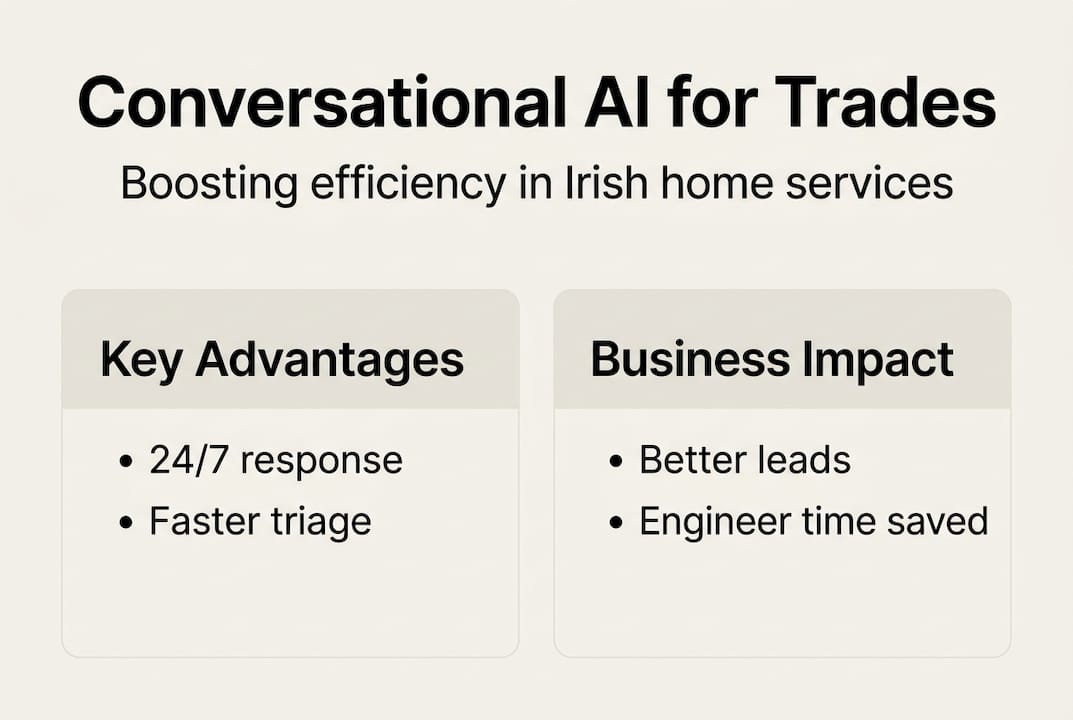
The gains are not theoretical. Businesses using AI-driven inquiry handling report up to 87% faster inquiry response times compared to traditional phone-only models. That speed matters enormously in trades, where the first business to respond often wins the job.
Here are the core operational benefits, in order of impact:
- 24/7 booking and scheduling: Customers can book a plumber or electrician at any hour without waiting for office hours. Missed calls become captured leads.
- Faster response to service requests: AI handles the initial intake instantly, so your team only steps in when a job is confirmed or complex.
- Consistent lead qualification: Every enquiry is asked the same qualifying questions, which means your team receives better information before they ever pick up the phone.
- Reduced admin burden: Repetitive tasks like confirming appointments, sending reminders, and collecting job details are handled automatically.
- Improved customer satisfaction: Customers get immediate acknowledgement and a clear next step, rather than voicemail.
For businesses focused on boosting revenue, the compounding effect of these benefits is significant. Better customer service improvements lead directly to more repeat bookings and stronger word-of-mouth referrals.
Pro Tip: Start your inquiry automation with the three most common call types your team receives. Automate those first, measure the time saved, then expand. This approach delivers fast, visible ROI without overwhelming your staff.
The impact on lead quality improvement is equally important. When an AI agent pre-qualifies every enquiry, your engineers and technicians spend less time on tyre-kicking enquiries and more time on jobs that convert.
Limitations and edge cases in home services
However, no technology is flawless. It is crucial to understand where conversational AI can fall short and how to address these challenges.
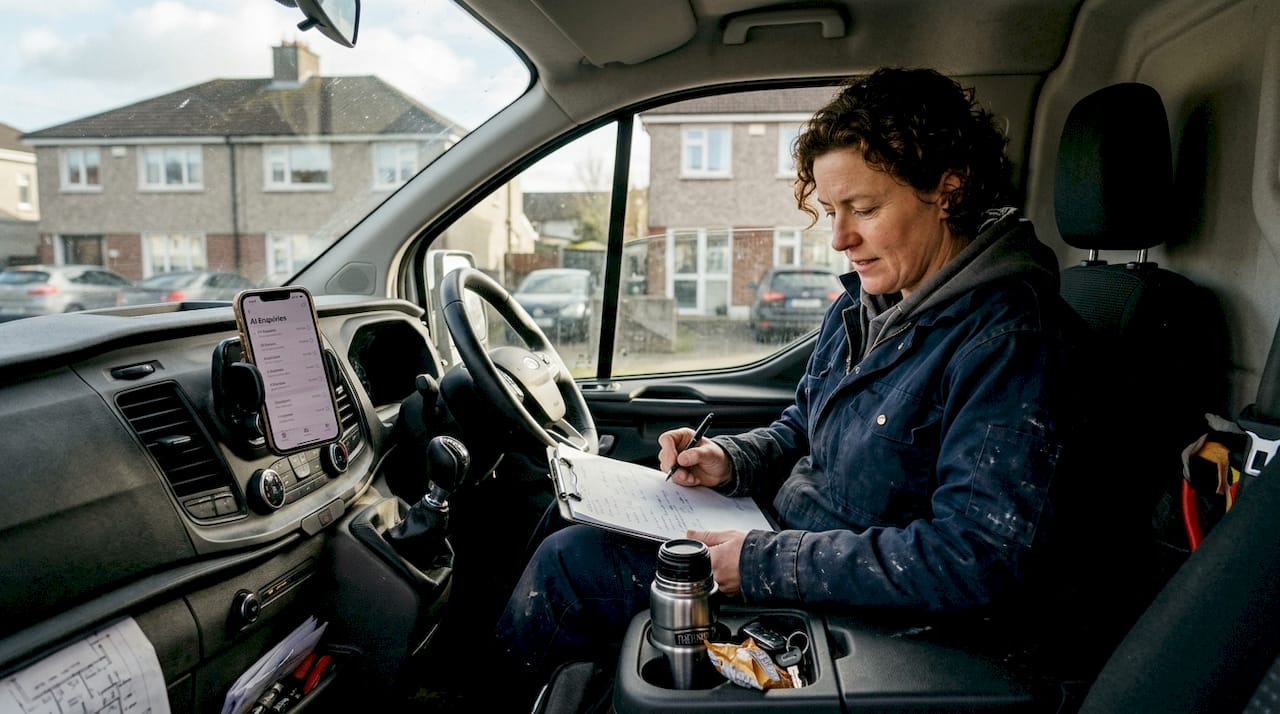
One of the most important concepts here is the context window. This refers to how much of a conversation the AI can hold in memory at once. Research shows a 39% performance drop in long conversations where key details appear early but are referenced much later. For a complex HVAC fault diagnosis call, this is a real risk.
| Scenario | AI handles well | Potential pitfall |
|---|---|---|
| Standard booking call | Excellent | Minimal risk |
| Repeat customer with history | Good | May not recall past jobs |
| Emergency with emotional caller | Moderate | Misses emotional cues |
| Heavy regional slang or dialect | Poor | Misinterprets intent |
| Complex multi-part fault query | Moderate | Loses context mid-call |
Other AI limitations worth knowing about include:
- Slang and dialect gaps: Irish regional expressions and trade-specific jargon can confuse AI systems not trained on local language patterns.
- Emotion gaps: A distressed caller reporting a gas leak or electrical fault needs human empathy. AI cannot genuinely provide this.
- Adversarial inputs: Customers who speak in unusual ways or test the system can cause unexpected responses.
- Bias amplification: If the training data skews in any direction, the AI's responses can reflect that bias.
The most critical safeguard is a well-designed human handover protocol. Any call involving an emergency, a vulnerable customer, or a situation the AI cannot resolve with confidence must be routed to a live person immediately.
"AI without a human handover plan is not a customer service tool. It is a liability."
For AI tools for plumbers and electricians specifically, the best automation solutions are those built with these failure modes in mind from the start, not patched in later.
Practical steps to implement conversational AI in Irish trades
Having explored the technology and its challenges, let us get practical: here are the steps to integrate conversational AI efficiently in your business.
The process does not need to be complex. Most Irish trades businesses can go from zero to a functioning AI voice agent in a matter of weeks, provided they follow a structured approach. Conversational AI works best when it is deployed with a clear scope from the outset.
- Define your highest-volume call types. List the top five reasons customers call your business. These are your automation targets.
- Choose a vendor with trade-specific experience. Generic AI platforms are not built for the nuances of plumbing, HVAC, or electrical services. Look for proven trade deployments.
- Map your integration requirements. Your AI agent needs to connect to your job management system, your calendar, and ideally your CRM. Plan this before you sign anything.
- Train the system on your language. Feed it your most common queries, your service area, your pricing structure, and your emergency protocols.
- Run a parallel test period. Let the AI handle calls alongside your existing process for two to four weeks. Compare outcomes before going fully live.
- Set clear escalation rules. Define exactly when the AI hands over to a human and make sure that handover is seamless for the customer.
Pro Tip: The voice agent platform you choose should offer a clear integration workflow with the job management tools you already use. Switching systems mid-deployment is costly and disruptive.
For HVAC businesses, prioritise fault triage scripts. For electrical services, focus on safety screening. For plumbing, emergency booking flows deliver the fastest ROI. Tailor the deployment to your specific trade rather than using a one-size-fits-all configuration.
Our perspective: What most guides miss about conversational AI
Most articles on conversational AI focus on what it can do. We think the more important question is what it should do in your specific business context.
The businesses we see getting the best results are not the ones who automate everything. They are the ones who are deliberate about where a human adds irreplaceable value and where automation genuinely serves the customer better. A customer booking a routine boiler service does not need a person on the phone. A customer reporting a potential carbon monoxide issue absolutely does.
The uncomfortable truth is that poorly configured AI damages trust faster than no AI at all. A bad automated experience feels worse than a missed call, because the customer feels dismissed rather than simply unlucky. Our automation tips consistently point to one lesson: blend AI with skilled staff, and invest as much in your handover protocols as you do in the AI itself. That balance is where the real competitive advantage lives.
Discover Apex Emerald AI solutions for Irish trades
If you have read this far, you already understand more about conversational AI than most of your competitors. The next step is putting that knowledge into practice with the right infrastructure behind you.
At Apex Emerald AI, our AI solutions for trades are built specifically for the Irish plumbing, HVAC, and electrical market. From our voice agent platform to full omnichannel automation, every solution is designed to deliver measurable ROI within 90 days. Browse our successful case studies to see real results from real Irish trades businesses, and get in touch to book a consultation or live demo with our team.
Frequently asked questions
How does conversational AI differ from regular customer service chatbots?
Unlike basic chatbots that follow fixed scripts, conversational AI uses NLP, NLU, and LLMs to understand intent and respond naturally, even when customers phrase things in unexpected ways.
Can conversational AI handle emergency calls in plumbing or electrical services?
AI can recognise urgent keywords and route calls appropriately, but poor handling of emergencies without a human handover is a known risk that must be designed out from the start.
What are the main risks or drawbacks of using conversational AI?
The primary issues are context loss in long calls, poor recognition of slang and regional dialect, emotion gaps, and the potential for bias if the underlying model is not well trained.
How quickly can trades businesses see results from conversational AI deployment?
With proper integration and staff training, most businesses see faster inquiry handling and improved booking rates within the first few weeks of going live.